Changed and unchanged: 16 years on since the establishment of SAR
Updated: 2013-06-28 07:40
By Bob Lee(HK Edition)
|
|||||||


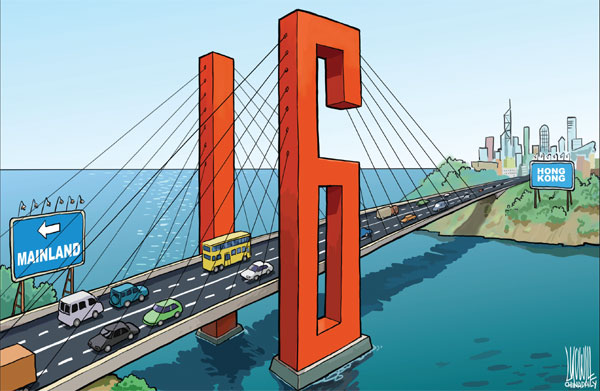
Since Hong Kong's reunification to the motherland 16 years ago, great changes have taken place, but essential elements that constitute Hong Kong remain unchanged, namely, its social and economic systems, its unique lifestyle.
Based on our long-time observation, there are at least three things that remain unchanged, or firmly intact. First is the rule of law. It has often been said that if HK people have a defining ideology, it must be the rule of law. This explains why, since 1997, any perceived threats or changes to HK's judiciary, are sure to touch a raw nerve for our fellow citizens.
Indeed, the rule of law is one of Hong Kong's greatest strengths, the cornerstone for the city's many successes, as it ensures individuals have access to the justice system, and provides a level playing field for organizations, both local and foreign.
Unfortunately, this unbending principle is at stake, possibly to be yielded due to looming "Occupy Central". The opposition camp has been stoking this lawless and unruly campaign for months, in the name of so-called genuine universal suffrage. We need to remain vigilant against this entrapment.
Second, the central government's determination and wholehearted support in advancing the cause of "One Country, Two Systems", "Hongkongers governing Hong Kong", and "A high degree of autonomy", remain unchanged. It is a matter of course, because such arrangement serves the best interests and aspirations of Hong Kong compatriots and the mainland people as well.
The "One Country, Two Systems" principle, first expounded by Deng Xiaoping, virtually places Hong Kong as a testing ground, a showcase, and the whole world is watching. We Chinese have no alternative, but remain committed to the principle, and will try our best to make this unprecedented design work.
Having said that, solidarity is a prerequisite for its effective implementation. In recent years, we have witnessed some politicians and parties politicize almost every livelihood issue, in an attempt to counter Beijing by messing up Hong Kong. Such evil intent may cost the city its stability and prosperity, and their seemingly endless empty talk in the LegCo chamber may bleed Hong Kong dry. It is therefore important for the public to see the truth, and narrow the divide between citizens from different strata and sectors in our society, so we can unwaveringly devote ourselves to changing the prolonged sluggishness of our economic development.
Third, the freedom stipulated in the Basic Law and enjoyed by Hong Kong has never changed. In fact, people are now enjoying a much broader range of democratic rights and freedoms than they ever did in the British colonial era. Moreover, we are striving to build a more democratic and harmonious society.
Some pundits might argue that the reality is too much "One Country", and not enough "Two Systems", because Beijing has exerted ever increasing influence on Hong Kong, but we should be mindful of the fact that the Chinese mainland's clout goes global, far beyond this tiny territory, also on the United States and the European Union.
Of course, some prominent changes have been made since the handover, most noticeably, its status in the global economy, and an upsurge in integration with the mainland.
Over the past 16 years, after weathering two crippling financial tsunamis in 1997 and 2008, a deadly epidemic in 2003, and other setbacks, Hong Kong has shown its world-acclaimed resilience by achieving remarkable progress, and strives from strength to strength. A vivid example is that credit-rating agency Standard & Poor's has upgraded Hong Kong's credit rating to the highest AAA. Currently, only two Asian economies, Singapore and Hong Kong, have such a rank. Most of the recipients of this rating are developed economies in Europe and North America.
While its status as an international financial hub has been enhanced, Hong Kong has also upgraded its economic structure previously dominated by labor-intensive manufacturing to high-end, value-added, innovative economy. Such effort has yield impressive results - HK's annual average GDP grew by approximately 5 percent in the last decade, nearly two times that of the other developed economies in the same period.
In recent years, we have found a new direction, that is, with the central government's blessing and support, to develop itself into an offshore renminbi business center. Nowadays, more than 9 percent of the mainland's foreign trade is settled in renminbi. Of which, 90 percent is handled by banks in our city.
Hong Kong's economy is integrating with the mainland at an unprecedented pace. This robust and irresistible trend is reflected in three policy arrangements. First, CEPA (Closer Economic Partnership Arrangement) signed in 2003. Second, for the first time, the Outline of the 12th Five-Year Plan (2011-15) dedicates a whole chapter to Hong Kong and Macao. Third, then Vice-Premier Li Keqiang rolled out a set of 36 measures in August 2011, hailed as "grand gifts" by Hong Kong's media, to boost the city's future development. Obviously, Hong Kong is poised to be a leading beneficiary of the mainland's burgeoning power.
More encouragingly, by judging the current Chief Executive Leung Chun-ying's first-year performance report released just days ago, we can observe that he and his team are devoted to make prudent adjustments, and seek changes while maintaining stability - as promised in his election platform when competing for the city's top job. Many thorny issues have been appropriately dealt with, such as the influx of pregnant women, a shortage of baby formula, and most recently, CY delicately got rid of a diplomatic hot potato by shipping ex-CIA employee Edward Snowden out quietly while faithfully abiding by Hong Kong law. The SAR government's witty chess move, tactically in tandem with the central government, has won a rare round of applause from both pro-establishment and opposition camps.
All these indicated that Hong Kong is able to herald changes on a par with its peers around the globe.
Although the road ahead is bound to be rough, we have proved that "One Country, Two Systems" is the best solution to the Hong Kong question left over from history, and the best institutional arrangement to ensure its long-term prosperity and stability.
The author is a staff writer.
(HK Edition 06/28/2013 page7)