No woman's land
Updated: 2013-07-05 07:20
By Emma Dai(HK Edition)
|
|||||||


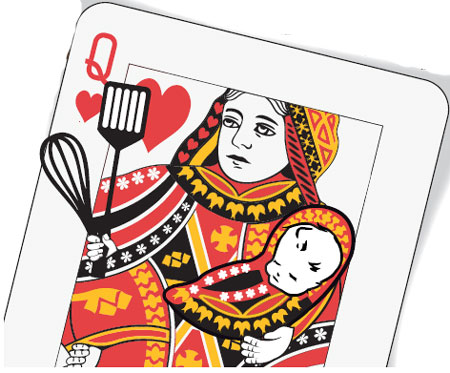
There can be no doubt, there is an abundance of women in Hong Kong, highly accomplished in the business, professional and technical arenas, yet strong biases against them remain. For every step taken by working women, there is somebody standing in the way. Emma Dai reports.
Back in 1995, May Tan, Asian CEO of Cazenove, a UK-based partnership, got a call directing her to fly to London where the company's head office was located. Tan says the directive left her confused and anxious. "I couldn't figure out why. I thought something must be terribly wrong. I thought I may get sacked," Tan said.
Her fears proved groundless. A senior company partner sat her down and immediately declared, "we want you to be a partner." Tam was shocked. The only thing she could find to say was that she needed time to think. "You're the only one who's ever said I need to think about it," the partner told her, recovering from his own shock.
"I wasn't sure," Tan recalls. "I had two kids. My son was eight. My daughter was four. It was very attractive but a partnership also means lots of responsibilities. Though all of the 80 partners were white men, I knew I deserved the promotion. I built the Asian business from scratch. It was a tough job."
So Tan, after deciding she deserved it, said she'd take the job. It meant the company had to rewrite the contract. "They never imagined promoting a young woman to that position. The contract was a standard male deal. There was no maternity clause." And so the deal was done. During the third decade of her life Tan became the first Asian and the second woman to make it to the top of the business that had been founded in 1823.
"The partnership was like a pie in the sky to me," Tan said. "I should have asked for it. I could have had it years earlier. But the recognition of my ability by the company still built more confidence in me to take on even greater challenges."
Today, Tan is executive director of Standard Chartered Bank (HK) Ltd and vice chairman of Asia wholesale bank of Standard Chartered. She also sits as an independent non-executive director of The Link Management Ltd, a title bestowed upon her earlier this year.
A leaking pipeline
Not many women enjoy the success Tan has had. A recent survey by Community Business, a local NGO tracking diversity, revealed that as of February, women held just 9.4 percent of board positions on Hang Seng Index companies. That was a marginal increase over 2009 when the figure was 8.9 percent. Nineteen of the 50 HSI companies had boards that were exclusively male.
"There is a gap," said Nick Marsh, managing director of Harvey Nash, a UK-based executive search firm. "Down to the senior executive level, it's not much better." Major accounting companies and the big multinationals hire about the same number of women as men straight out of university. Among older workers in their thirties, the ratio of women to men drops off to about 30:70.
"It's called the leaking pipeline syndrome. As one ascends the ranks of most big organizations, the proportion of women to men falls sharply," said Fern Ngai, CEO of Community Business. "Something must happen to women along the way. It's not just about diversity at the board level. There has to be a pipeline for talent to ensure enough qualified candidates reach the top."
What companies are losing are not just female employees but half of the talent pool. "A lot of leaders are not recognizing the benefits of a diversified board," said Ngai. "They are used to finding new board members within their old boy's club and they find people similar to them in terms of background and education. In a diversified team that includes women, more creativity and innovation are secured - as people would ask questions and challenge the status quo. As boards play a big role in the success of a company, members should be asking questions." That helps decision makers to see things from different angles, thus helping companies to weather risks efficiently and deliver better results.
Among the many barriers standing between women and the corporate executive officer are family responsibilities. That appears to be the big one. "With women there are dual responsibilities - looking after family: having a career," said Christine Greybe, president of DHR International, a Chicago-based executive search firm. "The reality is someone has to take the one-year-old son to the doctor when he gets sick. That's usually the mother." That's especially true in Asia. US corporate executives like Yahoo CEO Marissa Mayer and Facebook COO Sheryl Sandberg can show off their supportive husbands, but "supportive husband is a rare thing in Hong Kong," said Greybe.
"It is also hard for women to get back into the workforce at the same level after they leave to have children," she added. "Women are seen to have no continuity. Some employers assume that female employees can be distracted by family issues and don't have the 110 percent focus companies can expect from men. Not every employer is willing to take that risk."
Besides, women tend not to advance at the same pace as their male counterparts. "Take a pair of workers, a man and a woman - both have been in the workforce for 20 years, the man probably has worked all 20 years without a break, while the woman may have taken off four years to have children and spend time with her family. If there's a promotion on the line, the woman has less leverage."
Experience counts heavily where promotion is concerned. "Ideally, companies with C-level roles open want people who have done the job before," said Greybe. "If that doesn't change, we are not going to see transformation in male-dominated board rooms. Women may have less experience, but they are capable. If employers really want to improve diversity, they may have to look at factors other than straight experience when promote female workers."
A personal choice
Priorities are matters of personal choice. "I've never stopped working," said Christine Wong, a lawyer. In order to spend more time with her family, Wong left her job as a senior director of SFC and found part-time work at a law firm when her daughter was seven and her son was three. That role still means working seven hours a day, five days a week. But it provided flexibility for her to pick up the children from school and look after them during their primary school years. A full-time lawyer, however, is expected from time to time to stay late in office until midnight if not later. Wong carried on, making family her priority until her daughter turned 16 and her younger son was old enough to attend school abroad.
When she decided to go back full time, the years she'd put in as a part-time lawyer paid off. "The thing that benefited me most from the part-time job was that it allowed me to keep in touch with what was going on in the market and kept my knowledge current," Wong said. "The fact that I was up to speed in the work front gave me confidence when I applied for full-time work again. Without that, adapting to the current working environment could be hard." Wong joined the Hong Kong Exchanges and Clearing Ltd three years ago. Now she heads the Legal Services Department of the bourse.
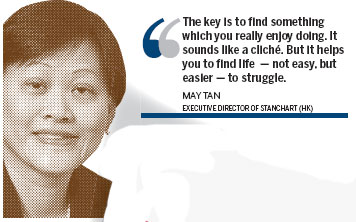
"Work and family don't present a black and white choice," said StanChart's Tan. "It never occurred to me to leave the workforce. I think it's a task to combine the two. The key is to find something which you really enjoy doing. It sounds like a clich. But it helps you to find life - not easy, but easier - to struggle. Without passion, I wouldn't spend 30 years doing my job and still feel excited waking up and get to work. Make sure you are interested, so work doesn't become a chore."
A wire-walker
Lack of work-life balance is harder on women than on men, because women bear a bigger burden of family responsibilities, Ngai said. A survey by Community Business last year found that long working hours present greater stress to women than to men - and women also found the quality of their family relationships more deeply diminished. They find little solace in the regulatory environment, as it affects their working lives.
Statutory paid maternity leave is 10 weeks in Hong Kong - among the lowest in Asia. Among women who have jobs, 37 percent say they have no free time to spend with their families and 39 percent say they want to leave their current jobs to try to establish a better work-life balance.
While nearly one in four local companies offer flexible working arrangements, the efforts often fail to achieve results. "People find they are not able to take up these offers," said Ngai. "Policies need to be implemented in a very fair way, so that it is not received as favoritism. It should not be just for women but for men as well. You can't have one person enjoy all the benefits and others envying that."
Another important element that stands in the way of women advancing in the business world is the absence of board room role models. Seldom do female workers see women at the top of their organizations. "That creates a perception that it's really difficult to get there," said Ngai. "If there are very few women on your board, younger women probably don't see themselves there either. Women should be groomed to take senior roles."
The latest Community Business survey found only 12 HSI companies have female executive directors - a decline from 31 percent in 2009 to 24 percent now. "That's a shame," Ngai said, pointing out that non-executive directors show up only at board meetings. Executive directors have to be on the job, working, planning, interacting with staff. Women in these positions can be viewed as role models and indicators of the culture in which women are able to move up.
A step forward
The lack of assertiveness among women in the work place doesn't help their cause much either. Plainly, women are just too humble. "We typically find self-confidence an issue," said Kirti Lad, director of Harvey Nash. "Very often women are not putting themselves forward. Compared with men, women need to feel prepared before they are ready to go."
"When you get an opportunity in a company, men who think they have 30 percent of the skills needed for the job step forward," said Marsh. "Women, however, would exclude themselves unless they felt 80 percent secure. It's ingrained, even among senior female executives."
Those differences are highlighted during negotiations. "Men are very aggressive and clear about what they want, so they are more likely to hit their targets. Women, on the contrary, are more likely to give in," said Greybe, adding that at C-level, approaches are similar between genders - people must be assertive to get there. But at director and VP levels, men earn 20 to 25 percent more. "The question is whether one can overcome barriers that early in the career."
"Women should put up their hands and plan their careers more aggressively," said Greybe. "Ask for what you want. Men do it all the time. A lot of people still believe that somehow the company is going to get them to the top. But where one ends up is one's choice. Once you made a decision to be a leader, you have to make a plan and go after it. If you are not ambitious, not networking, not using coaches, mentors, you will get lag behind because those who are doing it will get the top jobs."
Contact the writer at
emmadai@chinadailyhk.com
(HK Edition 07/05/2013 page4)