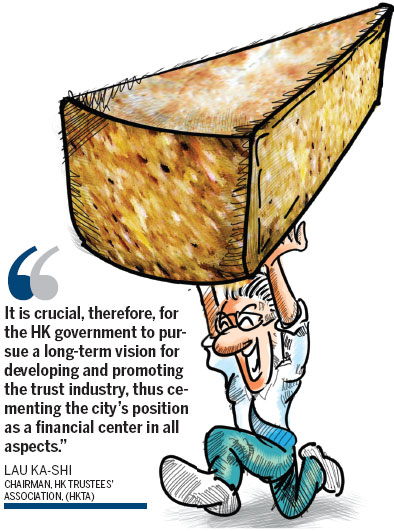
A slice of successional mainland pie?
Updated: 2013-09-27 07:01
(HK Edition)
|
|||||||


With the Chinese economy expected to overtake the US as the world's largest by 2030, the rapid creation of wealth in the country will translate into tremendous demand for intergenerational wealth transmission and family business succession services. Hong Kong trust services players can meet that demand.
Credit Suisse data reveals the number of millionaires in China will swell 97 percent to 1.9 million by 2017 from the 960,000 registered in 2012. China is expected to surpass Japan as the world's second-wealthiest country, with aggregate household wealth above $38 trillion by 2017. The country's total wealth level will be second to the US, with a total household wealth of more than $89 trillion.
As China leapfrogs into the world's wealthiest nations, the country's stringent capital controls and high taxation remain as deterrents to invest. These conditions appear to compel wealthy clients to adopt Hong Kong trust administration.
According to Capgemini's Asia Pacific Wealth Report 2013, 56.5 percent of wealthy mainland clients have the highest need for advice on family wealth planning.
"Wealthy mainland clients are usually the bosses of listed corporations, whose wealth surged after the listings of their previously privately-held companies. Their needs for expert services, international investment allocation guidance, as well as taxation planning, are enormous," says RBC Wealth Management Hong Kong's Managing Director Simon Ng, also a member of STEP.
That may not prove the case. Mainlanders have distinct preferences, heavily influenced by culture. Local trust services providers should not underestimate the importance of these, or they will lose opportunities.
Mainlanders may not understand the concept of trust. Potential clients may resist ceding control over their assets to trustees. There are strong cultural barriers surrounding discussions about death among mainlanders. These factors make the road difficult for Hong Kong trust managers.
Families on the mainland tend to be smaller. The one-child policy is still in place, so transmission of wealth, succession planning from one generation to the next is not so much in demand on the mainland.
Finally, wealthy mainlanders can get better returns by reinvesting profits in their own businesses rather than in investments. That also depresses the potential market.
Given all these potential market restrictions, a KPMG and HKTO trust industry report cautioned that Hong Kong trust services providers should not presume that wealthy mainland clients will come rushing through the door looking for services just because of the city's unique political and cultural ties with the mainland.
"The Hong Kong trust services providers must proactively discuss the legal and tax implications that will entail if mainlanders choose to adopt Hong Kong private trust services because they have legitimate concerns around their wealth flowing out of the mainland via Hong Kong," the report adds.
Overseas capital is increasingly contributing to the local asset management business, as SFC shows, so that the trust industry must leverage the recent HKTA amendment and the city's internationalized investment platform to elicit more trust management business.
According to the Securities and Futures Commission (SFC) survey on fund management activities in July, Hong Kong continues to be the preferred locale for international investors. Of the total HK$12.413 trillion non-REIT fund management business, 64.6 percent was sourced from non-Hong Kong investors in 2012.
The local asset management sector posted a strong revival last year. The combined fund management business in Hong Kong rebounded 39.3 percent in 2012 to hit a record HK$12.587 trillion high (non-REIT fund management business plus REIT market capitalization) as at the end of 2012, according to the SFC, owing to the favorable economic outlook of the Asia-Pacific region that drives demand for asset management and fund advisory services in Hong Kong.
Contact the writer at oswald@chinadailyhk.com
(HK Edition 09/27/2013 page5)