Does HK need a poverty line?
Updated: 2013-10-05 07:25
By Li Kui-Wai(HK Edition)
|
|||||||


At last, the Hong Kong SAR government announced on Sept 28 the official poverty line. Based on 50 percent of the median income, 1.3 million people in the city are below the poverty line. This is estimated from taking a relative approach, rather than an absolute approach, which probably would give a higher estimate. Out of a population of 7 million-plus, the working population is about 2 million people, and the salaried tax-paying population amounts to about 1 million. Yet, about 500,000 shoulders 95 percent of salary tax revenue to the government. A population of 500,000 people in the city assumes the economic burden of 7 million-plus.
We train people to be educated, to have better skill, to have more knowledge and to stand on their own feet so as to ensure economic security. Hong Kong always cherishes and promotes able people so as to enlarge the job market, and employment allows upward mobility. Surely, there are always less-able individuals who need assistance with their economic and social survival. Welfare assistance in Hong Kong has previously been considered as adequate. Even with welfare, the intention is to make the less-able become more-able, not a blanket provision of welfare to erode individual incentives. 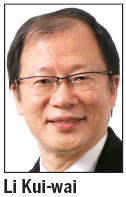
That is economics. But discussion on income inequality and poverty has always been political. Political considerations and decisions often use economics as their instruments. In all economies, there are always more low-ability than high-ability people; it is politically advantageous to provide financial aid to low-ability people, as they are a majority pool for political support. It is easy to commit to larger welfare expenditure while the economy is in good shape, but when there is economic downturn in future, the government can turn to issuing bonds and debt accumulates. Debts in this generation means future generations suffer, but since nobody defends the future generation, it is thus easy to pass the debts on.
With the poverty line, it is easy to commit more government spending, as it will be some time before our fiscal surplus dries up. Redistribution will definitely be used to rescue the less-able people. But looking at Hong Kong's contemporary economy - other than property transaction and equity speculation - there are not that many channels through which the economy can be widened or diversified. The pace of economic restructuring has been slow, and has not generated sufficient high-end jobs. Hence, without much job creation and the chance of upward mobility, the only alternative to keep the less-able people under control is to squander the fiscal surplus. 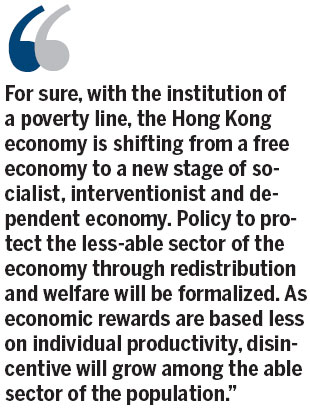
Business considerations have been secondary in recent times, as much of the business sector itself still looks to the mainland market for their investment. Indeed, there are still plenty of discussions about the advantages of investing in the mainland. The Hong Kong market is small when compared to the mainland market. Businesses will not be hurt that much even if the fiscal surplus dries up, or even tax increases for finance redistribution. The Hong Kong economy sits in a comfortable fiscal cushion, and there is no need for a "prepare for a rainy day" attitude now. The wealthy people in Hong Kong can always earn from speculative activities through property and stocks. For the less-able, welfare expenditure will keep them happy. The economy's long-term performance has become a secondary concern.
The poverty line in Hong Kong is more politically oriented than economically structured, since there can never be a proper economic formula to define poverty. It is the individual ability that counts in economics. The post-1997 Hong Kong economy has already become domestic-driven, while the externally-driven, outward looking nature of the Hong Kong economy has evaporated. With the large fiscal surplus, it would be politically convenient to spend. Aiding poverty will give rise to another interested group that holds contrasting social principles to the traditional non-interventionist approach Hong Kong had. The dominant view among welfare advocates in Hong Kong is that they consider poverty as a stock and not as a flow. This means that they only look to poverty as a quantity and what to do with the existing amount of poor people and not look to policy on how to limit entry to the poverty pool and how to attract people to depart from the poverty pool.
For sure, with the implementation of a poverty line, the Hong Kong economy is shifting from a free economy to a new stage of socialist, interventionist and dependent economy. Policy to protect the less-able sector of the economy through redistribution and welfare will be formalized. As economic rewards are based less on individual productivity, disincentive will grow among the able sector of the population.
The author is an associate professor of the Department of Economics and Finance at City University of Hong Kong.
(HK Edition 10/05/2013 page5)