Mainland reforms bring golden opportunity for HK
Updated: 2013-11-21 07:02
By Kam Ping-chor(HK Edition)
|
|||||||


The Third Plenary Session of the 18th Central Committee of the Communist Party of China (CPC), held last week, was the most important meeting of the CPC Central Committee since 1979 in terms of decisions on reform, and which focused on utilizing market forces, improving the efficiency of resources usage, aiming for higher added value, and quickening the pace of technological development and financial system reform so that the nation's economic growth can remain faster than its Western counterparts in the next 10 years.
Another key element of the plenum was about State-owned enterprises and government administrative system reform, including restricting the use of public power for personal benefit, judicial independence, protecting the rights and interests of private enterprises, nurturing private enterprises, separation of government and business, making market competition fairer, and enhancing opening to and cooperation with Hong Kong, Macao and Taiwan as well as the rest of the world.
The first phase of reform more than 30 years ago mainly liberated the productivity of the manufacturing industry and took full advantage of the country's inexpensive labor and land supply to achieve fast growth and export surge. Today, the United States is in the thick of forming trans-Pacific and trans-Atlantic trade groups to marginalize China by making new game rules. They have proposed new laws on labor, environmental protection, market access and intellectual property rights (IPR) transfer to stack up protectionist barriers against China. They have raised the bar particularly high for China in the financial, modern services and information industries. If China does not start the second phase of reform and opening-up, it will be marginalized by the US in the next decade.
Last week's plenum called for concerted efforts of the nation to achieve the main goals with tangible results by 2020, which means we have only seven years to pull it off. That means the next phase of reform will be deeper, more intense and more urgent than the last one. President Xi Jinping pointed out that China has managed to gain a relative edge over its capitalist competition solely on the strength of reform and opening-up.
A particular manifestation of further reform and opening-up is the establishment of free trade zones (FTZs), where not only manufacturing but modern services such as banking, logistics, accounting, insurance and investment consultancy will all be as open as possible for overseas investors to join the competition as well. The FTZs will render State-owned enterprises no choice but to fight for their survival with others in free market competition by improving the quality and efficiency of their business management and operation as much as necessary.
History proves we can achieve the goals if we put our mind to it. Back when China joined the World Trade Organization in 2001, many people were worried our national industries would collapse under the trade barriers. But, as it turned out, the industrial sectors with the most foreign investment were hurt the most in the beginning, but once we learned and mastered advanced technology and management skills, our manufacturing industry quickly grew stronger and went on to dominate the world market with not just competitive prices, but excellent processing and unmatched productivity as well.
The next phase of reform will also curtail the power of governments at all levels and require them to become service-oriented and law-abiding as well as lose bureaucratic weight, and give up some authorities so as to reduce administrative intervention in market activities. Moreover, governments will no longer be allowed to calve up markets for their own benefit or barricade local markets with protectionist measures. It is safe to say the next phase of reform will affect local government officials the most, as they will no longer be able to inflate their performance score with misleading GDP growth or drive economic development with blind investments. Instead, they will have to prove their worth with their knack for better allocation of resources such as land and agriculture to elevate local residents' living standards in the context of a sustainable market economy.
Make no mistake about it: Further reform does not take away the importance of opening-up. The deeper reform of China's economy to a market-driven model cannot succeed without further opening, which means attracting as much foreign investment into the domestic market as possible and expanding economic, trade and investment scale to enhance mutual reliance, mutual benefit and mutual assistance with its trading partners. Against this backdrop, things look quite promising for Hong Kong progressively. The question is whether the HKSAR government and business community can seize this golden opportunity to establish itself in the forefront of the country's service industry by making full use of the advantage of being closest to the mainland market.
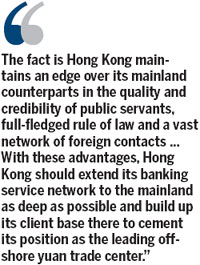
The fact is Hong Kong maintains an edge over its mainland counterparts in the quality and credibility of public servants, full-fledged rule of law and a vast network of foreign contacts. It will take the mainland a very long time, if not forever, to catch up. With these advantages, Hong Kong should extend its banking service network to the mainland as deep as possible and build up its client base there to cement its position as the leading offshore yuan trade center. The same theory goes for other modern services.
The author is a current affairs commentator. This is an excerpted translation of his article published in Hong Kong Commercial Daily on Nov 19.
(HK Edition 11/21/2013 page1)