Realistic approach needed to achieve universal suffrage
Updated: 2014-05-12 07:13
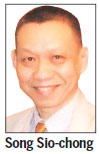
By Song Sio-Chong(HK Edition)
|
|||||||


It was reported that the "Occupy Central" movement conducted a poll on 15 of their own proposals for participants pledging allegiance to them on May 6. Out of a total of 2,508 votes, 1,124 voted for a proposal from Scholarism, 685 for a proposal from People Power, and 445 for a proposal from the Alliance for True Democracy. All three proposals advocate civil nomination - which has been rejected by the government.
The organizers insist on putting these three civil nomination proposals to an electronic "referendum" on June 22. They called for the government to include civil nomination if the result of the electronic referendum turns out to be favorable.
It is really ridiculous that the "Occupy Central" movement has selected proposals based upon their own political biases. This can hardly be called democratic when compared with the government's public consultation for the constitutional development and reference to the Basic Law.
I remember when former US president John F. Kennedy made his inaugural speech on June 20, 1961, he appealed to his fellow Americans to "ask not what your country can do for your, ask what you can do for your country." I would advocate a similar view to those who support the "Occupy Central" movement: "Ask not why your government does not accept your proposals, ask why your proposals do not comply with the Basic Law".
Just as the term implies, civil nomination means nomination by citizens. The definition of citizens refers to people who legally belong to a particular country and have rights and responsibilities to it, whether they are living there or not. Their exercise of these rights and responsibilities should be carefully balanced. Demanding rights without accepting any responsibilities is unrealistic.
If we read the Basic Law, we find there is a chapter on the "Fundamental Rights and Duties of Residents". There is already a chapter in China's Constitution titled "The Fundamental Rights and Duties of Citizens". It has to be noted though that the duties of a Chinese citizen - as outlined by the Constitution and other laws - include those with socialist characters and those without them. On the mainland, both duties need to be observed, but in Hong Kong, duties with socialist characters are waived under the principle of "One Country, Two Systems". For example, military service is exempted in Hong Kong despite it being provided in Article 55 of the Constitution. The duties of citizens to safeguard the unity of the country and of all its ethnic groups, to safeguard the security, honor and interests of the nation as stated in Article 52 and 54 of the Constitution are not mentioned.
I believe it is difficult, if not impossible, to implement relevant provisions of the Constitution in Hong Kong for all Chinese citizens, I believe that references to the Basic Law alone suffice to deter civil nomination.
One's attention is drawn to Article 42 of the Basic Law in which Hong Kong residents have an obligation to abide by the laws in force in the HKSAR. Article 11(1) demands clearly that the systems and policies practiced in the HKSAR should be based on provisions of this law. Unfortunately, the Basic Law provides no basis to support the various claims by those advocating civil nomination, or permanent resident nomination, or registered voter nomination, or something similar.
It is not easy to enforce the Constitution on Chinese citizens in Hong Kong. But it may not be difficult imposing it on participants who run for the highest post of the HKSAR in the Chief Executive Election Ordinance. I find no reason why such a person who will uphold the Basic Law, swear allegiance to the HKSAR (Article 104 of the Basic Law), be accountable to the central government (Article 43(2)), cannot also pledge allegiance to the Constitution as well. As a Chinese citizen required by the Article 44 of the Basic Law, he or she should be a model Chinese citizen who will be more than willing to perform duties to safeguard national unity, protect the interests of both the nation and the HKSAR, and not commit acts detrimental to the security, honor and interests of the nation.
If civil nomination succeeds, Hong Kong will likely have at least a CE candidate reluctant to uphold the Basic Law in 2017, let alone the Constitution. The "One Country, Two Systems" principle will be jeopardized if such a candidate is elected. The best thing the opposition camp can do for Hong Kong's constitutional development is to withdraw from "Occupy Central" campaign and stop advocating civil nomination.
The author is a HK veteran commentator and professor at the Research Center of Hong Kong and Macao Basic Law, Shenzhen University.
(HK Edition 05/12/2014 page9)