The return of the fire dragon
Updated: 2014-09-09 06:22
By Wang Yuke(HK Edition)
|
|||||||


With the arrival of the Mid-Autumn Festival returns a venerable tradition to the old Hong Kong Island village of Tai Hang, which for 135 years has celebrated the yearly coming of the fire dragon. Wang Yuke writes.
With their bare hands they fashioned the fire dragon, evoking its spirit from reeds and a loop of wire. One of the craftsmen held a bundle of reeds, as thick as a tree trunk, while two others wound the wire around it. Layer upon layer of reeds were added, until there it was, a robust dragon, at least 220 feet in length.
It's a 135-year-old tradition. A pageant featuring the fire dragon is held between the 14th and 16th of the eighth month in the Chinese lunar calendar.
|
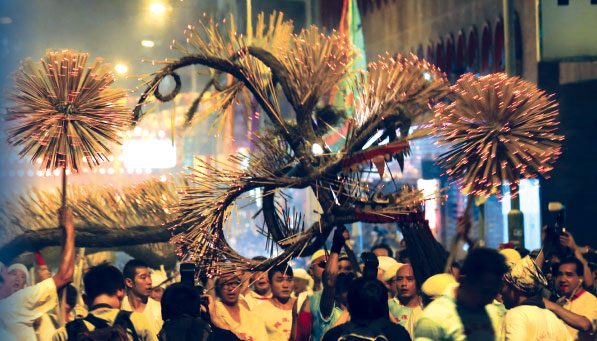
The dragon's head, inserted with burning incense sticks, is lifted by the strongest and most skilled dance performers. Edmond Tang / China Daily |
The annual celebration is a poignant reminder for Cheung Kwok-ho, one of the builders and commander of the fire dragon troupe, who grew up in Tai Hang, Hong Kong Island, and has carried on the tradition of his late father.
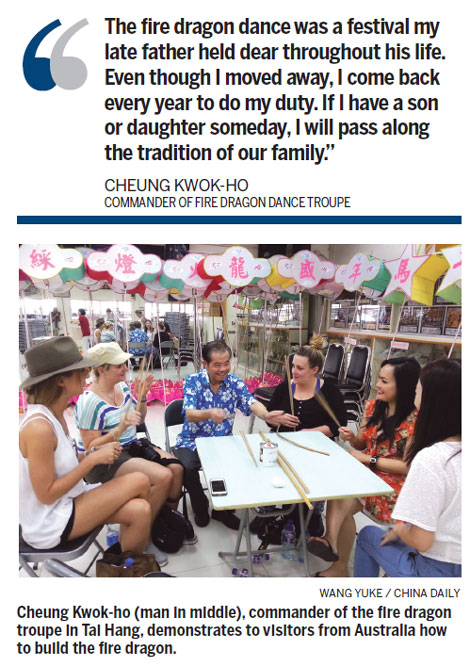
"The fire dragon dance was a festival my father held dear throughout his life. He would come and help prepare for every Mid-Autumn Festival." Cheung recalled, with a trembled voice and tears in his eyes.
"Even though I moved away many years ago, I come back every year to do my duty," he added. "If I have a son or daughter someday, I will pass along the tradition of our family."
According to legend, in 1880, a python slipped into Tai Hang village, devouring the products of people's labor. The people fought back and slew the reptile. Soon after, the legend holds, a mysterious plague swept the village. Word spread that the marauding python was the son of the Dragon King and that the primal entity had come to take revenge on the people. In desperate hope of driving away the evil spirit, the villagers mounted a fire dragon dance and set off firecrackers during three consecutive nights of Mid-Autumn Festival. The plague was dispersed and the evil spirit exorcized. The dragon dance has thus been an annual tradition ever since.
A step at a time
Crafting the dragon effigy is a backbreaking slog. The bamboo used to build the frame for dragon head must be roasted to make it pliable. After the frame for the head takes shape, it is wrapped round and round with reeds. The dragon body is divided into 32 segments, each linked with sturdy hemp rope. Assembling the 850 kilogram body, its tail and head is labor-intensive.
Cheung has been a dragon dance performer for 30 years since he was 12.
"At first, I was only permitted to fashion the cloud-shaped lantern because I was too young and not strong enough", he said. "At 15, I was one of the many performers responsible for lifting the dragon's body. When I was 18, I was allowed to handle the tail. It was until I was in my 20s that I touched the dragon head for the first time." The head, where numberless sticks of incense are inserted, is the weightiest. It's also the most difficult feature for the builders.
On the three evenings marking its annual return, at the stroke of 7:30 pm, the fire dragon dances out to Tai Hang to perform his flamboyant routines. Spectators from the local community and from all around the world roar their approval for the spirited manifestation of this star of the evening. The dragon's body rises and falls, twists side to side and thrashes. Two fire balls spin at dazzling speed, tens of thousands of incense sticks burn so that each gyration of the beast's body leaves trails of smoke and fire. Accompanying the dance is the deafening beat of drums and the baleful wail of gongs.
The fire dragon dance was inscribed into China's third national Intangible Cultural Heritage list in 2011. Chan Tak-fai, officially named as an inheritor of the intangible cultural heritage, said he has observed more mainland tourists and foreigners descending on the festive celebration in recent years.
While the numbers of visitors are growing, Chan said he feels saddened by the seeming indifference of local young people to the tradition. He has kept trying to promote the event and recruit potential young performers.
There is government support to sustain interest in the tradition. The Wan Chai District Council provides funding to have student tours organized. Hong Kong Heritage Museum offers free tours to the public interested in the theme.
Chan is optimistic about the future. "I feel upbeat about passing the baton to the youth," he says.
(HK Edition 09/09/2014 page7)