Hong Kong should pursue balanced policies
Updated: 2014-12-31 09:50
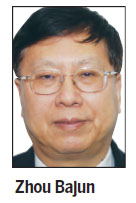
By Zhou Bajun(HK Edition)
|
|||||||


On Dec 25 while leaving for Beijing to meet central government officials, Chief Executive (CE) Leung Chun-ying reiterated that his report would focus on the implementation of universal suffrage for the 2017 CE election. The city has just weathered the illegal "Occupy Central" protests. These were meant to paralyze Hong Kong's financial center in the name of "genuine universal suffrage". It seems the government failed to achieve consensus on how universal suffrage will be implemented in the 2017 CE election. Therefore, the city's constitutional development will probably be held up.
On Dec 26, President Xi Jinping told Leung that political reform in Hong Kong should be carried out in accordance with the real situation and always in a lawful, orderly manner. It must be beneficial to residents, and ensure their prosperity and stability. Moreover, it must always safeguard the nation's sovereignty, security and development.
What is the real situation in Hong Kong? It's now clearly a divided society between those supporting the opposition and those backing the patriotic camp. In the Legislative Council (LegCo) 23 opposition members have vowed to veto the SAR government's plans for the 2017 CE election by universal suffrage and 2016 LegCo elections. Some commentators argue that, of the four opposition lawmakers known for relatively moderate political views, one or two might be persuaded to vote in favor of the government. Hong Kong has a long tradition of business-first political considerations.
This often leads politicians to support business-friendly policies. But the severe polarization of Hong Kong society today is making some politicians hesitate before deciding which side to take on an issue as serious as universal suffrage. Moreover, the opposition camp has become radicalized in its defiance of the central government.
While trying to pursue constitutional development so Hong Kong can have a universal election in 2017, Leung and his government also have to develop sound economic policies. The city has already wasted too much time in a political struggle initiated by the opposition.
Don't accept the opposition's argument that Hong Kong will no longer enjoy economic prosperity and social stability if "genuine universal suffrage" is not achieved. This is not correct. Indeed, in the West there is a prevailing viewpoint that democracy is actually failing.
For example, on Dec 26, The New York Times published several comments, under the title "Why democracy is failing". These criticizes the article "Democracy in deficit" written by Britain's former prime minister Tony Blair. Blair thought the lack of economic growth was due to a lack of democracy. A person from British Columbia said: "At present, what little economic growth we get is creating a vastly more unequal world, as finance and banking grow larger in relation to the rest of the economy. In the United States, democracy is directly threatened by this increasing inequality, as billionaires in finance and oil exert disproportionate influence on the government and judiciary. Inequality is the greatest present threat to democracy, it is the cause of the increasing polarization, and it is destroying people's trust in democratic institutions."
Another person from New York said, "In our capitalistic democracy, some votes are worth more than others. If we want democracy to be relevant, we must strive for a more perfect union of people acting together for common causes, not a union of corporate interests and endless economic growth at the expense of the people."
Hong Kong cannot ignore lessons from supposedly mature Western democracies. The HKSAR has to think carefully about its developing democracy because the city's democratization has been affected by the path set by Britain when it announced its plans to reform Hong Kong's political system in 1984. Over the last three decades Hong Kong has experienced vicissitudes, and in past two years these have been much more tumultuous. The Standing Committee of the National People's Congress therefore decided to put the HKSAR's constitutional development back on a sensible track by setting clear guidelines for Hong Kong to obtain universal suffrage.
This is why President Xi told Leung: "The central government supports the HKSAR Government in the development of Hong Kong's political system in accordance with the rules set in the HKSAR Basic Law and relevant decisions by the Standing Committee of the National People's Congress".
Xi urged Hong Kong residents to consider the country's fundamental interests and also the welfare of Hong Kong. He said they should preserve social stability, promote economic development, recognize the rule of law and ensure that Hong Kong moves steadily along the path outlined by the "One Country, Two Systems" principle and the Basic Law. The SAR government, therefore, has to implement balanced policies. It should not only focus on constitutional reform but also on economic and social development. The government should be fully prepared for the possibility that political reforms for 2017 CE election might not be achieved. Meanwhile, Hong Kong people should support the government implementing sensible and balanced policies.
The author is a veteran current affairs commentator.
(HK Edition 12/31/2014 page12)