Mainland banks queue for HK share sale
Updated: 2015-04-14 10:22
By Yang Ziman(HK Edition)
|
|||||||


Capital-hungry lenders turn to SAR to shun tedious IPO process
The queue keeps growing and it seems there's no end in sight - that of local commercial banks on the mainland seeking to go public on the A-share market, and are now turning to Hong Kong for an initial public offering (IPO) to win capital replenishment.
The rush to get the nod from the relevant authorities reflects the lenders' relentless thirst for funding, experts say.
Bank of Jinzhou Co Ltd, based in Northeast China, is among the latest to have applied to the Hong Kong Stock Exchange for an IPO, aiming to raise HK$4.6 billion. But, the lender's tier-one capital adequacy ratio (CAR) is only 8.64 percent, according to its prospectus.
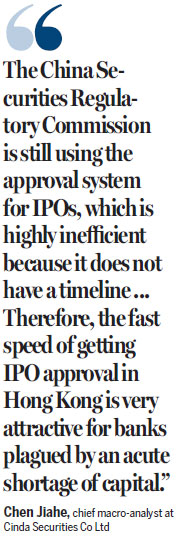
"The China Securities Regulatory Commission (CSRC) is still using the approval system for IPOs, which is highly inefficient because it does not have a timeline," said Chen Jiahe, chief macro-analyst at Cinda Securities Co Ltd. "It may take years for an applicant to gain approval. Even a short cut may take a year or two. Therefore, the fast speed of getting IPO approval in Hong Kong is very attractive for banks plagued by an acute shortage of capital."
Henan province-based Bank of Zhengzhou Co Ltd and Bank of Hebei Co Ltd are also planning to get listed in Hong Kong.
Two mainland commercial banks went public in Hong Kong last year - Shengjing Bank Co Ltd, based in Shenyang, Liaoning province, raised $1.5 billion in an IPO in December, while Harbin Bank Co Ltd raised $1.1 billion in the H-share market.
The mainland's approval system has been criticized for being inefficient, with the CSRC usually engaged in a lengthy investigation into an applicant to see if it's qualified for a share sale.
Waiting for the green light is a tedious process. However, once the company is listed, it stays in the market regardless of the performance of its stocks. In other words, whether a company should stay in the stock market or be eliminated is solely decided by the government instead of shareholders.
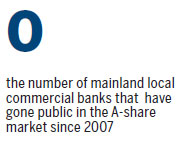
No local commercial bank on the mainland has been listed in the A-share market since 2007.
Banking and IPO experts have proposed changes to the approval and registration system, whereby applicants would not be required to go through a lengthy and thorough investigation.
But, once they've gone public, they would be delisted immediately if they performed badly in the stock market. Such a system was mentioned in the government's work report by Premier Li Keqiang last year.
"This year will mark the transition from the approval system to the registration system in IPO applications in the A-share market," said Li Daxiao, chief economist at Yingda Securities Co Ltd. "However, the change will come in a measured manner. Otherwise, there will be a sudden surge in IPOs considering the fact there're already more than 600 enterprises awaiting approval."
Harbin Bank and Shengjing Bank have seen their CARs improve following their flotation in Hong Kong in 2014. By the end of last year, Harbin Bank's CAR stood at 14.64 percent - up 2.69 percentage points from the same period the previous year.
Shengjing Bank's CAR was 12.65 percent by the end of 2014 - rising 0.13 percentage points from the same period the previous year.
Although it's relatively easier to go public in Hong Kong, it's not a sustainable way for banks to resolve their capital crunch, reckoned Chen.
"Going public is an easy way to raise funds within a short period of time. However, it only addresses the problem temporarily. The pressure of capital can only be resolved when the banks have updated their growth model and improved their pricing capacity with a more diversified portfolio," he noted.
Two mainland local banks that have been listed in Hong Kong for more than a year - Bank of Chongqing Co Ltd and Huishang Bank Corporation Ltd - have seen their CARs decrease by about 2 percentage points.
Shengjing Bank said recently it planned to issue 1.5-billion-yuan renminbi-denominated bonds for foreign investors and not more than 10 billion yuan in financial bonds in the domestic interbank market. The funds would be used for "replenishing the mid- and long-term capital flow," the bank said.
"These local banks should pay more attention to higher value-added services, turn themselves from a credit intermediate agency into an information and capital provider, and enter other markets, such as currency, capital, futures and foreign exchange," Chen said.
"The pressure on banks to reform their business model is now generally quite high on the mainland. For local banks, if they can't find new sources of profits other than bank interest, they will be quickly eliminated as they lack large capital reserves compared with their national competitors," he said.
yangziman@chinadaily.com.cn
|
Despite the efficient procedure of going public in Hong Kong, it's not a sustainable way for mainland banks to resolve their capital crunch. The local lenders are urged to upgrade their business models to compete with their national peers. Photo Provided to China Daily |

(HK Edition 04/14/2015 page1)