Hand of Hope reaches out to stroke victims
Updated: 2015-08-13 09:08
By Deng Yanzi in Hong Kong(HK Edition)
|
|||||||


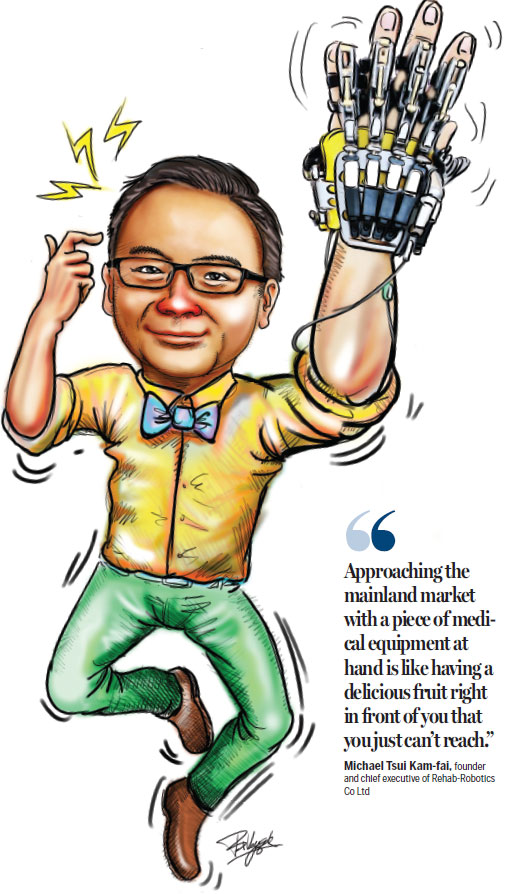
Michael Tsui Kam-fai is fastening some straps on his finger. On the back of his hand, something that looks like a metallic skeleton clings firmly to his skin from the wrist to the fingernails.
Once he is all suited up, his robotic hand makes Tsui look like a superhero who is about to smash a wall without batting an eyelid.
But Tsui is not a fierce, muscle-bound comic book character. This round-faced, soft-spoken gentleman used to be an occupational therapist caring for the elderly at a nursing home.
And the meticulously assembled metal hand is not made to destroy, but to rebuild. This piece of exoskeleton, dubbed "Hand of Hope", is a medical device that helps cerebral stroke patients regain the control of hands made numb by a damaged nervous system.
A sensor in Hand of Hope detects the weak nerve signals remaining in the muscle that indicate the patient's intention to move. The device will subsequently process and magnify these signals, and help the patient move in accordance with their intention.
Through repeated practice, stroke patients could hopefully relearn how to control their hand muscles freely.
The idea took shape in 2008, when Tsui partnered with his long-time friend Raymond Tong Kai-yu - a professor in biomedical engineering at Hong Kong Polytechnic University - in research and development (R&D) of the concept of a robotic hand for stroke patients.
R&D took the duo over a year, and Tsui decided to establish a company to officially commercialize the technology. Tsui serves as the founder and chief executive of the company, Rehab-Robotics Co Ltd, which was accepted by the incubation program of Hong Kong Science and Technology Park in 2011 and graduated earlier this year.
For the innovation and social values of the device, Hand of Hope was awarded the highest prize in the International Exhibition of Inventions of Geneva in 2012, making it the first Hong Kong invention to receive this honor.
Hand of Hope continues to be active in the international market. Each year 17 million people suffer strokes worldwide, according to a 2014 report by the World Stroke Organization.
Setting out to serve this large population, Hand of Hope is now in use in quite a few European and Asian countries and regions, while it has also been adopted locally in Hong Kong by more than 10 prominent rehabilitation centers and has benefited thousands of patients around the world.
But a good product does not necessarily sell itself, not even an internationally acclaimed and socially beneficial product as this one. Regrettably, the hope that soars high overseas is tied down by red tape in its homeland.
The gap between Hong Kong and the Chinese mainland regarding regulations on medical equipment has posed some practical barriers for Rehab-Robotics in terms of getting registered and certified on the mainland.
Hand of Hope has already been certified in Taiwan, Singapore, Malaysia, Ukraine and Saudi Arabia, and certification by the US Food and Drug Administration is expected in the coming months.
But the same luck has eluded the company in its home country. Tsui has waited for certification for more than 18 months and his spending on the certification fee has crossed the total for all those other markets.
It is missing out on the opportunity to serve the 7 million existing stroke patients on the mainland, almost equal to the entire population of Hong Kong, as well as 2.5 million new cases each year, according to statistics from the National Health and Family Planning Commission in 2012.
"Approaching the mainland market with a piece of medical equipment at hand is like having a delicious fruit right in front of you that you just can't reach," Tsui said, describing this issue as a "bottleneck" for the company.
The lack of downstream capacity in Hong Kong is also holding back Rehab-Robotics, if not most local tech companies in general.
When Rehab-Robotics completed the prototype in 2010, Hand of Hope was the first and only one of its kind in the world. Now, at least six companies globally have developed similar devices for stroke patients, according to Tsui. "We have learned from our experience of exhibiting abroad in recent years that our competitors from other markets have a much shorter cycle than we do. The industry in countries including Germany and the US is well developed, and they can receive instant feedback from manufacturing to R&D. The industry chain operates at a very fast pace," Tsui explains.
Even though Hong Kong companies are close to the manufacturing base in South China, he points out the gap in intellectual property (IP) protection. Rehab-Robotics was reported to have encountered a copycat product on the mainland that has sparked IP protection concerns.
"There's an invisible gap between the mainland and Hong Kong, even in the technology sector. We are hoping for closer cooperation, but we have our differences in terms of respect for IP as well as regulations," he said.
Tsui likened running the company to an athlete running with weights, which add to the difficulty.
"You can see us running with heavier steps, as if we're moving forward with weights on us. But I'm willing to do so. One step at a time, there will be light at the end of the tunnel eventually."
iris@chinadailyhk.com
(HK Edition 08/13/2015 page7)