Linked exchange rate system is still best for HK's economy
Updated: 2016-01-28 08:42
By Raymond so(HK Edition)
|
|||||||


Last week, the Hong Kong dollar weakened against the US dollar, aggravating market volatility as well as speculation that the Hong Kong dollar could be "de-pegged" from the US dollar. Objectively speaking, any speculation about the Hong Kong dollar being de-linked from the US dollar is a natural phenomenon, given that Hong Kong is an open economy. Moreover, heightened concerns about the prospects for the Hong Kong and mainland economies after the latest batch of poor data from the mainland have provided speculators with another excuse.
Hong Kong's linked exchange rate system has a distinct feature in its currency board arrangement. In addition to the official price of pegging the Hong Kong dollar at a rate of HK$7.8 to the US dollar, there are the strong-side and weak-side convertibility undertakings. When capital flowed into the city earlier, the Hong Kong dollar repeatedly hit the strong-side undertakings. Now that capital is flowing out of the city, it is normal for the Hong Kong dollar to fall. The current wave of capital outflow has not yet reached its highest levels as the current situation is just a return to normal. When there is really a large volume of capital outflow and the Hong Kong dollar starts to hit the weak-side undertakings, there could be another round of panic in the market.
Here, we have to understand that capital inflow and outflow in the Hong Kong market is normal. In particular, under the linked exchange rate system Hong Kong dollar interest rates need to follow those of the US dollar. Nowadays, the US Federal Reserve has started a new cycle of interest rate increases. When the Hong Kong dollar interest rate is lower than that of the US dollar, it is logical for the Hong Kong dollar to weaken against the US dollar because of interest arbitrage. In other words, the current slide of the Hong Kong dollar is a simple reflection of changes in the operation of the market. As long as the market transacts and settles in an orderly way, we do not need to worry about the stability of the linked exchange rate system, which is supported by strong fiscal reserves.
In the past 30 years, Hong Kong's linked exchange rate system has overcome many challenges, weathering a variety of financial hiccups - both large and small. It still runs smoothly today.
During the 1997 Asian financial crisis, the linked exchange rate came under severe speculative attack. Since then, it has undergone several improvements. Together with the city's ample foreign reserves and policy stability, we do not have to worry about the stability of the linked exchange rate. From a pragmatic point of view, the linked exchange rate system is the most suitable for Hong Kong. Rumors about the Hong Kong dollar de-pegging from the US dollar is just an excuse for speculative bets in the market. Hong Kong's financial markets are mature.
One often overlooked reason is that the value of the Hong Kong dollar has stabilized. International financial markets mainly use the US dollar as a pricing unit. With the Hong Kong dollar being pegged to the US dollar, Hong Kong effectively has no currency risk at all for international investors. When the currency risk is gone, the Hong Kong market becomes a magnet for international capital. If the Hong Kong dollar is freely floating, international investors will have to face a currency risk. This will naturally have an adverse impact on the development of financial markets in Hong Kong. In this sense, the linked exchange rate system is still the most favorable system for Hong Kong.
Of course, everything has its costs. The implementation of the linked exchange rate system is no exception. The biggest cost of the linked exchange rate is the loss of independent interest rates. Because of the peg, the Hong Kong dollar interest rates will have to follow those of the US dollar, otherwise the interest rate differences will trigger capital movements for the purpose of interest rate arbitrage. Because of the peg system, during the past 30 years of Hong Kong's experience in using it, the Hong Kong dollar interest rate movements and the SAR's economic performance have never been relevant: Hong Kong has increased interest rates during recessions and cut rates when the economy became over heated. So deciding interest rate levels is in the hands of the US Federal Reserve.
Another shortcoming of the peg system is the inflexibility of the Hong Kong dollar to adjust to economic conditions. When the US dollar strengthens, the Hong Kong dollar will also become stronger. Consequently, Hong Kong's exports and tourism will suffer. But this is an unavoidable price which has to be paid.
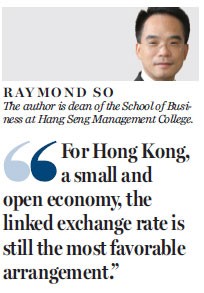
Many people suggest that the linked exchange rate should be abolished so interest rates and the exchange rate of the Hong Kong dollar can move in line with the Hong Kong economy. However, any change to the peg system should not be an impromptu one. Otherwise, people will lose confidence in the system. For Hong Kong, a small and open economy, the linked exchange rate is still the most favorable arrangement.
(HK Edition 01/28/2016 page9)