CBD really matters for techs and status
Updated: 2016-04-20 07:24
By Zhou Mo in Shenzhen(HK Edition)
|
|||||||


|
A man takes a rest in Shenzhen's Futian district. A host of technology firms have chosen downtown Futian and Nanshan districts as their operating base, attracting lots of internet talents. Edmond Tang / China Daily |
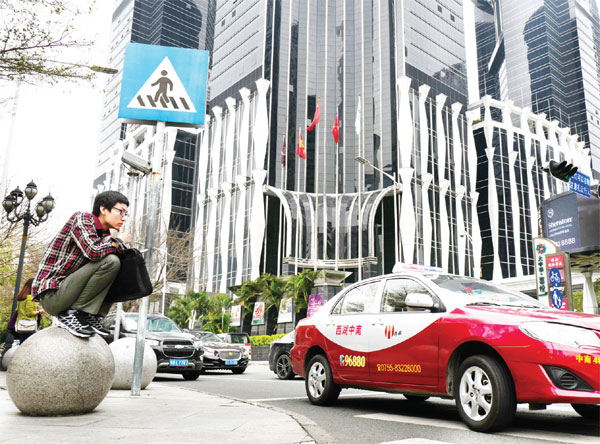
Burgeoning technology firms across the Asia-Pacific region are changing the use of office space, with offices in central business districts (CBDs) increasingly occupied by young companies or startups, rather than traditional financial institutions.
In low growth office markets like Hong Kong, Singapore and Australia, mature technology firms like to locate themselves in decentralized areas to ensure more space for research and development, while the younger ones prefer to set up offices in the CBD or city centers, according to a report by Colliers International, a commercial real-estate services organization.
"Finance and insurance companies have traditionally been the major tenants of CBD offices in Asia, but that's now changing as more and more tech firms - many of them younger companies or startups - take up CBD space," says Sam Harvey-Jones, managing director of Occupier Services in Asia of US-based Colliers International.
"Tech companies are looking to recruit talented younger staff with quite different mindsets. Millennials (born between the early 1980s to the early 2000s) prefer working environments that are fun, creative and unstructured, and the market is changing to give them what they want," he says.
In Hong Kong, specifically, Science Park and Cyberport have been ideal places for many first-generation firms, the report says, referring to those well-established companies which have been operating in the Asia Pacific for more than two decades and have relatively low growth in headcount, like IBM, Microsoft and HP.
Second-generation enterprises like Google, Yahoo and LinkedIn - companies that have established themselves in the region in the past 10 years and normally have moderate growth in headcount - and those of the third generation, mostly startups, often occupy offices in downtown areas, but not in CBDs.
However, financial technology firms, which see strong growth in the SAR, are typically located in close proximity to traditional banking and finance firms, with most of them in Central or the International Commerce Centre in Kowloon, the report points out.
Some young graduates in Hong Kong say the workplace is among their major considerations when seeking jobs.
"The CBD, as I see, represents vibrancy, high-efficiency and also great pressure. Working in the area makes me feel energetic," says Annie Yin, 24, who graduated from Hong Kong Baptist University with a master's degree last year and now works at a technology company in Sheung Wan.
"And also, it's a status symbol," she says.
While offices in the CBD or city center are believed to have the power of helping smaller companies gain greater fame and attract more talents, they have also raised companies' expenditure and their risk of failure, especially in a market known as one of the most expensive in the world.
A report by global real-estate advisory firm CBRE shows that office rentals in Hong Kong's Central district were the second most expensive among all areas around the world by the end of September 2015, just behind London.
However, on the Chinese mainland, which is classified as an office market with high growth, some entrepreneurs of technology startups tend to see the matter in a different light. They believe decentralized areas, rather than the CBD, can promote creativity and help them build their brands better.
"As a company that focuses on technological innovation, we rank creativity as our first priority. That's why we have chosen an office with an excellent seaview," says Huang Dinglong, co-founder and chief executive officer of Malong Technologies, a Shenzhen-based artificial intelligence startup.
"When our team members walk into the office every day, the beautiful seaview unfolds before their eyes. This will help them create new and interesting ideas. And also, it will help us attract more talents."
Different from many other technology firms clustered in the downtown of Futian and Nanshan districts, Huang located his office in the city's eastern district of Yantian. It is not just about the sea view, but also about making itself a benchmark enterprise in the area, he says.
"Every area (in the city) needs its own benchmark enterprise to attract talents. Nanshan district, for example, has Tencent, which has helped attract a number of internet talents into the area. In the Yantian district, however, there's none. We want to become the benchmark firm of the area," he adds.
A company's business prospects are the most fundamental thing in deciding where talents are going, he says.
Meanwhile, in Singapore, setting up office in the CBD is widely deemed by young technology firms as a way of differentiating themselves, with second and third-generation firms preferring a core CBD location. On the other hand, more established firms show greater confidence in choosing a more decentralized location for their business, according to the report by Colliers International.
sally@chinadailyhk.com
(HK Edition 04/20/2016 page9)