EU-HK ties have a great future
Updated: 2016-05-16 08:43
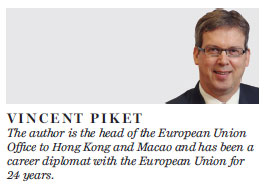
By Vincent Piket(HK Edition)
|
|||||||


Vincent Piket examines the future of EU-HK relations, arguing that Hong Kong can further maximize the benefits of the 'One Country, Two Systems' principle
On May 9, we marked Europe Day in Hong Kong, our "national" day. It was a joyful event, in which we celebrated our relations and friendship with Hong Kong.
The relations between the European Union (EU) and Hong Kong are wide-ranging and diverse. The EU is Hong Kong's second largest trade partner, after the Chinese mainland. In 2015 bilateral trade between Hong Kong and the EU increased to 71 billion euros ($80.5 billion), covering both goods and services. The number of EU firms in Hong Kong rose to a new high of 2,030 in 2015. Hong Kong firms and Hong Kong citizens are interested in Europe for business, education or leisure. There are ever more EU citizens residing in Hong Kong, because it is an attractive place to live and to work.
Our relations with the SAR are embedded in the EU's overall relations with the mainland. Last year the EU and China celebrated 40 years of diplomatic relations. Over the years EU-China relations have expanded well beyond trade and we have become truly strategic partners, working together closely in areas ranging from international security and the fight against terrorism to the environment, research, education and green growth. The EU supports China's market-based reforms and its transition to a more sustainable growth model. We have a stake in this process, as China's transition affects us all.
Within the overall EU-China relations, EU-Hong Kong relations have a distinct identity, thanks to the unique "One Country, Two Systems" principle. The EU and other trade partners benefit from Hong Kong's free-port policy and from its preferential access to the mainland market. This explains why Hong Kong ranks 15th on the EU's trade partners list, ahead of much larger economies.
Just a few weeks ago, the EU institutions brought out their annual report on the functioning of the "One Country, Two Systems" principle, because it is the basis of our relationship. We have been issuing such reports since Hong Kong's handover to China. The 2015 report noted that overall the "One Country, Two Systems" principle was implemented well and Hong Kong maintained its independent judiciary and high anti-corruption standards. The report voiced some concerns about freedom of speech and the press and the rule of law.
What is on the EU-Hong Kong agenda? First of all we wish to maintain and expand our vibrant economic agenda. Our trade and investment relations are largely problem free. We have agreed to step up cooperation on market regulation for food safety and access to government procurement. We also agreed to explore launching negotiations for a bilateral investment agreement which would complement the Comprehensive Agreement on Investment being negotiated between the EU and the Chinese mainland. In the customs field we work with Hong Kong to tackle international trade in goods that infringe intellectual property rights. Strengthening tax cooperation is vital given the global drive for fair taxation. In 2016 the EU will be rolling out a new platform for engaging Hong Kong and other major financial centers. We hope that Hong Kong will soon adopt the law for automatic exchange of tax information and join the new international initiatives to increase transparency and equitability. We will also continue the regulatory dialogue for the financial services sector. We are keen to see how the EU financial institutions can cooperate with Hong Kong on the Belt and Road Initiative and on projects under the Asian Infrastructure Investment Bank. Both initiatives have links with the EU's own European Fund for Strategic Investment.
And finally, we will work together on research and innovation in the EU's Horizon 2020 programme for research and technological development. Our new agreement gives Hong Kong access to the entire European Research Area.
The EU is confident that our relations with Hong Kong will further deepen. We are likewise confident that the EU has left the economic crisis behind, and that we are on track to growth, provided we continue our structural reforms. The refugee crisis will be a major challenge, but the agreement reached with Turkey shows that we can find workable solutions while remaining true to our value of giving shelter to those who are in need. An internal challenge for the EU is to make a new connection with its citizens, because support for the EU among citizens is too low and Euro-sceptic parties have been voted into member-state parliaments as well as the European Parliament. While the UK's EU referendum is a case on its own, it does illustrate a debate across Europe about what the EU should stand for, and how it should meet tomorrow's needs.
We are also confident that Hong Kong will face up to the challenge of taking the "One Country, Two Systems" principle further. As is true for the EU, Hong Kong's assets and strengths need to be nurtured and developed, through collaboration and compromise. Having lived and worked in Hong Kong for almost four years now, I am convinced that Hong Kong people will have the common drive to make this a success, to the benefit of the SAR, China and Hong Kong's international partners.
(HK Edition 05/16/2016 page11)