Future convenience stores live up to their name
Updated: 2016-06-02 06:41
By zhou mo in Shenzhen(HK Edition)
|
|||||||


In a 70-square-meter or so convenience store in Foshan, Guangdong province, there's not a single shop assistant.
A man walks in, makes a few clicks on a machine and, after 20 seconds, a bowl of steaming noodle appears in front of him. He sits down beside a table enjoying the meal. After he finishes, the table is cleaned automatically.
It's the F5 Future Store, where all the work - that of the cashier, chef and waiter - is done by machines. Shoppers can pay for snacks and drinks through the store's mobile app and go there, retrieve the food or order a fresh meal and eat there.
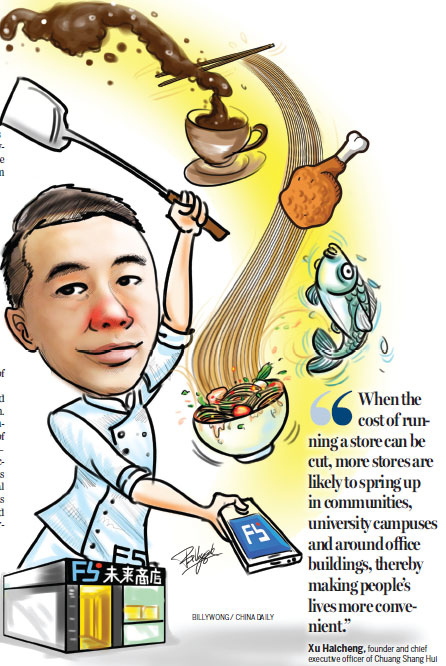
The most prominent feature that distinguishes the F5 Future Store from traditional convenience stores, like 7-Eleven, is that it has no staff, says Xu Haicheng, founder and chief executive officer of Chuang Shang Hui - the company behind the operation.
"This allows us to reduce costs by 50 percent or even more."
A convenience store's operating costs normally come from three aspects, Xu explains - the rent takes up about 40 percent, personnel 50 percent and energy consumption accounting for the other 10 percent.
"When the cost of running a store can be cut, more stores are likely to spring up in communities, university campuses and around office buildings, thereby making people's lives more convenient," he says.
Currently, there are four F5 Future Stores up and about in Foshan - one in the local community, two near a university area and the other in a high-tech industrial park. Students make up the bulk of the customers in the university district, with each store's daily revenue reaching 4,000 yuan ($607).
A new store is expected to open this month in downtown Guangzhou, while the finishing touches are being put to another in Shenzhen.
"Our plan is to open 20 or more stores in Guangzhou next month and increase the number to 100 by the end of this year," says 36-year-old Xu.
The ambitious entrepreneur's objective is based on the promising outlook for convenience stores on the Chinese mainland. According to a report by Beijing-based market intelligence provider Zhiyan Consulting Group, the number of convenience stores on the mainland rose 11.7 percent year-on-year - from 13,567 in 2008 to 26,345 in 2014. Sales revenue hit nearly 40.8 billion yuan by 2014 - an annual growth of 14.8 percent.
The 2016 Convenience Store Development Index of Chinese Cities, published last month by the China Chain Store and Franchise Association, shows the convenience store business is one of the fastest-growing sectors in the retail industry. Almost half of the 36 cities polled recorded more than 20 percent growth in the number of convenience stores last year.
Shenzhen topped the list in the rankings, which took into consideration a number of factors, including the number of convenience stores, its growth rate, the percentage of 24-hour stores and policy support. Dongguan came in fourth.
"The convenience store sector is growing robustly and has huge potential," Pei Liang, secretary-general of the association, told the 2016 China Convenience Store Conference in Dongguan last month.
"However, we still face a number of challenges in trying to achieve sustainable development against the backdrop of the current economic slowdown - rising costs, as well as disorderly and excessive market competition," he said.
Xu, a veteran businessman, launched his first entrepreneurial project - repairing computers - in 2004 when he was 24. "My initial thought was simple - to earn more money - as my family's financial situation wasn't good at the time."
With only 30,000 yuan as startup capital, he managed to generate 10 million yuan in revenue annually by 2013.
He later opened a fresh-food delivery company, but it did not turn out to be as successful as his previous one.
"The distribution cost was very high. We had 40 deliverymen at a time, but they could be given work only between 9 am and 11 am, and from 3 pm to 5 pm, because the food had to be sent to customers right before meal time. And, sometimes, when we arrived, they were not at home. So, it was a waste of human resources," recalls Xu.
He then came up with the idea of renting a space outside communities to place the food in order to enhance efficiency. The situation got better and Xu began selling food there.
"That's the original form of the F5 Future Store."
Xu's most difficult period now seems to be behind him. In January this year, his company secured 10 million yuan of investment from TCL Capital - a subsidiary of consumer electronics and home appliances maker TCL Corp. Industrial production of the machines is expected to be completed soon, paving the way for further expansion of his business.
"We hope to emerge as the country's largest self-service convenience store chain in future," Xu says. "There's still a long way to go, probably 10 years, but with all our efforts, I'm confident that day will come soon."
sally@chinadailyhk.com
(HK Edition 06/02/2016 page9)