Innovation starts in creative education
Updated: 2016-08-12 08:15
By Jon Lowe(China Daily)
|
|||||||


Jon Lowe writes that deeper reform is needed in Hong Kongs schools to foster creativity and self-expression, if we are serious about making the SAR a leading hub for innovation
There is a growing sense that, developmentally, Hong Kong is at the crossroads. A lot of core industries are under threat. In trade, global recession looms, while expanding mainland ports and shopping destinations threaten retail and perhaps even Hong Kong's role as "super-connector". Then there are the shockwaves of Brexit and the prospect of a Trump presidency. Finance and logistics appear secure in the medium term, and likely to get a boost by proving useful to the nation's Belt and Road Initiative, while various other highly skilled professions such as law, medicine and so on appear fairly secure. But there is uncertainty for the average man and woman. Hence the government has been attempting to push Hong Kong to be a center of innovation in the digital age, even using money from the public coffers in its efforts. But are Hong Kong people a natural fit for such a plan?
I think the answer to that question is, it has nothing to do with nature and everything to do with education. For at least 10 years, innovation has been something of a buzzword and there have been efforts to gear kids toward the kind of thinking that produces it, but there is a long way to go still. Innovation will essentially flow from two aspects in secondary education. The first is through encouraging young students to be self-starters who are creative in their thinking and thus not afraid to develop ideas - a tricky challenge. The second aspect is that secondary education also needs to teach them how to set goals, undertake the necessary research and have the skills to put all their ideas into a presentable format. Imparting such skills should be more straightforward once the first goal is achieved.
Looking more closely at the first challenge, teaching children to be creative is really about self-expression. Most teachers in Hong Kong would agree that this does not come easily to kids here. This may have something to do with the powerful Confucian heritage which lingers and can invest figures such as teachers with too much authority, so that if students are not exposed to self-study or pair or group work at an extremely young age, this mindset becomes almost impossible to break through, and kids will simply expect the teacher to "spoon-feed" knowledge from the front of the class. Since most teachers have been raised in this same environment it is also hard for them to break the mold. Above all, as with the development of innovative ideas in the real world, if we are serious about gearing education toward producing innovation, then classes need to be more project-based.
Let us take English as an example, which is a subject crucial to innovation and also one in which creative thinking can be fostered. Looking at the Diploma of Secondary Education's (DSE) past exam papers available, one can easily observe that the core English paper (leaving aside elective additions) is dominated by comprehension tasks in which students need to synthesize information, answer questions about language usage, etc. What is more, almost all the comprehension tasks involve the same kind of formal English, almost exclusively from newspaper pieces, or the occasional official report, about subjects that a very "square" person has decided are of interest to young people, such as articles about dolphin aquariums, the need for civic centers or markets, youth camps you get the drift. Things have barely moved on since the first DSE paper I saw nearly a decade ago, which rather hopefully sought to foster innovation by - wait for it - including a comprehension task on a government report about innovation!
Yet the path to creating an innovative workforce begins even earlier than secondary and primary school. In a recent commentary here on the importance of play in early education, expert Dora Ho railed against traditional thinking on education reflected in proverbs such as "Progress in learning depends on diligent work rather than play". Ho said, "But in reality, contradictory to such traditional Chinese thinking, during play children have to come up with solutions when faced with problems. This propels their cognitive development." She added that play affords "interactive communication with peers", and "requires children to regulate their emotions and collaborate with others". She concludes that "playing stimulates children to think, invent and create, explore the world around them, construct knowledge, and gain self-confidence". Play is thus closely linked to the kind of fulfilling investigation we wish to foster in older students, and one hopes that Ho's campaign is successful in getting the relevant authorities to recognize the need to develop young children's creative, linguistic and cognitive development.
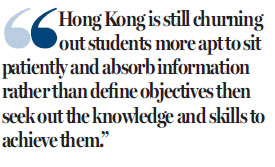
I think Hong Kong is still erring on the side of caution, still churning out students more apt to sit patiently and absorb information rather than define objectives then seek out the knowledge and skills to achieve them. Our students remain more attuned to following than leading; and this is a big problem if we want innovation to get into our society's bloodstream. Thus, deeper education reform is urgently needed - not just tinkering with the existing system. I believe kids will have a far better time in schools where more, if not most, lessons are geared toward self- or group-generated projects. The only "losers" may be teachers who have not been involved in this kind of teaching before. However, there can be retraining and seminars to help them overcome their initial resistance to noisier classrooms and apparent indiscipline - in fact the natural effects of kids being engaged rather than bored or reluctant to express themselves.
The author is a seasoned journalist who has worked in many places in the world.
(China Daily 08/12/2016 page12)