HK is resting too heavily on its laurels
Updated: 2016-08-31 07:53
By Naubahar Sharif(HK Edition)
|
|||||||


Naubahar Sharif says that Hong Kong is now at the crossroads and it is imperative for the city to move decisively toward becoming a knowledge-based economy
In Hong Kong, we are rightly proud of how far we've come over the last few decades and of where we are today. We are a first-world city, with all the indicators of a high standard of living: GDP per capita in purchasing power parity (PPP) terms ranked 10th in the world in 2015 ($56,719.5); life expectancy ranked first in the world in 2014 (87 years for females and 81 years for males); infant mortality rate ranked lowest in the world in 2015 (1.3 per 1,000 births); and mobile cellular subscriptions ranked second in the world in 2014 (234 per 100 persons). The list can go on and on.
Hong Kong did not secure its status as a first-world city (or, as Hong Kong would like to put it, "Asia's World City") overnight. Our road to prosperity has been arduous. In February 1967, we witnessed riots, a spillover from the "cultural revolution" on the Chinese mainland. Within a decade, however, Hong Kong had become a manufacturing powerhouse with three-quarters of a million people, or one-quarter of the labor force, employed in manufacturing. With the opening-up of the mainland beginning in 1979, we saw a second momentous shift in Hong Kong's economy, with the workforce transitioning almost seamlessly from manufacturing to services, with little effect on the unemployment rate. Today, however, with the role of manufacturing receding (it contributed only 1.3 percent to Hong Kong's GDP in 2014), we find ourselves yet again - and let's be optimistic about it - at a crossroads.
What crossroads? While we in Hong Kong have been successful in the past, our past successes are absolutely no guarantee of future prosperity. Consider a city that bears no small resemblance to Hong Kong, a relatively small place that played an outsize role in world trade and finance in its heyday: Venice. Italy's famous city of canals was once a leading global power; in 1320, the city was a world leader in banking and trade. Seven hundred years later, Venice has become just a charming tourist destination where visitors flock to traverse its quaint canals and admire its picturesque landscape half-submerged in water. Today, there exists no vestige of its glory days as a business and finance power house.
We see similar outcomes resulting from complacency in every walk of life, including sports, politics, education, literature, etc. Examples abound of how leaders, leading companies, political parties and social groups fall from grace for lack of drive for excellence.
Before the window of opportunity shuts on us completely, our government, educators and decision-makers in all sectors of our community need to consider moving more decisively and determinedly toward becoming a knowledge-based economy (rather than simply a tourist destination), and not just relying on a few pillar industries. As Hong Kong's manufacturing competitiveness withers, especially in the face of the continued opening and ascendance of mainland cities such as Shenzhen, Guangzhou and Shanghai, we need to embrace the exploitation of information and knowledge more vigorously to usher in a new era of economic growth. To be sure, moves are underway to achieve this goal (such as the establishment of the Innovation and Technology Bureau, and the stimulus measures announced in this year's Policy Address and Budget), but the coherence, top-level cross-bureau support and speed of the process remain questionable.
In a knowledge-based economy, information, know-how and conceptual mastery underpin innovation and economic growth. A knowledge economy is driven by a constant flow of information that generates corresponding capabilities, harnessing the power of science and technology. Examples of knowledge-based industries include high technology (electronics, fiber optics, etc), education and training, research and development, healthcare services, and finance and investment.
Although Hong Kong has already made considerable progress, beginning as early as the 1980s, toward becoming a regional finance, investment and service hub, thereby establishing a knowledge-based economic sector, there are other aspects of a knowledge-based economy, especially investment in high technology, research and development, and healthcare services, in which there is much room for improvement. We should see Hong Kong's growing economic integration with the mainland as an opportunity to make similar progress in other sectors as new markets open and expand rapidly.
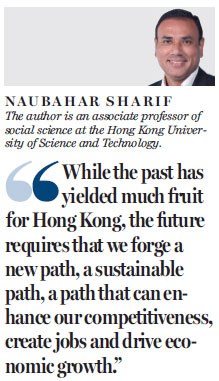
If Hong Kong is to broaden its economic base to the extent needed to meet our growing needs and take the competitive challenge from mainland cities head-on (not to mention succeed globally), it needs to move forward with its future in mind - rather than try to make do based on the sources of its past success. While the past has yielded much fruit for Hong Kong, the future requires that we forge a new path, a sustainable path, a path that can enhance our competitiveness, create jobs and drive economic growth.
Hong Kong needs to remember these lessons and not rest on its laurels, lest it become another Venice.
(HK Edition 08/31/2016 page10)