FSDC calls for tax shakeup to lure global enterprises to Hong Kong
Updated: 2017-01-13 07:56
By Lin Wenjie in Hong Kong(HK Edition)
|
|||||||


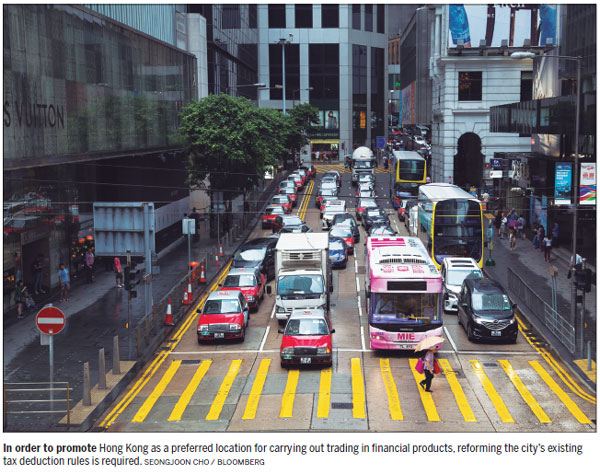
Although Hong Kong is well known for its simple, predictable and low tax system, multinational financial companies are still baffled by some of the local tax rules, which need to be improved to help further promote the city's position and reputation as a preferred origination and trading location for international financial products, suggests a top government financial advisory body.
A recent report by the Financial Services Development Council (FSDC) offers five suggestions to reform the SAR's tax rules to lure global financial enterprises to relocate their booking business to Hong Kong, as many of them are considering moving their trading locations out of London following Britain's decision to quit the European Union last year.
"Britain's decision to leave the European Union, as well as the vastly changing regulatory landscapes in many other countries, may prompt some international investment banks and financial firms to move part of their operations to Hong Kong," says Florence Yip, convener of the council's New Business Committee.
She believes that Hong Kong's economy will benefit a great deal if the city's is to become a world trading center. "The increased asset allocation, liquidity and volume of transactions will not only translate into significant financial revenues for Hong Kong, but will also promote an increased pool of talent, such as job creation, in areas of operations, risk management and compliance," she says.

The FSDC's first suggestion is for the government to consider amending the interest deductibility rules so that companies licensed by the Securities and Futures Commission (SFC) can use their interest expenses for tax deductible items in the same way a bank does.
Currently, the interest expense deduction rules under the Inland Revenue Ordinance vary between banks and non-banking financial institutions, even if both of them are involved in similar businesses. A bank licensed by the Hong Kong Monetary Authority is allowed to deduct interest expenses simply because it's a bank. But, corporations regulated by the SFC, such as brokers and dealers, are not entitled to deduction rules unless they meet certain conditions in the first place. As a result, non-banks may not consider establishing trading center activities in Hong Kong if there's a risk of its funding costs not being eligible for a deduction, while the related profits are subject to tax, the report said.
In addition, the report urged the government to give clearer guidance on how to interpret and apply the sourcing rules to complex global financial products' origination and trading operations when charging profit tax. Under the sourcing rules concept, only profits sourced in Hong Kong are taxable in general, but in practice, many transactions involve multiple locations, so companies need to define whether the profit is derived from Hong Kong or not for every transaction, which is a lengthy and complex process that requires considerable human and material resources.
Instead of conducting a detailed examination on defining the source of profits, the FSDC advocates a simpler approach to this complex issue - adopting a "deemed onshore/offshore split", say a 50:50 apportionment for the total profits.
"Trading can be complex, such as the principal trade executed in Hong Kong, whilst the hedge trade takes place in London. If a 50-dollar profit generated onshore, the amount of money taxable in Hong Kong is 50 dollars under the current practice, regardless of the 20-dollar loss offshore. But, if we split the overall income into a 50:50 apportionment, the amount of profit taxable onshore is only 15 dollars," explains Yip.
The above tax arrangement seems alluring to multinational corporations, but there's concern that such practices maybe manipulated by companies to evade taxes.
"Loopholes may occur when companies take advantage of the rules by packaging several transactions to reduce tax expenditures," warns State Shi, head of tax at consulting firm Alvarez & Marsal Asia Ltd, while acknowledging that the FSDC's suggestions could reduce the time consumed for defining the Hong Kong source income.
Other suggestions in the report include regulating capital requirements and total loss absorption capacity; base erosion and profit shifting and transfer pricing; and double tax treaties with tax jurisdictions where financial products are issues or where clients reside.
Hong Kong has already signed 35 tax treaties with other markets. Yip says these should be expanded to include Australia, India, the Philippines, Singapore, Taiwan and other markets along the Belt and Road Initiative.
The FSDC has been active in introducing changes to Hong Kong's tax environment, and will discuss with the Inland Revenue Department its proposals in the following months.
But, will these suggestions really appeal to multinational firms? According to Shi, financial institutions will consider a lot of factors when choosing a place to set up business, such as local economic conditions and market demand.
"I want to emphasize that tax is one of the factors to consider, but it should never be a driving force behind a company's business decisions. Only when a company has to choose between two places with similar business conditions, tax should be considered," he says.
cherrylin@chinadailyhk.com
(HK Edition 01/13/2017 page1)