Shenzhen eyes global metro title
Updated: 2017-01-26 07:32
By Chai Hua in Shenzhen(HK Edition)
|
|||||||


|
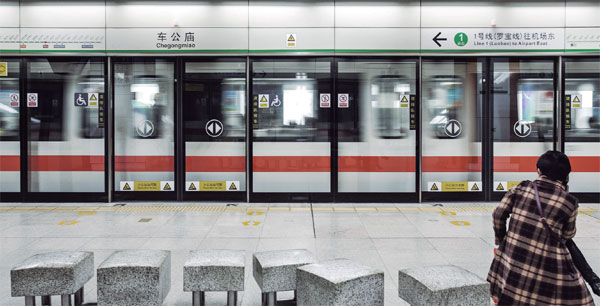
The Shenzhen Metro currently has eight lines spanning about 285 kilometers. In a bid to support industrial upgrading and structure transformation, the city plans to build four new metro lines this year, part of a total of 1,142 kilometers to be built by 2030. Qilai Shen / Bloomberg |
Boomtown in bold bid to expand metro system to 32 lines, making it the world's largest network by 2030
The southern boomtown of Shenzhen is embarking on an ambitious drive to expand its metro system from the current eight lines to a total of 32 over the next 13 years, outranking Shanghai as the city with the largest subway network in the world.
The expansion is part of efforts to give a gigantic boost to the city's industrial upgrade and infrastructure setup, which plays a key role in catering to business and industrial operations, as well as the overall community, throughout the Pearl River Delta region.
Shenzhen's subway network, which entered service in December 2004, currently has eight lines with nearly 170 stations, covering almost 290 kilometers. The southern top-tier hub is the sixth city on the mainland to have a metro system after Beijing, Shanghai, Tianjin, Guangzhou and Wuhan.
The Shenzhen Metro, which boasts a daily ridership of close to 4 million, will start building four new lines this year alone to back up the city's industrial upgrading process, and infrastructure and community layout.
The four new lines, with a total length of 163.4 kilometers, are due to be completed by 2022, according to the just concluded Fifth Meeting of the 12th Guangdong Provincial People's Congress.
Shenzhen has been constructing three new lines and four extension lines since 2014.
The overall outline is to have a total of 32 lines, covering 1,142 kilometers by 2030, up and running by 2030, linking downtown centers with remote areas and neighboring cities, according to a plan thrashed out by the Urban Planning, Land and Resources Commission of Shenzhen Municipality late last year.
If completed on time, the extensive network is set to overtake that of Shanghai, which plans to extend its urban metro system to 1,050 kilometers by 2025, earning Shenzhen the honor of running the largest metro network worldwide.
According to the commission, one of the plan's principles is to stimulate primary business centers' radiation functions to peripheral areas and promote the development of its sub-centers by realizing rapid transportation among them. "Our aim is to reduce the travel time between primary and subordinate centers to 45 minutes," said an officer at the commission.
Creating multi-centers is a unique development mode of Shenzhen, said Sun Andong, deputy director of Guangzhou-based think bank South China Urban Research Association, and an efficient one for megacities.
The trend of having more new lines is designed to connect sub-centers and primary centers. For example, Line 14 links up the Shenzhen Central Business District and Shatian area near a new exhibition center and the city airport.
Line 13 connects Guangming district, a sub-center for manufacturing parks, with Shenzhen Bay - a downtown center where a dozen top international companies have their headquarters.
Shenzhen Metro President Lin Maode said earlier a closely-knit urban transportation system is the key to promoting a complementary and balanced development of regional industries and resources.
A series of new manufacturing projects are currently under construction at these sub-centers, along with expanding infrastructure. At sub-center Longgang district, which will be linked with the metropolitan's technology center Nanshan district by Line 21, local high-tech startup Royole Corp has invested 11 billion yuan ($1.59 billion) to build a 100,000-square-meter production base for advanced ultra-thin color flexible displays.
Sun said it's reasonable for the megacity to develop a 1,142-km rail transportation plan, considering its intensity of passenger flow is already larger than those of Shanghai and Beijing.
In addition, the innovative city's industrial structure upgrade, where the financial and services industries are gaining weight, has created greater interpersonal communication demand.
Shenzhen's metro system ultimately aims to span neighboring cities like Guangzhou, Huizhou and Dongguan, making it easier for local companies to take maximum advantage of the resources in the Pearl River Delta region.
grace@chinadailyhk.com
(HK Edition 01/26/2017 page15)