Sitting tight in the fintech age, warding off threats
Updated: 2017-07-28 06:07
By Lin Wenjie in Hong Kong(HK Edition)
|
|||||||


With financial and information technology perceptibly and incessantly creeping into our everyday lives, governments and enterprises worldwide are at the crossroads in looking for ways both to better protect investors and ward off risks, notably unwanted threats from ransom-happy cyber invaders.
How safe is Hong Kong in this respect - in giving investors and financial institutions some peace of mind in a city that had been caught up in two global financial crises in the past 20 years?
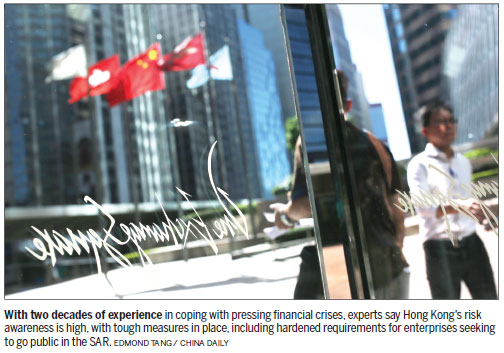
After two decades of relentless efforts by the authorities, the SAR now boasts high standards in financial safety to help the city live up to its reputation as a global financial center. The new HKSAR Government has also vowed to build up an improved and resilient risk-coping mechanism, while pledging to leave ample room for financial technology (fintech) to grow.
Chief Executive Carrie Lam Cheng Yuet-ngor said in her election manifesto the government will play a more active role in strengthening financial security to reinforce Hong Kong's position as an international financial hub by enhancing "day-to-day communication among regulatory departments" so that they can update their emergency plans to handle serious financial incidents, and share analyses and risk migration measures on how to keep the financial systems safe.
Hong Kong's financial supervision system is principally in the hands of four gatekeepers - the Hong Kong Monetary Authority (HKMA), the Securities and Futures Commission (SFC), the Insurance Authority which officially began operating in June this year, taking over the duties of the Office of the Commissioner of Insurance (OCI), and the Mandatory Provident Fund Schemes Authority (MPFA). They operate independently of the government, overseeing the banking, securities and futures industries, insurance, and the Mandatory Provident Fund (MPF), respectively.
Terence Chong Tai-leung, executive director at the Institute of Global Economics and Finance of the Chinese University of Hong Kong, commends Hong Kong's financial safety standards, but stresses there have been side effects arising from stringent supervision.
"Hong Kong has gone through two financial crises, so our regulators have a high level of risk awareness. I don't see big risks currently for Hong Kong's financial system. Carrie Lam's talk is a message to the central government that no one with bad intentions could undermine national financial security through Hong Kong, as our financial markets are tightly linked to those of the mainland," he said.
Any potential risks he could think of at the moment could come from property developers' enticing mortgage loans with high loan-to-value ratios, as well as the increased mainland exposure of Hong Kong banks. "But, they're all manageable."
Norman Chan Tak-lam, chief executive of the HKMA - the city's de facto central bank - has said he's constantly keeping an eye on potential risks, pointing to the city's overheated housing market. The HKMA, he noted, had introduced countercyclical measures to reduce the risks facing banks, and is closely watching the local banking sector's mainland-related loans, which have grown rapidly in recent years.
Chan stressed that Hong Kong's banking system remains robust and has rebounded well from the crises. "Our banks have a robust capital adequacy ratio and great liquidity, so we have a higher anti-risk capacity than before."
The SFC, on its part, has been working with the Hong Kong Stock Exchange on listing reforms, having raised the thresholds for flotations, while the OCI has hardened requirements for insurance companies, such as increasing the minimum number of independent non-executive directors and raising remuneration requirements for companies wishing to go public. All these measures are aimed at ensuring the stability of the insurance business and protecting policyholders.
Chong said tighter rules can shield the market from risks, but warned that black swans, or unexpected consequences, could crop up, saying that strict management of financial markets may inhibit growth of the fintech industry. "So, we've seen Hong Kong's adoption of mobile-payment services lagging behind that of other markets in Asia, especially the Chinese mainland."
Fortunately, the government understands that adequate space needs to be given to the fintech sector to develop, with the goal of catching up with the rest of the world and consolidating Hong Kong's status as an international financial pivot.
Carrie Lam has also promised that the government will encourage financial enterprises to keep abreast of the times and participate in financial innovation by adopting a "launch-and-try-first" regulatory approach. Innovative means will also be used to guard against financial risks so as to provide safe and quality services to users of financial services.
According to a joint survey by accounting firm KPMG and the Hong Kong Institute of Chartered Secretaries, cybersecurity is among the top five risks confronting Hong Kong-listed companies this year.
The fintech industry has to be on constant alert in the wake of the recent "WannaCry" assault on computer networks, wreaking havoc on a global scale, with the computer systems of organizations in at least 150 countries coming under attack.
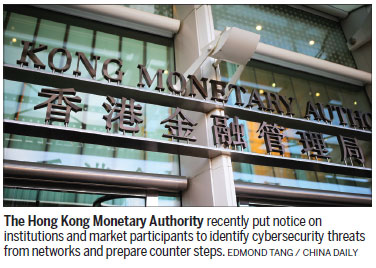
The HKMA, SFC and OCI recently put notice on institutions and market participants to identify cybersecurity threats from networks, emails and relevant devices, saying they should have mitigation measures in place to prepare for possible cybersecurity threats.
Although some people are worried that Hong Kong is losing its competitive edge to Singapore as a world financial hub, Norman Chan is confident that the SAR's status is undiminished for its unique geographical advantages, such as cashing in on the Chinese mainland's expeditious economic growth, notably the opportunities deriving from the yuan's internationalization and the China-led Belt and Road Initiative.
"Hong Kong has been part of the global financial markets for so many years," he said. "With such an advantage, as long as we aren't complacent and keep working on our soft skills, there's still a bright future ahead of us."
cherrylin@chinadailyhk.com
(HK Edition 07/28/2017 page12)