Xie: China working hard to mitigate climate change
Updated: 2017-10-04 07:50
By Honey Tsang in Hong Kong(HK Edition)
|
|||||||


China will boost efforts to develop a low-carbon economy to deal with climate change and promote its green vision for the Belt and Road Initiative, said Xie Zhenhua, this year's Lui Che Woo Prize winner.
Xie, China's special representative on climate change, said the country will also strive to achieve international consensus on sustainable development. He made these comments during an exclusive interview with China Daily in Hong Kong.
The Lui Che Woo Prize honors Xie's contributions to helping to conclude the Paris Agreement in 2015, a global treaty signed by 195 countries to stop global warming.
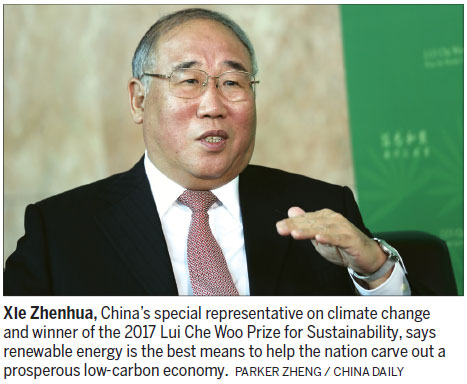
He said that the Chinese government, leading the biggest developing country in the world, had accepted a great environmental responsibility - to reduce carbon dioxide emissions.
"Meanwhile, it will also strike a balance to foster economic growth which is as green as possible," explained Xie prior to the award ceremony.
"Renewable energy so far is the best way to help the nation create a prosperous low-carbon economy. It's the biggest trend in the world's energy sector," he added.
Xie said he wants to further encourage technological exchanges on advanced renewable energy between countries and regions along the Belt and Road routes. This is in order to meet rising global demand for energy.
Over the past years, China has been the world's leader in domestic investment in renewables. In 2015, the Chinese mainland accounted for 40 percent of global renewable power growth, according to the International Energy Agency, an autonomous intergovernmental organization designated to promote clean energy. The strongest growth has been seen in wind and solar energy, according to the IEA's report.
In 2015, two wind turbines were installed every hour. Impressive new solar power operations were installed in 2016; the Chinese mainland now has about half of the world's total new solar power capacity.
As for now, the non-fossil fuels, including hydro, wind, solar and biomass energy, will reach 13.3 percent of the mainland's total energy consumption, according to the report. It is intended to rise to 15 percent by 2020 and 20 percent by 2030.
This is in line with the promises set out in the Paris Agreement. Xie said the central government had been working hard to increase its potential to find substitutes for fossil fuels.
The rampant process of burning of fossil fuel to create energy has released large amounts of carbon dioxide into the atmosphere, which traps the solar energy and aggravates global warming. Over the past century, China recorded an average increase of temperature of around 0.9 to 1.5 C, as shown by the official report.
The adverse impact caused by higher temperatures, such as a greater prevalence of droughts and floods, has been noticeable in the nation. This led to deterioration in soil for growing crops and resulted in a downturn in agriculture industry. It was one of the factors leading to total economic losses of 233.3 billion yuan ($35.12 billion) due to climate change from 1991 to 2014.
"We're expect to turn the hazards into opportunities, by banking on renewables to develop a robust, sustainable and environmentally friendly economy," said Xie.
Once the sector evolves, the cost of renewables will be more modest and available. This would benefit the environment, economy and public health, he added.
China's achievements
China's accomplishments in tackling climate change have been significant and are now internationally recognized. Between 1990 and 2010, the country accounted for 58 percent of all the energy saved worldwide, figures from the World Bank revealed.
Even with these successes in mitigating climate change, Xie is determined to deliver more. He said that the Chinese government - as agreed within the Paris Agreement's framework - is stepping up moves to reduce CO2 emissions.
He expects the mainland to lower carbon dioxide intensity (carbon dioxide emissions per unit of GDP) by 60-65 percent relative to 2005's levels.
The United States, the world's second-largest emitter of greenhouse gases, announced it was withdrawing from the Paris Agreement this year.
Despite this, Xie said that China still has an unwavering commitment to reduce global CO2 emissions.
The Lui Che Woo Prize winner believes organizations and industries in the US will still take the initiative themselves to reduce CO2 emissions.
Impressive record
Xie has an impressive record in helping to bring together 195 countries, including developing and developed ones, to work toward a greener world. He was involved in negotiations leading to the signing of the Paris Agreement.
Xie has great faith that China can deliver its promises by 2030.
"The Lui Che Woo Prize 2017 is a sign of international recognition given not only to me, but also to the central government for its endeavors to preserve the environment," Xie noted.
He said developed nations with mature renewable energy-producing technology could share their experiences and skills with other countries. This would boost cooperation and further help develop a greener world.
honeytsang@chinadailyhk.com
(HK Edition 10/04/2017 page5)