-
News >Bizchina

Official: Currency reform 'our own affair'
2010-06-28 06:03TORONTO - China will not bow to pressure from the outside world on revaluing the renminbi and any changes in the nation's foreign exchange will be made on China's own terms, Chinese officials heading to the G20 summit in Toronto said at a press briefing.
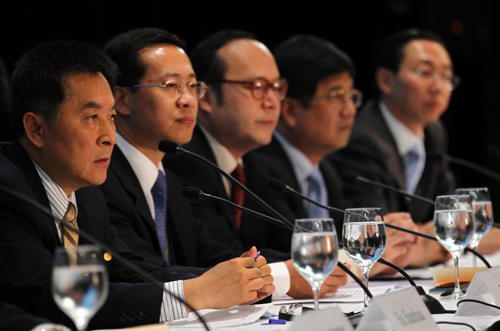
Ma Xin (left), director-general of the department of international cooperation of the National Development and Reform Commission, fields questions at a press conference on Saturday in Toronto on China's foreign exchange reform and currency appreciation. [Xinhua]
The remarks come on the heels of US senators sending proposals to the Obama administration last Thursday calling for fresh pressure on China to allow more flexibility of its currency and a large-scale appreciation, despite the Chinese government's announcement on its foreign exchange reform last weekend.
"Any changes in the foreign exchange will be decided by China's needs for supporting domestic economic development, rather than foreign pressure. Now the country's key goal is to transform the economic growth model, which will impact how the foreign exchange reform goes," said Ma Xin, director-general of the department of international cooperation of the National Development and Reform Commission, China's top economic planner.The Chinese government recently announced that it will enhance the flexibility of renminbi exchange rate, which ended a fixed peg to the US dollar since July 2008. But this has not reduced the pressure from some countries, led by the US, which are now considering demanding that China takes an even bigger step in currency flexibility.
Otherwise, the US Senators said they will urge the Obama Administration to punish China and its exporters by imposing countervailing duties, because China has been "subsidizing its exporters unfairly by undervaluing its currency".
Some said the US and others will even pressure China to agree to implement big steps at the G20 summit.
However, China denied such pressure. "China's move has been welcomed by the world and we have not felt any difference in the pressure on the currency issue from the group of G20 nations," said Zhang Tao, director general of the international department of the People's Bank of China.
"I don't think we will make any changes on the pace, depth and scope of the renminbi exchange rate reform," he added.
Last week, the yuan gained 0.53 percent, the most since December 2008 after China had set the yuan at 6.83 to the US dollar in July 2008.
Nomura Securities International said it expected a moderate pace of appreciation of the yuan in the remainder of 2010 and during 2011.
Nobel laureate Paul Krugman said China's move was an "exercise in bad faith" aimed at fending off international pressure at the G20 summit. He also said he believed China is still undervaluing the yuan to make its exports "artificially cheap" and to keep imports expensive.
Economists at home and abroad said they believed currency revaluation is not the key to global trade imbalances. Appreciation by large margins, or even one-off appreciation, is harmful to Chinese economic growth, some said.
"There is no need for foreign nations to add pressure on China, as appropriate appreciation is not the last resort for solving trade imbalances," said Zuo Chuanchang, professor from the Academy of Macroeconomic Research of the National Development and Reform Commission.
Nobel Prize Laureate Robert A. Mundell, also known as the Father of the Euro, told China Daily on the sidelines of a forum in Beijing: "I don't think it's a good time for China to have a large appreciation," he said, adding that it would not affect China's economy if the yuan is not allowed to appreciate very much, though too much appreciation would hurt the country's economy.
Welcoming move
On Sunday, the group of 20 nations released the draft of a communiqu, which welcomed China's initiatives to further proceed with its foreign exchange reform, to allow its currency to become more flexible and to boost domestic demand.
"The foreign exchange reform could help control inflation and avoid asset bubbles," said Zhang at the press briefing.
But sources said some G20 nations argued that China should go a step further in the reform and some also said China opposed the idea of any mention of its currency at the G20.
"China is sensitive to outside pressure and resists that, but I don't think it needs to," said Alan Alexandroff, co-director of the G20 Research Group at the University of Tonronto.
"More flexibility is in the interest of Chinese people. It is important, because it adds to value and ensures more powerful domestic consumption."