-
News >Bizchina

Guangzhou set to rise from its rubble
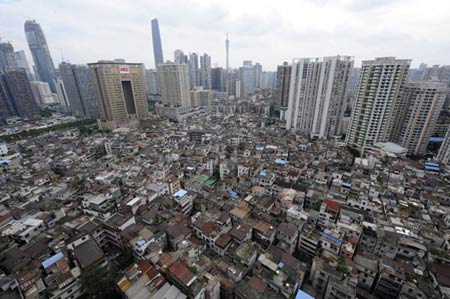
2010-08-14 08:36GUANGZHOU - As part of an ambitious renewal project, this southern metropolis plans to create as much as 539 sq km of building land during the next decade out of the demolition of much of its old downtown, its urban villages and aging factories, a local official said on Friday.
Chen Jianhua, vice-director of the city's office of reconstruction of old buildings, told a news conference that the plan is aimed at making way for new development and improving the living environment of residents in the capital city of South China's Guangdong province.
"It is also about helping to boost the local economy by creating more land for new buildings and improving the efficiency of land allocation in urban areas," Chen said.
"As one of the key cities in South China, Guangzhou has seen a severe shortage of land for buildings."
"If the city keeps the same annual growth, the land originally designed for use up to 2020 will be used up within the next three years," Chen said.
Under the project, all buildings in the city's old urban core will be reconstructed within the next three to five years and some 138 urban villages will be demolished to make way for new developments during the next decade. Meanwhile, some 200 old factory buildings will also be dismantled.
In total, the local authorities plan to demolish more than 10 percent of the old town's built-up areas and relocate up to 600,000 people.
Guangzhou is not the only big city to go through such an upheaval. Metropolises including Beijing and Shanghai have also started to demolish old houses to make way for new residential and commercial use.
More than half of the country's existing residential buildings will be demolished and rebuilt during the next two decades, according to a senior researcher from the Ministry of Housing and Urban-Rural Development.
Chen Huai, director of the policy research center with the ministry, said recently that the majority of homes built before 1999 will be razed to make way for new housing because the old buildings have largely either long passed their designed lifespan or are not able to meet safety standards.
He said about 40 percent of building land in China is created each year by the demolition of old developments.
However, Shan Jixiang, head of the State Administration of Cultural Heritage, said during a recent online speech that the reconstruction of old cities nationwide threatens the protection of historical cultural relics and claimed many cities are heading in the wrong direction by demolishing architectural gems.
In Beijing alone, for instance, some 4.43 million square meters of traditional courtyards have been demolished since 1990, accounting for about 40 percent of the capital's old downtown area.
Chen Jianhua, however, said the Guangzhou authorities will attach great importance to the protection of traditional architecture and heritage sites.
"We have gone in the wrong direction before in terms of failing to protect traditional buildings during the reconstruction of old urban areas. But this time, the protection of such buildings will be given priority," Chen said.
Guangzhou, which has a history dating back more than 2,000 years, has long been famous for its typical Lingnan-styled architecture that includes Qilou, or arcade buildings, in its old urban areas.
"Those typical Lingnan-styled buildings and heritage sites like temples will not be demolished. Instead, we will undertake renovations to present them as they originally looked," Chen told China Daily.
Chen said the Yuxugong Temple in Guangzhou's Yangji village, for example, will be protected. He said demolition crews have been dismantling houses in the neighborhood since June, but in addition to the preservation of the temple, an ancestral hall for the families of Yao, Li, Qin and Liang will be built next to the temple to respect the original folk custom of the village.
In addition to concerns about the protection of traditional architecture, many locals are also worrying about whether the redevelopment of the city will lead to another round of price hikes.
"We have been given a generous amount of compensation from the government and the property developers for the demolition of our homes," said a resident surnamed Gao, who has lived in the Yangji village for 40 years. "But we are afraid that we might not be able to afford to buy new houses built on the site of our old home.
"The government and the property developers could push up the price of the new projects to offset the high cost of the demolition and reconstruction."


