-
News >Bizchina

Bumpy road ahead for car sales
2011-01-14 09:33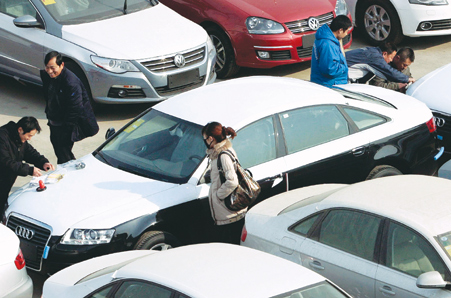
Potential car buyers check out an Audi model at a car market in Nanjing, capital of Jiangsu province, on Jan 11.?[Photo /?China Daily]
Automakers shift gear to focus efforts on smaller cities after capital applies the brakes. Li Fangfang in Beijing reports.
Car salesman Liu Jun enjoyed the best time of his career in December. After shifting 19 cars in the first 23 days, he was already looking ahead to lavishing his family with expensive gifts at Spring Festival.
Less than one month later, the 25-year-old is fighting to keep his job.
Since Christmas Eve, the day after Beijing announced strict measures to limit the number of new cars in the capital, Liu has not received even one prospective buyer, let alone signed any contracts.
His showroom in Beijing's Chaoyang district, which sells China-made Chery models, could "encounter its first single-digit monthly sales before Chinese New Year", said the salesman, who started in the industry four years ago.
"We've heard the store will lay off 60 to 70 percent of its sales staff after the holiday," added Liu.
To ease the gridlock, city authorities will now issue just 20,000 new vehicle license plates a month, meaning annual sales will plunge from 891,000 units in 2010 to 240,000 units in 2011.
The unexpected curb on China's largest vehicle market is a major bump in the road for automakers, especially as some 20 other cities with chronic congestion are watching on with keen interest. However, industry experts predict the big players will likely adapt by focusing more on smaller cities further inland.
"The best and most efficient way for automakers to offset the declined sales in Beijing and maybe other first-tier cities in the near future is to rapidly shift their dealer network expansion inland," said Zhong Shi, an independent analyst in Beijing.
By the end of last September, China's total vehicle capacity was 70 million units, lower than the 75 million in Japan and 285 million in the United States, according to the Ministry of Public Security statistics.
However, most of the country's vehicles run on roads in large cities and coastal areas, as 300 second- and third-tier cities of 2 million people or less still have low car capacity.
"There is still huge potential for car consumption in China's small cities, as well as rural markets," added Zhong.
Geared for change
Data provided by the State Information Center shows that when it comes to car ownership in metropolises like Beijing and Shanghai, the average is about 200 vehicles for every 1,000 people. In most second- and third-tier cities, that number drops to 100, while for 20 of the country's 34 provinces and autonomous regions, the average is no more than 30 automobiles for every 1,000 people.
In eastern Shandong province, for example, the two largest vehicle markets - Jinan, the capital, and Qingdao - reported sales growth of 58 percent in 2009, while smaller cities like Weifang saw a sales surge by 91 percent year-on-year.
"China's fast-growing urbanization also indicates that, in the near future, second- and third-tier cities will be the major power driving auto sales," said Xu Changming at the State Information Center.
Jia Xinguang, another independent Beijing analyst, added that he is pleased that automakers "dig the potential" of fourth- or fifth-tier cities.
US automaker Ford's joint venture, Chang'an Ford, opened 40 4S stores (sales, service, spare parts and survey) on Nov 25, mainly in small cities in northern and western regions.
"Small, developing cities are our major target for the near future," said He Junjie, general manager of sales for Chang'an Ford.
Mercedes-Benz, the German luxury brand, has also been expanding into fourth- and fifth-tier cities since 2009, when it opened its first county-level 4S store in Cixi, Zhejiang province. The Cixi showroom sells more than 1,500 units a year and is listed as a best-seller, said a spokesman.
"Zhejiang is the champion of China's luxury car sales, yet its capital, Hangzhou, contributes only 20 percent of total sales, with the rest coming from second- and third-tier cities," said Cheng Zhengzhong, general manager of car dealers in Zhejiang Baolide Group.
Last November, Klaus Maier, president and chief executive of Mercedes-Benz China, paid a visit to the company's second county-level dealership in Zhuji, Zhejiang, to highlight his focus on small city markets. He said he was pleasantly surprised by the branch's ability to sell more than 100 luxury cars since its launch in late July.
Maier told China Daily that Mercedes-Benz will continue to add 25 to 30 4S stores annually in the coming years, with most in low-tier cities.
As Beijing's traffic control policy will greatly increase the purchase and usage costs of a car, industry experts predict the move will spell the end for homegrown automakers, which currently dominate the nation's low-end market.
"It will be the biggest impact ever suffered by domestic auto brands," said Su Hui, an analyst with the China Automobile Dealers' Association, who suggested they "focus more than 90 percent of their efforts outside first-tier cities, and further establish dealer networks in third- and fourth-tier cities".
Chinese companies should also further improve the quality of their products, as consumers in the third- and fourth-tier cities always want reliable, high-quality cars at low prices, he added.
Fellow analyst Zhong recommended both foreign and domestic automakers boost service quality to strengthen their competitiveness as the market matures.
Market potential
Automakers have struggled for years to keep up with soaring demand in China. Since the country joined the World Trade Organization in 2001, automobile sales have grown at an average rate of more than 20 percent year-on-year.
Fueled by the central government's stimulus measures, including tax reductions for small cars with engine capacities of 1.6 liters or less and subsidies to encourage farmers to trade in old, oil-guzzling vehicles, sales in 2009 surged 46 percent from the previous year to 13.6 million units during the global financial crisis.
That year, for the first time, China overtook the US as the world's largest automobile market.
The number of cars and light trucks sold in China was just one-tenth of that in the US in 2000. Yet, in 2010 domestic auto sales jumped 32.37 percent to 18.06 million units, the highest annual sales in the global automotive history, according to the China Association of Automobile Manufacturers.
The figure far outstripped the expected 11.5 million units of sales in the US, although arguably more impressive is the fact that, within two years, China nearly doubled total auto sales from 9.38 million.
However, the unexpected growth rate has caused problems for Chinese consumers, however.
"I never imagined buying a car was so difficult," said Yang Jing, 31, an events manager in Beijing. "I was told by different brands to wait several months to get a car or pay a lot of extra money to shorten the wait."
Consumers' enthusiasm for cars led to almost all automakers expanding production capacity, with some building brand new plants.
Analyst Jia Xinguang urged automakers to beware "risky expansions" this year, as he predicts the market will shrink after recent national and local policy changes.
Race for sales
To cool the fast-growing auto market, the Ministry of Finance last year announced that, from Jan 1, the central government would end its two-year tax incentives for small cars and subsidies to farmers.
"The policies have made us lower our expectations for this year's auto market from 10 to 15 percent year-on-year growth to no more than 8 percent," said Cui Dongshu, deputy secretary-general of the National Passenger Car Information Exchange Association. "The serious excessive consumption in 2010 may even lead to zero or negative growth this year."
The association's secretary-general, Rao Da, also said he believes China is facing negative growth for the first time in two decades, although "short-term negative growth is good for the industry restructure and mergers, which the government is calling for"."The fierce competition will help improve the quality and technology, as well as the management and operation of the automakers," said Rao. "It should be a good opportunity for China to strengthen its industry."
Looking long term, analysts agree the country is still the automobile market with the most potential.
Official statistics show that average ownership nationwide is 52 units for every 1,000 people, no more than half of the world average of 128 units. With this in mind, experts expect the market to grow 10 to 15 percent annually in the next five to 10 years.
For Beijing dealerships, however, the news offers little comfort ahead of the coming Lunar New Year holidays.
"We all expected to get an extra bonus for the high profits our 4S store made last year," said a salesman called Ma at a showroom selling Volkswagen models. "Forget about the bonus, now we're hoping we can hold down our jobs."