-
News >Bizchina

Foreign capital drives growth
2011-01-27 15:07
The debate on how foreign capital and companies should be treated in China is not new. It started with the reform and opening-up process in the late 1970s, and got fiercer in the 1980s and 1990s.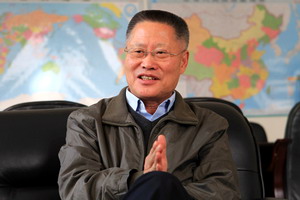
Wang Zhile, a research scholar with the Chinese Academy of International Trade and Economic Cooperation.
The debate, however, does not perturb Wang Zhile, a research scholar with the Chinese Academy of International Trade and Economic Cooperation. He says all foreign companies operating in China are Chinese companies, because their products are made and innovated in China for the benefit of the country as well as the rest of the world.
Today, the debate is centered mainly on four disputes, Wang says. The first, whether China should continue introducing foreign capital, was first raised in 2005. Foreign capital has been playing an important role in China's economic development for the past three decades.
But some experts argue that an economy should invite foreign capital only when it does not have enough foreign exchange or investment funds. They say that China does not need foreign capital for now, because it has foreign exchange reserves of $2.64 trillion, the largest in the world, and enough investment capital.
Wang disagrees with them. He says introducing foreign capital is not a simple process of just capital flow into China. For a developing country like China, which is transforming from planned to market economy, foreign capital can also mean advanced mechanisms that can expedite the transformation.
For instance, had the reform and opening-up not made it possible for foreign companies to operate in China, there would have been no modern corporate management for Chinese companies to emulate and/or improve on to drive the country's modernization.
China still needs the motivation to change its development pattern to move toward a greener economy and multinationals can act like a catalyst for the country to complete the transition.
The second dispute is over whether international mergers and acquisitions (M&As) involving Chinese companies could threaten China's economic security. This dispute dates back to the 1960s, when relations between China and the erstwhile Soviet Union soured, creating great problems for the Chinese economy. Some people still use the developments in the 1960s to express fear over international M&As.
What they do not realize is that the end of the Cold War made peace and development the two key words for the world. This, in turn, has made Chinese and multinational (or global) companies the representatives of globalization and advanced productive forces.
The transnationality index, a means used by economists and politicians to evaluate multinationals, in most industries increased from 40 to 60 in the past decade. It shows that almost two-thirds of multinationals' assets, sales and employees are outside their country of origin. Multinationals or global companies can help take China's economy closer to the world economy. Hence, the concern over China's economic security is not justified in the new era, Wang says.
The third dispute is over independent innovation. Many foreign businesses have reportedly complained that the government does not treat them and Chinese companies as equals and that it does not regard foreign companies' innovations in China as independent innovations.
The government, however, has reiterated that it treats foreign and domestic companies as equals. The Ministry of Science and Technology has clarified that foreign companies' products are "independent innovations", and Premier Wen Jiabao has emphasized that all companies registered in China would be treated as Chinese companies. Premier Wen said that just like their products carry "made-in-China" tags, their innovations will be considered to have been "created in China", and all foreign companies registered in China will get equal national treatment.
Globalization combines intelligence from across the world, Wang says. China has already made huge progress by entering the global industrial chain. The Chinese government should now focus on upgrading its industries and make efforts to climb up the industrial chain, which can be done through more innovations.
But there is no real need to define a multinational according to the place of its registration, because a multinational by definition cannot belong to any one nation.
Take Nokia for instance. People and corporations outside Finland, considered its country of origin, hold more than 80 percent of its shares. Nokia may have started in Finland, but it has used global sources and resources to spread its business across almost every corner of the world to earn its profit and reputation.
The same applies to many other listed companies, which are attracting increasing amounts of capital out of the mainland. For example, 25 percent of China Mobile shares have been issued by the Hong Kong Stock Exchange.
Recent M&A conflicts and failures should not force an economy to resort to trade protectionism. Multinationals and international M&As will benefit China's economy and help build a peaceful environment for the country's economic development. China's total exports last year hit $1.58 trillion, and a big percentage of that were products made by multinationals.
Introducing foreign capital and encouraging Chinese companies to venture aboard both are important for China's economic development. Multinationals are engines of economic growth and can help China build the right environment for its peaceful rise.


