-
News >Bizchina

Taking inflation by the horns
2011-06-16 13:23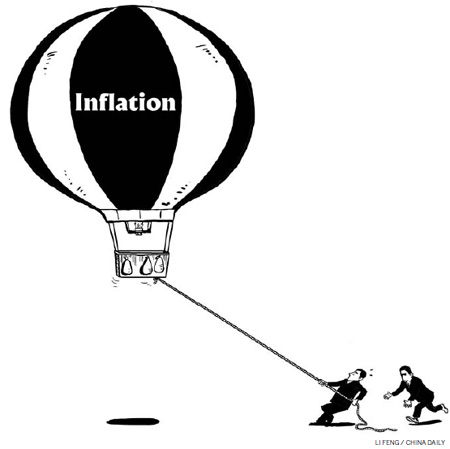
Curbing soaring prices has become a priority for China. In May the consumer price index (CPI), a measure of inflation, reached 5.5 percent year-on-year, a 34-month high, according to the National Bureau of Statistics.
Inflation is the result of the government's loose monetary policy since late 2009 which allowed extra money to flow into the economy, says Liu Lingling, professor of economics at Tsinghua University. The broad currency supply, or M2, in China reached 76.34 trillion yuan ($11.78 trillion) in May.
Since it is impossible to take back the extra money by tightening the monetary policy, it is important to analyze the types of inflation China faces and pay more attention to the fiscal policy, Liu says.
Two types of inflation have pushed the CPI to a historic high, namely, imported inflation and cost-push inflation.
The second round of quantitative easing (QE2) in the United States, the deprecation of the US dollar and the debt crisis in the eurozone, have increased bulk commodity prices in international markets and, by default, raised the cost of China's imports. They have prompted more international hot money to flow into China, too. But despite being highlighted by the Chinese media, imported inflation is not a significant factor.
The cost-push inflation - inflation caused by substantial increases in the cost of necessary goods or services for which no suitable alternative is available - is more dominant, she says.
Three factors have paved the way for China's rapid economic growth with relatively low inflation over the past three decades: comparatively cheap labor, government-controlled prices of natural resources including gas, water and electricity, and the ignored environmental cost. They contributed to the relatively low cost of production.
But all the three costs are rising now.
The Chinese economy faces a shrinking migrant workforce because of demographic changes. The shortage of migrant workers in recent years is there for all to see.
Authorities control the prices of important natural resources, too, a practice that has survived since the planned economy days. The problems that the distorted prices created lay dormant and have surfaced today.
The large-scale power shortage this summer is not because of power plants' insufficient capacity to generate electricity, but because they are unwilling to generate more and suffer deficit. The thorough overhaul of the electricity pricing mechanism that many scholars have called for shows how urgent reforming prices of natural resources is. Liu says an increase in prices of natural resources in the coming years is inevitable.
To achieve higher GDP growth, many local governments turned a blind eye to polluting enterprises over the past three decades. But official figures show that in 2004 alone the economic loss caused by environment pollution was 511.8 billion yuan, or 3 percent of GDP that year.
Premier Wen Jiabao has said that China needs to introduce a tax for environmental protection during the 12th Five Year Plan (2011-2015), which will raise costs of many goods and services further.
The inflationary pressure will be a long-term affair, Liu says, because none of the three factors mentioned above can be solved in the short term. Behind the cost-push inflation is the country's imbalanced economic structure. Until now, China's economy has relied on government-led investment and export-oriented manufacturing, powered by cheap labor and cheap natural resources, and overlooked the impact of environmental pollution.
Therefore, Chinese enterprises need to upgrade their production mode with technological innovation, and the government has to stimulate domestic consumption by building a truly integral market.
As a professor researching financial policies, Liu says that apart from monetary policies, fiscal tools can also help transform China's economic model and help the real economy develop healthily.
Huge amounts of currency, as part of the government's $586-billion stimulus package, cannot be used in the real economy through efficient channels. In fact, they have created asset bubbles like the one seen in the property market. Banks' reluctance to lend money to many small- and middle-sized enterprises (SMEs) has inflated the asset bubbles further, because many big enterprises with over-production often pour the loans they easily get from the banks into the realty sector to make easy money.
Liu says the financial policy can play a more important role in curbing inflation by reducing tax to encourage innovation and creation of new industries, and by supporting SMEs with more funds.She suggests establishing an exchequer transfer payment system and a budget coordination system to narrow the income gap in society, balance the expenses of various levels of governments and reduce the revenue gap among different local governments. This in turn would balance industrial distribution among different areas and help the relatively poorer countryside to have larger budgets for development, and increase investment in social security, healthcare, as well as encourage people to consume more instead of saving.
By adopting efficient policies, the CPI can be kept within 4 to 5 percent this year, Liu says.