-
News >Bizchina

Debate: Luxury goods
2011-07-11 13:45Should the tax on luxury products be reduced? Three experts were asked about their views, and they came up with three different answers. Read on ...
Liu Shangxi
Do not cut tax on luxury goods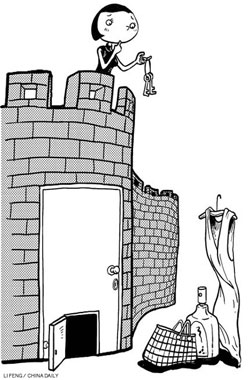
Many people are debating whether the government should reduce the tax on luxury products. The answer is "no", because luxury goods are not necessities. Since consumers of luxury products are generally rich, high taxes will make them part with some of their money, no matter how small that fraction is, and help narrow the wealth gap in the country.
The consumption of luxury goods is already high in China. According to the latest report of the World Luxury Association, China's luxury goods market was worth $10.7 billion in 2010, or one-fourth of the world's total. Moreover, China is likely to surpass Japan as the largest luxury goods-consuming country in 2012.
Many luxury brands have intensified their marketing campaigns in China, opening new outlets and even expanding their sales networks in second- and third-tier cities. Compared to China's national GDP, which is less than 10 percent of the total global GDP, its 25 percent share in the global luxury market is irrational.
Even without any tax cut, the sales of luxury goods are expected to increase in China. A reduction in tax on luxury goods will only prompt the existing consumers to buy more and/or attract new ones into the market, increasing the already high consumption further. Though many feel a cut in tax will reduce the sales of luxury products, the notion is contrary to the reality in China.
There are different definitions of luxury goods. But the most significant characteristic of a luxury product is its high price, which consumers tend to think adds to their social status. In other words, consumers draw satisfaction from the price and show-off factor of expensive products. By nature, luxury products are targeted at a small section of society. That's why only the high-income groups rush to buy them.
Many Chinese travelers have started buying such products overseas. The government levies taxes on all luxury goods irrespective of whether they are made in China or foreign countries, which reflects the country's unified and fair taxation system. Taxes are levied on imported luxury goods during the import process and on domestic ones at the production and retail stages.
According to taxation and Customs laws, Chinese tourists who buy goods worth more than 5,000 yuan ($773) overseas have to declare them and pay value-added and consumption taxes on re-entering the country, which brings the prices of luxury products in overseas and domestic markets on par. But since many travelers do not declare them to Customs, they end up paying less than the actual price.
Besides, there is no reason to assume that a reduction in tax on luxury products will boost overall domestic consumption, because most of them are made by overseas companies and, by definition, are imported goods. On the contrary, if we encourage the consumption of such goods, it will harm the competitiveness of domestic enterprises, leading to serious consequences for the Chinese economy.
Although many luxury products are made in China, the domestic enterprises making or assembling them receive a tiny amount as "processing" fee, which is just a fraction of the profit that the brand-owning company makes.
Take the iPhone for example, which costs $499. The company in China that actually makes them, or the original equipment manufacturer, gets only a few dollars for every product.
Therefore, the government cannot expect to boost the domestic market by encouraging the sale of luxury products in China to increase.
The author is vice-director of the Research Institute for Fiscal Science, affiliated to the Ministry of Finance. The article first appeared in the People's Daily.