-
News >World

South Korea rocket crashes in second straight failure
2010-06-11 07:04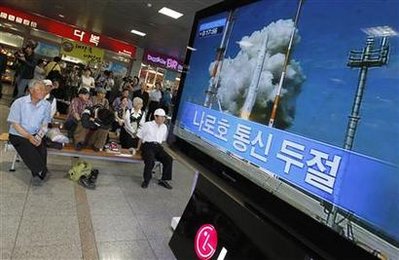
People watch television news broadcasting the launch of the Korea Space Launch Vehicle-1 (KSLV-1), or Naro-1, at the Seoul railway station June 10, 2010. [Agencies]
SEOUL- A South Korean space rocket carrying a scientific satellite exploded two minutes into its flight in the second failure in two tries to put a payload in orbit, dealing a major setback to the country's space program.
The launch had been delayed for a day due to technical glitches. Hopes were running high for its success after the country's first attempt to put a satellite into orbit failed last year due to problems in stage-separation mechanism.At 137 seconds into the flight, mission control lost contact with the rocket as it would have reached the altitude of 70 km (43.5 miles), Science Minister Ahn Byong-man said.
"Looking from the bright flash seen on the camera mounted on the tip of the rocket, it appears the Naro exploded in flight during the first-stage ignition," Ahn told a briefing.
The rocket lifted off successfully on its maiden launch in August 2009 but failed to put a scientific satellite into orbit because of problems in stage-separation systems.
South Korea's launch last year riled neighbor the Democratic People's Republic of Korea(DPRK).
Pyongyang said it was unjust for it to be hit with UN sanctions for firing off a long-range rocket in April 2009, but regional powers saw the launch as a disguised test of a ballistic missile that violated UN measures.
Apart from DPRK, few doubt the South's rocket was for anything but its civilian space program, although experts said it did raise questions about regional security because it could also enhance Seoul's ability to build ballistic missiles.
The Naro-1, also called the Korea Space Launch Vehicle-1, was 33 meters (108 ft) long. The two-stage rocket was built at a cost of 502.5 billion won ($450.7 million).
Russia's Khrunichev space production center built the first-stage booster, conducted tests and provided technical assistance. South Korea has produced several satellites and relied on countries including Russia to put them into orbit.
South Korea wants to build a rocket on its own by 2018 and send a probe to monitor the moon by 2025. It also wants to develop a commercial service to launch satellites.
Budget and legal constraints will weigh on South Korea even as it tries to move forward with the program, space experts have said.