-
News >World

Nuke crisis raises many questions, no easy answers
2011-03-14 14:46The nuclear crisis in Japan has developed rapidly on many fronts, making it difficult to track the threads. What are the dangers? Will the situation improve? Can the reactors be cooled?
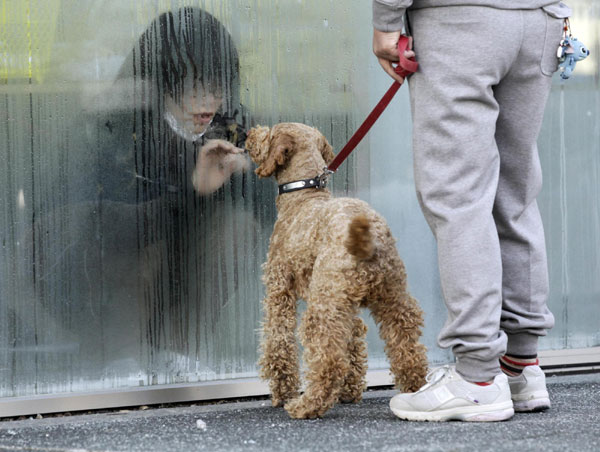
A girl who has been isolated at a makeshift facility to screen, cleanse and isolate people with high radiation levels, looks at her dog through a window in Nihonmatsu, northern Japan, March 14, 2011, after a massive earthquake and tsunami that are feared to have killed more than 10,000 people. [Photo/Agencies]
The crisis began Friday when a magnitude-9.0 earthquake and tsunami cut off regular electricity to the oldest unit at the Fukushima Dai-ichi nuclear complex, 170 miles (270 kilometers) northeast of Tokyo.Since then more reactors - at more nuclear sites - have lost at least some cooling ability, increasing concerns about possible meltdowns.
Some questions and answers about the crisis in Japan:
Q: What is the status of nuclear reactors as of Monday?
A: There are nine units under states of emergency - three at Fukushima Dai-ichi, three at Fukushima Daini and three at Onagawa. All are north-northeast of Tokyo, along the eastern coast, and all are boiling water reactors.
The other three reactors at Fukushima Dai-ichi, operated by Tokyo Electric Power Co, were shut before the earthquake. A fourth reactor at Tokyo Electric's Daini site appears fine. There are only three units at the Onagawa facility, owned by Tohoku Electric Power Co. Most concern has been directed at Dai-ichi units 1 and 3.
Q: What are the worries?
A: At Unit 1, which began operating in 1971, workers are trying to prevent a meltdown, complicated by the fact that a need to release a pressure buildup in the reactor vessel led to a hydrogen explosion that blew off the roof and walls of the containment building. Officials say the reactor vessel is intact, but worry about the overheated uranium fuel. In a desperate move, officials have piped large amounts of seawater into the reactor vessel to try cooling the severely overheated uranium core.
On Monday, a hydrogen explosion also hit Unit 3. It was not immediately clear how much, if any, radiation was released. Officials were using seawater to cool the unit, where they believe there has been a partial meltdown.
Q: What is the significance of using seawater?
A: With so many equipment failures, plant operators face challenges using mobile generators powered by batteries. They also need a dependable high-volume water source. The Pacific Ocean solves the supply problem. But using it assures that these very expensive reactors will never be used again to generate power. The salty sea water, accompanied by a boron mix, is very corrosive.
Q: What is the situation at the nearby Fukushima Daini facility?
A: Japanese officials say units 1, 2 and 4 retained offsite power after the earthquake and tsunami, but were experiencing increased pressure inside their containment vessels and equipment failures. As a result, plant operators vented steam at each unit and were considering additional venting to alleviate pressure increases.
Q: And now there are concerns about a third complex?
A: Yes, as of late Sunday, there are states of emergency at each of the three reactors at the Onagawa nuclear site. Officials have said only they've detected higher than permitted radiation levels there.
Q: Has radiation already escaped from any of the other reactor sites?
A: An official from Japan's Nuclear and Industry Safety Agency said Saturday that a small amount of radioactive cesium was detected outside Fukushima Dai-ichi Unit 1 the day before. That would have been before the containment building explosion, but after some venting of steam had occurred. The official said the presence of cesium did not necessarily indicate a partial meltdown; he said it could have been from a mechanical failure.
Q: Any indications of radiation exposure to humans yet?
A: Of the more than 180,000 people evacuated from around the two Fukushima complexes, up to 160 may have been exposed. And at one point, officials said the radiation detected outside the Dai-ichi Unit 1 in a one-hour period represented the allowed rate for an entire year.
Q: Exactly what is a meltdown, and why is it potentially dangerous?
A: A meltdown occurs when a reactor's radioactive core, which holds its uranium fuel, gets so hot that it begins to melt. A complete meltdown can breach a reactor's steel pressure vessel and other protective barriers - and spread radioactive byproducts like iodine and cesium into the surroundings. That endangers the environment and nearby residents. However, a reactor will not explode like an atomic bomb.