


Financial sector short of talent
High taxation
Yet with Zhang's former colleagues headhunted to Singapore one after another, where they benefit from much lower income tax, it may only be a question of time before Zhang decides to follow suit.
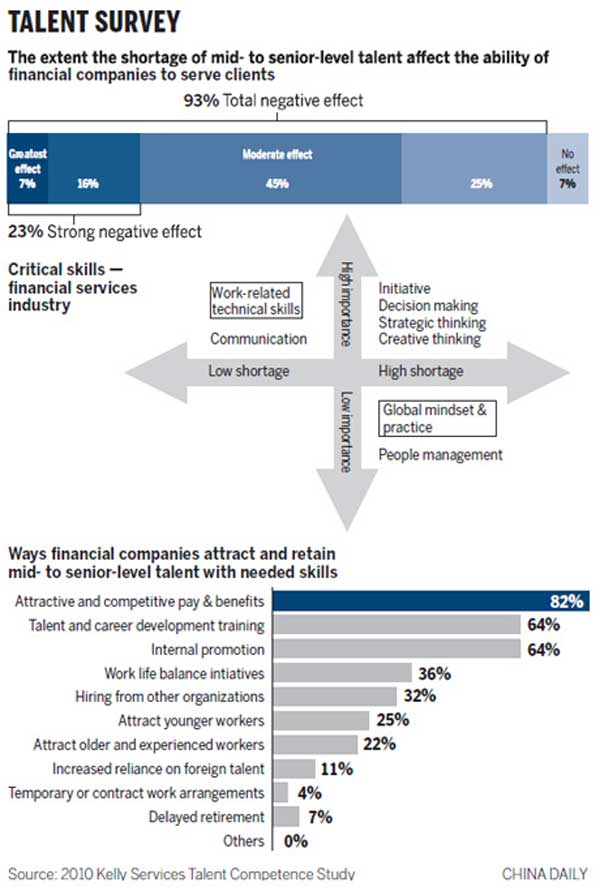
High taxation in China is one of a number of factors that make Shanghai less attractive to prospective employees than Hong Kong and Singapore, Theleen says. Income tax in Shanghai can be as high as 45 percent, against a 15 percent maximum in Hong Kong and 20 percent in Singapore.
Shanghai authorities have long been considering preferential income tax policies of 25 percent maximum for financial professionals, but only at the very top management levels.
Aside from payment, a city's soft power is equally important if it wants to retain talented people at home, Zhang notes.
"If people are willing to come for money, they would be happy to leave for exactly the same reason. Along with the lower income taxes, Singapore and Hong Kong also provide better education opportunities, medical care system and social infrastructure," Zhang says. "With inflation and housing prices soaring in downtown Shanghai, the city no longer has an edge over other financial centers in terms of living expenses."
Theleen from ChinaVest agrees. "If you try to hire seasoned expatriates, you have to persuade the family. You need to bear in mind the schools, the living facilities and the air pollution. In this regard, I believe Shanghai has taken proactive steps in building almost 30 international schools, which has a huge impact on attracting senior executives."
Financial wizards
Employers usually take a two-way approach to train workers. At ANZ, the company identifies opportunities for talented professionals from other parts of the world to spend time in China on medium-term projects, at the same time providing comprehensive on-the-job training programs and cross-border assignments for local employees.
Further complicating matters is the fact that the financial industry in China is expanding fast, fueled by high economic growth. Experts believe this makes it hard for young people to find a stable career path.
According to Xu Mingqi, a professor at the Institute of World Economy at Shanghai Academy of Social Sciences, the city suffers from the lack of an open and transparent financial market, a factor he considers more important than its income tax policies or other soft power factors.
"The government should not interfere with the market by adopting administrative methods, such as introducing a preferential tax income. The flow of talented people depends heavily on the market. When Shanghai's financial market is as open and developed as that of New York and Hong Kong, skilled financial workers would surely swarm to the city without additional incentives," Xu says.
The professor also points out that the biggest challenge for Shanghai now is not the lack of financial wizards in specific fields, but rather talented people with strategically innovative thinking and professional experience, who could help the government plan and design the financial system.
Academia has sensed the problem. According to Lu Xiongwen, dean of the school of management at Shanghai-based Fudan University, that is exactly why the school introduced two finance-related master programs last year, in cooperation with Princeton University and the University of Los Angeles in the US.
"Shanghai has a long way to go before it has an open financial market. The two programs are structured to prepare financial talent - people who could help design Shanghai's financial market system in the future," Lu says. He adds that one-third of the course would not be applicable to Shanghai's financial market because of policy restrictions.
The government subsidizes all the incoming students in the two master programs, waiving their tuition fees. Some are even granted an extra scholarship of up to 6,000 yuan (654 euros) a year.
Fudan's School of Management is expanding, vying to become the Chinese equivalent to the Sloan School of Management at the Massachusetts Institute of Technology.
This effort is in line with Shanghai's ambition to beef up its local business schools. In 2010, the government spent 320 million yuan on launching the Shanghai Advanced Institute of Finance under the auspices of Shanghai Jiaotong University, with the aim of making it a leading global business school within 12 years.
"Specialized degrees in finance are critical in training practitioners. They provide a short cut and tailor-made solution to meet the shortage of talented people in Shanghai," Lu says.
Li Luxiang contributed to this story.
















