


Making a mint out of humble herb
|
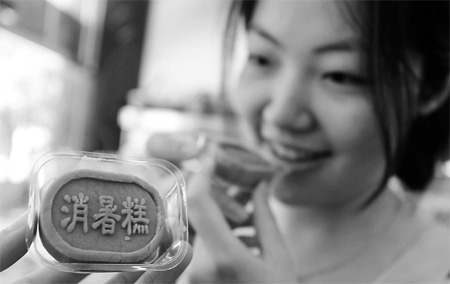
A Chinese woman shows a cake made of mint and tea extracts, flour, milk and eggs at a Beijing Daoxiangcun Foodstuff Co's store in Dongzhimen, Beijing. China now imports about 6,000 tons of mint products from abroad to meet domestic demand. Ajing / for China Daily |
Calls rise for government support of tiny agricultural sector dominated by imports
SHANGHAI - Mint growers in China are calling for more government support for the development of this small sector of agriculture.
Industry insiders say annual demand for the herb amounts to about 7,000 tons a year in the country. However, it only supplies less than 1,000 tons of mint products to the market, relying on imports for the rest.
Growing mint was at its most developed in the mid-1990s, when annual production was reported to be 10,000 tons. The main growing region was in Taihe county, in East China's Anhui province.
However, an excessive number of people entering the sector and the failure of farmers to maintain the quality of mint caused a drop in prices from about 800,000 yuan ($125,000) a ton in 1996 to 250,000 yuan a ton on average at present. As a result, many gave up growing the crop in favor of wheat and other products favored by the government.
"Some farmers only focus on short term profits, so they did not spend a lot maintaining the quality of mint. When they took the view mint was not bringing in their desired income, they moved into different fields," said Chen Guangyu, chief executive officer of Bell Flavor and Fragrances in China.
Currently there are fewer than 10 large, active mint planting companies in China, according to Zhang Xin, general manager of Aroma Shanghai, one of the main mint cultivators in China with some 2,000 mu (133.33 hectares) of land in Xinjiang Uygur autonomous region.
When domestic growers gave up in China, overseas traders became the dominant force in the sector. Chen from Bell said the United States dominates the high-end market, while traders from India dominate the lower-end sector.
"We are losing bargaining power in international markets because we do not have sufficient supply domestically. Some traders who lack credibility charge a higher price even after contracts are signed," said Zhang from Aroma Shanghai. "We have no choice but to accept this."
Zhang said the fall in supply does not mean there is no market opportunity in the sector for domestic growers, although it might be hard to make a profit in the short term. He said the demand for mint in China has been increasing in recent years as the Chinese pay more attention to oral health. Some international household chemical product manufacturing giants such as Colgate-Palmolive Co are said to be the main users of mint products in China with annual demand reaching 1,000 tons a year.
Zhang said the one of the challenges in the sector is to increase profitability. He said his company is exploring a business model that intends to have a complete industry chain in the future.
"We will be the growers and farmers and will be the sales people who trade directly with end users," said Zhang. "It means we will have full control over the whole process and it will be easy for us to ensure the quality of mint products."
Zhang's business model would be costly but it would help to lower default risks when the price of mint increases significantly during the year.
"Farmers may refuse to sell us the products at the prices agreed in contracts. It is troublesome," said Zhang.
Zhang estimated that mint oil produced in China can be sold for about 100 yuan less per ton than rival imports.
He said development in the niche sector is not as easy as people expected. It is difficult for companies to get land and hard to merge all the processes into one company. Zhang has invested some 15 million yuan over the past seven years. He did not make any profits until this year.
"Development in agriculture is not easy and it requires time and long-term commitment," said Zhang. He added he plans to increase the planting area to 150,000 mu over the next three years.
Compared with agricultural products such as wheat and corn, industry experts said mint growing is a niche sector that does not attract much attention from the authorities. Zhang said he is seeking to set up a corporation to lobby for more government support and so he can get more land to develop his plan.
"It is a niche market that will not have a direct effect on people's lives but we believe it is a sector that should not be dominated by international traders," said Zhang. "We have good natural resources that are suitable for growing mint, so this market should not be abandoned."
















