


Currency bill runs into opposition
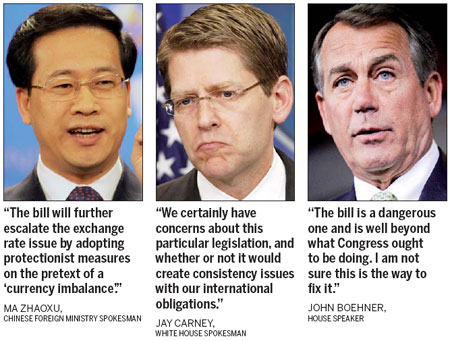
Trade war warning over move that would penalize countries with undervalued currencies
The United States Senate is debating legislation designed to press China to let its currency rise, a move that has raised opposition in the White House and in the House of Representatives.
On Oct 3 senators voted 79-19 to allow a week-long debate on the Currency Exchange Rate Oversight Reform Act of 2011, which calls for US tariffs on imports from countries with undervalued currencies.
The bill would require the Treasury Department to identify countries whose currencies are undervalued. It could then order the Commerce Department to impose duties on imports from such countries.
The US has been saying that China holds down its currency's value to give its exporters an edge in global markets. But the yuan has appreciated 7 percent against the US dollar since June last year and 30 percent since 2005. And the US trade deficit is still rising.
China's central bank, the People's Bank of China, expressed its "deep regret" about the bill. It said such legislation might seriously affect currency reform in China and could result in a trade war between the two economies.
There are many reasons for the global trade imbalance, the bank said, and the yuan's exchange rate is not the major reason for the trade imbalance between China and the US.
A Chinese Foreign Ministry spokesman, Ma Zhaoxu, said such a move by the US seriously violates World Trade Organization rules and obstructs China-US trade ties.
Ma said the bill will "further escalate the exchange rate issue by adopting protectionist measures on the pretext of a 'currency imbalance'".
The sentiment is shared by the White House. On Wednesday the White House said the bill could violate international trade rules.
"We certainly have concerns about this particular legislation, and whether or not it would create consistency issues with our international obligations," said the White House spokesman, Jay Carney.
Monday's vote allowed the Senate to begin considering the currency bill introduced by Sherrod Brown, an Ohio Democrat, and Charles Schumer of New York, also a Democrat. Brown said he was confident the Senate would approve the bill with minimal opposition.
After Senate approval the bill would go to the House of Representatives.
But House Speaker John Boehner, an Ohio Republican, has called the bill dangerous and has said it is "well beyond what Congress ought to be doing". Boehner said he had concerns over China's currency, but "I am not sure this is the way to fix it".
Experts in Beijing say the legislation is a clear sign of trade protectionism.
"The bill is rising trade protectionism," said Ding Zhijie, a professor of finance at the University of International Business and Economics in Beijing.
The legislation would spark trade disputes between the two largest economies, harming the global economy, Ding said.
David Riedel, founder and president of Riedel Research Group, said he believes the bill will not be adopted, that it is "pointless and unnecessary" and that a trade war benefits no one.
"This is not an action that would even the paying field and would not create jobs in the US. A trade war would not be in anyone's interest and should be avoided at all costs.
"I believe that longer-term there has been an impact on US jobs and economy from the emergence of China as a major exporter but the connection in the short-term is minimal.
"Washington should be working on what they can do to improve the jobs picture and economic situation here at home. Focusing on the Chinese currency is a distraction from this larger effort."
US legislators who back the bill argue that more manufacturing jobs will be created in the US if the yuan is allowed to rise.
Many refer to a paper by the Economic Policy Institute in Washington that says the growing US trade deficit with China has cost about 2.8 million American jobs over the past 10 years.
Erin Ennis, vice-president of the US-China Business Council, said the institute's assumption is "decades wrong". "Much of what we import from China replaces imports from other countries, not products we make in the US today."
Other experts reckon all the bill will do is prompt manufacturers to relocate production bases to cheap-labor countries such as Vietnam rather than moving jobs back to the US.
Shaun Rein, author of the soon-to-be published book The End of Cheap China, said the US government is running "one of the worst economic policies of the last 50 years" and "their irresponsibility is causing the world's financial problems, not China's currency policy".
"Appreciating the renminbi will not save American jobs. What it will do is cause more inflation to America as manufacturers have to raise prices or will cause more job creation in Vietnam and other lower-cost producing countries."
Rein, who heads China Market Research Group in Shanghai, says most big US companies his firm has interviewed want to keep the yuan low - an opinion most executives will not voice publicly, Rein said.
In addition to opposition from the US-China Business Council, the legislation is also opposed by business groups such as the US Chamber of Commerce.
Before the Senate vote to conduct a debate, 51 US industry groups wrote a letter to the Senate majority leader, Harry Reid, and the minority leader, Mitch McConnell, urging senators not to adopt the bill and warning that a "counterproductive" trade war may be the consequence.
The group, including farming and trading associations, wrote: "Legislation that would increase tariffs on imports from China is unlikely to create any incentive for China to move expeditiously to modify its exchange policies. Rather, it would likely have the opposite effect and result in retaliation against US exports into China."
US exports to China are a vital part of the US economic recovery, says the US-China Business Council, which is based in Washington. China is the third-largest US export market after Canada and Mexico, the two US neighbors with whom the country has a free-trade agreement.
The business council says that last year exports to China rose 32 percent and that from 2000 to 2010 total US exports to China rose from $16 billion (12 billion euros) to $92 billion (69 billion euros), or 468 percent. In the same period US exports to the rest of the world rose 55 percent, the council says.
"Exports to China contributed to growth and jobs in almost all congressional districts," Ennis said.
An editorial in The New York Times called the bill "the wrong way to deal with China".
"A Senate bill, with strong bipartisan support, to punish countries that manipulate their currencies is a bad idea. It could do even more damage to the American economy if - as is all too likely - China decides to retaliate," the editorial said.
Li Xiang contributed to this story.
















