


Paulson offers principles for US, China economies
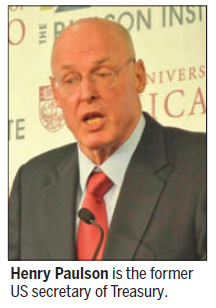
WASHINGTON - Henry Paulson, the former US secretary of Treasury, considers "unlocking the promise of capital and cross investment" as the primary principle to guide US and China through the current economic difficulties and ensure future growth. To achieve this, he said, the US should be more open to Chinese investors and provide more "transparent and predictable" investment procedures.
"Investment flow should be a source of growth and job creation for both countries, but today those flows are largely one way, from the United States to China," Paulson told a group of students, faculty and professionals who attended his speech at the Johns Hopkins University's School of Advanced International Studies (SAIS) in Washington, DC, on Oct 25. Paulson became a visiting scholar there right after he left the Cabinet. He offers five principles which he said can be applied to both economies and boost the global economy as well.
Paulson believes "assuring financial markets are transparent and have strong oversight" is the second principle to fuel the economies in both countries. Paulson was the chairman and CEO of Goldman Sachs before becoming the Treasury secretary. As a banker, he pays particular attention to the financial market system, believing "world-class capital markets are central to economic success".
Paulson said it is remarkable that China's banking system has come so far that it can serve as a vehicle through which Beijing injected its stimulus spending package into its economy in 2009. "That was a critical step for sustaining growth in China and became the engine of growth benefiting the entire world," he added.
At the same time he encourages China to speed up its reform of the financial system to make it more market-determined and transparent and in the meantime find a tool to better manage the non-bank lending which has led to the recent debt crisis in Wenzhou.
This year marks the 10th anniversary of China's access to the World Trade Organization (WTO). "At this moment of greatest economic challenge, we need more (trade) not less of it, and we need fewer barriers not more hurdles," said Paulson. He therefore considers "freeing up bilateral trade" as one of the principles he can subscribe for both countries.
The official data Paulson cited shows that US' exports to China have grown more rapidly than its imports from there and China is its fastest-growing export market. In 2009, the overall exports of the US dropped about 18 percent, but the exports to China fell by less than 1 percent, which is interpreted by Paulson as a strong demonstration of the potential of the Chinese market.
Paulson also urges China to grant US companies more access rights in certain areas. Calling himself a free trader, Paulson, however, said his ultimate goal is to "enlarge the entire pie".
"Working to strengthen market confidence in our economies" and "helping technology flow more efficiently and promote innovation" are the two other principles that Paulson advocates.
Paulson said the US should be willing to export innovated technologies that can help China to reduce its energy consumption and power more green growth in the future. In the meantime, he urges China to enforce its protection of intellectual property.
Jessica P Einhorn, the dean of SAIS, commented prior to the speech that Paulson has had "two major intellectual and cultural interests for decades: China and conservation." Those two domains have become the main focus of the Paulson Institute, an independent think tank based at the University of Chicago, established by Paulson in June.
"The great thing about China's leaders and its people is that they are looking everywhere they can to find out the best models and ways that can tackle their problems. I think if we do not engage, shame on us," said Paulson.
















