


Country 'set to remain' global clean energy hub
China invested $45.5 billion in clean energy in 2011, causing the country to cede its top ranking in such expenditures to the United States for the first time since 2009.
Even so, China's ambitious goals will continue to make it a clean-energy hub for the world, The Pew Charitable Trusts, a Washington-based research group, said on Thursday.
In 2011, $48.1 billion went into clean energy in the US, a 44 percent increase from 2010, making it the country where the most money was put toward that purpose in 2011. In third place was Germany, where $30.6 billion was invested in clean energy.
"China's overall economic growth rate slowed in 2011, so it is not surprising that investment growth in the clean energy sector also slowed," said Phyllis Cuttino, director of Pew's clean energy program.
But because of the falling prices of solar and wind-energy technologies, the same amount of investment was able to support the use of even more renewable power in 2011, he said.
Despite China's decline in the rankings, the country remains a global hub for clean energy, particularly in its support and use of wind energy and in wind-energy and solar manufacturing. China has the capacity to generate 133 gigawatts of clean energy, accounting for 26 percent of the world total.
China's long-term plans provide a predictable future for the country as it pursues its goal to meet "the world's most ambitious clean energy targets", he said. The country intends to install 160 gW of wind power and 50 gW of solar power by 2020, he said.
China now has the capacity to produce more than 64 gW of wind energy. He pointed out, though, that about a quarter or more of that capacity may not be operational or connected to the electrical grid.
In 2011, the country's investments in solar energy increased to $11.3 billion and 2.3 gW of capacity was installed.
The agency's research suggests that 87 percent of private investment in clean energy in China came in the form of asset finance. Only 1 percent of China's private investment for that purpose came from venture capital and private equity, while 11 percent of private investment in clean energy in China was through public markets.
In the US, meanwhile, investment in clean energy increased in response to loan guarantees, tax credits and other strong government incentives in recent years.
Even so, policy changes in the US make it unlikely that the country can maintain the momentum it gained in 2011, Cuttino said.
In 2011, there was a surge in the money put into solar investments, including into several very large solar projects in the US. But the relatively recent expiration of Treasury Department grants, the Department of Energy's loan guarantee programs and other stimulus initiatives, plus the expiration of production tax credits by the end of 2012, have made the country's energy policies uncertain and have undermined investor confidence, he said.
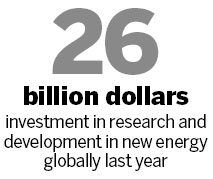
Globally, the amount of private financing going into clean energy and investments increased to a record $263 billion in 2011, a 6.5 percent increase from the previous year. Both public and private investment in research and development in clean energy globally declined to $26 billion in 2011, down 18 percent year-on-year.
The US continued to hold the lead position in such spending, being home to 30 percent of the total corporate spending for research and development on clean energy and 31 percent of government spending for that purpose.
The Chinese government spent about $1.6 billion on research and development in clean energy and the Chinese private sector invested about $380 million for that purpose in 2011.
Despite recent trade frictions between the US and China over Chinese solar panels, Cuttino said most experts do not expect to see a trade war relating to clean energy break out between the two countries.
"In fact, they have a robust trade in clean energy components," he said. "Rapidly declining prices in clean energy goods and services is putting a strain on companies in both countries. We expect this kind of competition to continue."
lanlan@chinadaily.com.cn
















