


Changes in branding are in the wind
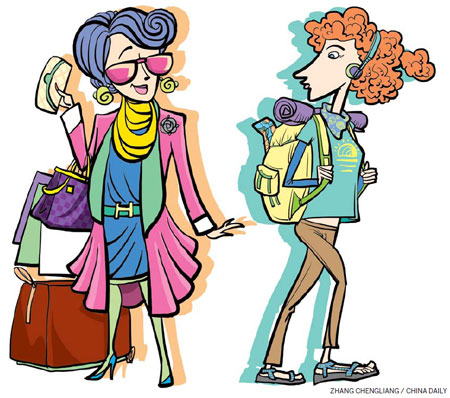
Irecently interviewed a Chinese woman in her early 30s as part of a research project about Chinese consumer behavior. We talked about how she and her friends relate to foreign and Chinese brands.
She told me they routinely inspect each other's cosmetics, tallying the number of bottles and comparing brand names. The higher the number of French or Italian brands, the better for a young woman's status among her peers was her message.
She also told me how car brands are ranked: First European, second Japanese, third Korean, and, fourth, if you cannot afford a foreign brand, Chinese. A ranking entirely based on the cost of the cars and the associated social prestige they carry.
The primary status symbol for young Chinese women, of course, is the handbag. But the woman I interviewed was also keenly aware of the brands in product categories such as clothes, jewelry, jogging kits, gyms and restaurants.
In every category, brands were ranked and served a purpose - for example, never take a close friend to a cheap brand of restaurant. Brands also serve a purpose in the marriage "market", where they help young Chinese to identify potential partners of similar social status.
The young woman I interviewed lives in a second-tier city on the east coast of China with a population of 6 million. Her relationship to brands should be fairly typical for the younger members or the growing middle class in China, though possibly with the exception of a sophisticated, small elite in the major cities like Beijing or Shanghai.
This social prestige fixation has served a number of foreign brands in China well, and China is soon expected to replace Japan as the world's largest market for luxury goods. The brands that appear to be most successful in China are those with world-famous names and prominent brand identifiers on their products. Ask a Westerner why he or she buys a luxury brand and they will tell you about quality, craftsmanship, and many other things, but rarely that it tells the world that you are rich.
Many people in China today can afford products and brands they could not have dreamt of buying a decade ago. Given the rapid pace of development it is not surprising that Chinese consumers come across as less sophisticated than consumers in the West when it comes to brands and what they stand for.
However, as China continues to develop, there is reason to expect that Chinese consumers will grow more sophisticated in their relationship to brands, foreign as well as Chinese, and that China will develop distinct Chinese brand consumption patterns.
The question is what can we expect to happen? Consumers in the West use brands for self-expression, that is, to tell the world who you are or who you want to be. An important part of this is to associate with one group of people and disassociate from other groups.
For some people this is a matter of signaling your social and financial standing, just like in China, but for many other people it is a matter of expressing other things. People in the West may choose brands to tell the world that they are artistic, independent, like to ride a skateboard, or belong to some other group they would like to be associated with.
Of course this will happen in China too as the market for branded products develops. The challenge for the brands, foreign and Chinese, competing for a share of that market is to figure out what Chinese consumers want to express, now and in the future.
Will the Chinese market follow the lead of the West and develop similar groups and market segments or will it develop into something uniquely Chinese? The answer probably is both, which means that there should be opportunities for developing brands appealing to distinct Chinese tastes as well as positioning brands in the same way as in the West. Chinese brands could have an advantage in the former category if they exploit their local knowledge rather than trying to imitate Western brands.
However, self-expression goes beyond brands. A recent study in the US found that people's need for self-expression is finite. We only need to express who we are up to a certain point. The study also found that different brands in different product categories can satisfy the same need for self-expression and also that this need can be satisfied with non-brand items - examples include books or TV shows - or activities through which we express ourselves.
This means that as the Chinese market matures, so-called symbolic brands, which satisfy people's need for self-expression, will be competing not only with other brands but also with other activities. It may also be the case that as Chinese consumers develop a more sophisticated relationship to brands they will experience a need for fewer branded products to express themselves than they do today.
This would mean that while the number of consumers buying brands increases with the growing economy, the number of branded products per consumer would go down. And if Chinese consumers start looking elsewhere than brands to express themselves, there will be market opportunities for art or language courses, sport activities, and other self-expressive activities.
The luxury market is likely to be in for great changes. Wealthy Chinese now regard luxury brands mainly as a way to flaunt their wealth. They prefer prominent logos or other brand identifiers and make sure others see them.
While there are consumers in the West with a similar view on luxury brand consumption, there are also other segments of the market. A recent study identified a luxury market segment made up of financially well-to-do people without any need to display their wealth to anyone outside their own group.
The people in this segment prefer luxury products without any prominent brand symbols that are identified only by people like themselves. They do not care whether anyone outside their own group identifies the brand.
According to the study, this market segment is prepared to pay a premium price for luxury brands without prominent branding. It appears to be a fairly safe bet that a similar luxury market segment will develop in China in the not-too-distant future, which will force the luxury brands to change their offerings to Chinese consumers.
It will also open up market opportunities for those luxury brands that have a more discreet branding strategy.
In a nutshell: Chinese consumers' preferences and behavior can be expected to change in line with more developed markets. This will open up opportunities for the brands now in the market willing to adapt and to new brands of Chinese and foreign origin.
The author is associate professor of marketing at the University of Nottingham Ningbo China. The views do not necessarily reflect those of China Daily.
















