


Rising wages should feed robot boom, say experts
|
An industrial robot on display at the 2012 China Robot Industry Promotion Conference, which opened on Tuesday in Shanghai. Gao Erqiang / China Daily |
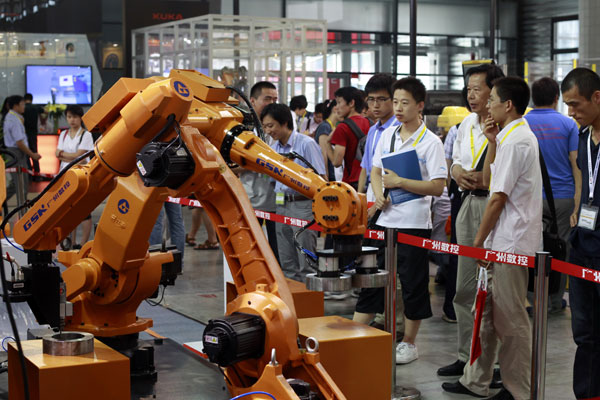
The government should provide fiscal and taxation incentives to encourage increased production of industrial robots.
That's according to Li Benjian, an inspector with the equipment department of the Ministry of Industry and Information Technology, who said that despite a massive expansion in their use in Chinese factories in recent years, the country's robot manufacturing capacity is still below competitor countries.
He said that as rising wages continue to squeeze profits in the under-pressure manufacturing sector, government action is needed to encourage increased use of automation in factories.
Li, whose department oversees the high-end manufacturing sector, said: "Automation and intellectualization are key for China's future manufacturing."
Speaking at the 2012 China Robot Industry Promotion Conference in Shanghai, he added: "It's imperative for the country's industrial robot industry to flourish."
Other experts agree that China's increased reliance on industrial robots is inevitable as the size of its workforce shrinks and wages rise.
According to Ge Wenjie, a machinery analyst with Nomura Holdings Inc, 28 percent of factory machines in China use numerical controls - one measure of automation.
That may be far lower than Japan's 83 percent, but China is growing far faster than Japan did at a comparable stage of development, he added.
China's working population is expected to peak in 2015.
A shrinking workforce means that wage growth will get even faster and finally strip the country of the competitive edge in terms of labor costs.
As a result, analysts insist that Chinese factories have to become more automated to compete in the global market.
"In fact, industrial robots are already cheaper than workers in China's eastern regions," said Wang Tianmiao, who heads the expert panel of robot technology under the State High-Tech Development Plan, a top national program to foster development of advanced technologies.
He said a typical industrial robot costs around 300,000 yuan ($47,200) and needs an extra 20,000 yuan annually for maintenance.
With total cost of 500,000 yuan over 10 years, that's less expensive than a 6,000-yuan-a-month technician, and a robot works three times more efficiently.
Foxconn Technology Group, a company in Taiwan that assembles Apple Inc's iPad and iPhone, has said that it plans to install up to 1 million robots in its factories over the next three years
But most of China's current demand for robots is met by imports, as few local manufacturers are capable of making sophisticated robots. In 2011, China's imports of industrial robots increased 62 percent to 38,000, worth $866 million. The country imported 23,400 robots in 2010, a 130 percent increase on 2009.
"China is set to become the world's biggest market for industrial robots, as its economic scale keeps growing.
"And it's of strategic importance that it can be self-sufficient on this front," Cai Weici, vice-chairman of China Machinery Industrial Federation, said in a speech to the conference.
The government has already identified the trend. The 12th Five-Year Plan (2011-15), the country's economic blueprint, has listed industrial upgrading as one of the country's key priorities.
Beijing is expected to pour billions of dollars into key strategic industries, including industrial automation, to encourage imports of advanced machinery from leading countries.
This year, the city of Tangshan in Hebei province, for instance, announced a plan to foster the country's biggest robot production base. It hopes that by 2015, annual output value of the base can reach 20 billion yuan. The welding robots made by companies in the base now take up 30 percent of the domestic market.
Contact the writer at gaochangxin@chinadaily.com.cn.
















