


At life's end, hospices ease pain
|
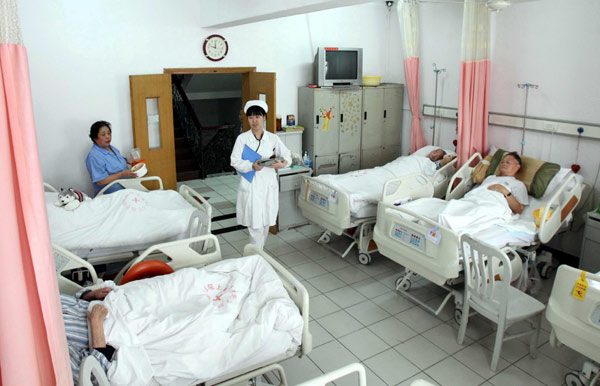
A nurse goes through her rounds inside an end-of-life care ward at the Linfen Community Health Service Center in Shanghai in October 2011. The center is one of the first medical facilities in China that provide end-of-life care for patients. Liu Ying / Xinhua |
Guo Wenyue (not her real name) is tormented by the memory of the most painful time of her life.
In 2005, her husband was diagnosed with terminal nasal cancer, and the entire family entered a nightmare.
"I knew there was no hope of his recovery, and I was told by doctors to halt the treatment. But we still wanted to try anything that could possibly extend his life, even just for one more day," the 59-year-old said.
"After a number of rounds of chemotherapy, he passed away in extreme pain. And I was totally worn down after that," she said.
Guo spent more than 100,000 yuan ($15,900), almost all her savings on her husband's treatment.
"There is such anguish," Guo said, because she often thinks of her husband's look in great distress and pain in his last days.
"If I could have made things different, I would have seen that he left the world in a more peaceful way," she said.
Like Guo, many families need to make such a bitter decision - giving up aggressive treatment to turn to end-of-life counseling and care.
"It can be so scary when people hear that they have to give up, even if they're told 20 times that hospice care has a lot to offer," said Huang Weiping, founder of Shanghai Hand in Hand Life Care Developing Center.
Earlier this year, Shanghai announced plans to provide hospice care for dying cancer patients.
Under the plans, each of Shanghai's 18 districts and counties will have a community health center providing palliative care. Each community will have a special ward with 10 beds for dying cancer patients. These wards are expected to open at the end of the month.
"So far we have finished the decoration work on the ward, shower room and visiting room," said a worker surnamed Xu from Siping Community Health Service Center in Yangpu district.
"The next step will be to train the nursing staff," she told China Daily on Wednesday.
These hospices are trying to change public opinion about the service they offer.
Rose pink curtains, floral patterns printed on the walls and colorful paper garlands hanging along the corridors those are some of the decorations at the hospice care ward in the Linfen Community Health Service Center in Shanghai to build a pleasant atmosphere.
The Linfen Community Health Service Center, founded in 1995, is one of the country's first hospitals to provide hospice care for dying cancer patients.
"Last week, five patients here passed away," said Chen Qi, a nurse at the center. Patients are expected to live no more than 90 days. Last year, more than 100 spent their last few days there.
"What we can do is to provide care in their final days of life to try to help them die with dignity and rest in peace," Chen said.
Hospice care offers a comprehensive program for patients who are dealing with a life-threatening illness in the last months or days of life. Unlike traditional medical care, hospices focus on keeping patients comfortable rather than curing them. The care involves the patients and their families. Professional staff members trained in dealing with the issues terminally ill patients and their families face try to meet their spiritual, emotional and physical needs.
But to many people, like Guo, the idea of a hospice is still new.
"In China, people's unfamiliarity with hospices prevents them from deciding to stop the treatment for the illness and turn to hospice care," said Huang Weiping, founder of Shanghai Hand in Hand Life Care Developing Center.
"Because of the lack of understanding, hospice care in China lags far behind that in Western countries," he added.
But the situation is improving in many parts of the country, Huang said.
Shanghai is taking the lead in promoting hospices. In-patients in the community health centers receive free pain medication and also get monthly 2,000 yuan medical subsidies - those who spend their last days at home receive 1,000 yuan subsidies.
A big problem in the sector, however, is the shortage of professionals, including social workers, and volunteers who provide the care.
According to the Shanghai Municipal Health Bureau, 36,000 people a year die of cancer, and 70 percent of terminally ill cancer patients need hospice care.
"We only have five doctors and eight nurses, which means we don't have enough hands to take care of each patient," nurse Chen said. "A large part of the care is provided by social workers and volunteers."
In China, most hospice social workers and volunteers come from community organizations or universities.
At Hand in Hand, only a small number of volunteers choose to stay or work regularly.
"Many volunteers have come and gone. Over the past four years, we have had more than 400 registered volunteers, but only 20 percent stay," Huang said.
At Shouwang student association in Shanghai Jiao Tong University, many members quit hospice volunteer work after just a few visits, student volunteer Wang Hang said.
"Terminally ill patients are often filled with depression, anxiety and fear. Such negative emotions can influence your emotions," said student Zhang Xing as he recalled his first visit to a terminally ill cancer patient, a woman in her 70s, in a ward one year ago.
"She talked a lot. All about the essence of life. Most of the time I could do nothing but listen to her. I knew I couldn't cure her disease, but I could stay with her, which in a way might ease her pain," he said.
"Hospice care is systematic work that needs the concerted efforts of governments, hospitals, schools and social organizations," said Shi Yongxing, executive deputy director of the research department at the Chinese Association For Life Care, and an expert who has long been working on policy research in the field of hospice and elderly care.
"In China, that type of effort has not been established," Shi said.
The absence of the legal framework also impedes the development of hospice care.
"Hospice care in China is developing very slowly. So far, there are no regulating guidelines," said Luo Jilan, secretary-general of Chinese Association for Life Care.
"Because it lacks a supporting policy, hospice care is mainly carried out at grassroots community hospitals, which must be self-financed and that impedes improvement in the care. Meanwhile, medical insurance doesn't cover hospice care," she said.
The government should recognize the advantages hospice care offers and establish a complete system to develop it which can better balance the medical personnel and resources between hospitals and hospices, Huang said.
Contact the writer at wanghongyi@chinadaily.com.cn
















