


Profiting from Cambodian hair
|
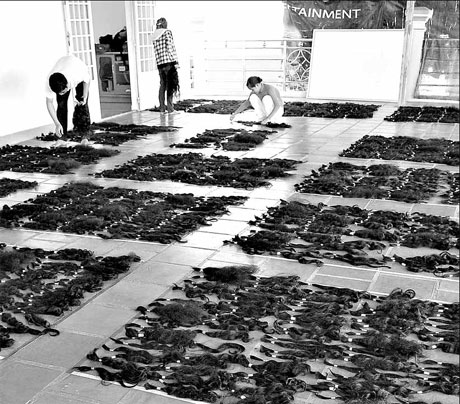
Arjuni is slowly gaining market share in the lucrative hair extension business. Company founder Janice Wilson. Photographs by Ron Gluckman for The New York Times |
PHNOM PENH, Cambodia - For an Internet start-up, Arjuni faces more challenges than usual.
The e-commerce site that sells hair extensions operates out of a five-story building here that lacks elevators and, sometimes, power. Employees typically have to travel to remote villages by motorbike or on foot to pick up the goods that Arjuni sells. And the office floor is cluttered with piles of hair strands instead of computers.
But in just two years, the company has grown from a handful of employees to 80, and it now makes more than $1 million in revenue. The start-up is also slowly gaining market share from the industry's dominant players in India and China, as well as retailers in the United States and Europe.
"We not only buy and collect the hair ourselves, but sell it directly to our customers. This makes us stand out," founder Janice Wilson said. A large proportion of Arjuni customers, like Ms. Wilson, are African-Americans seeking fuller styles for their tresses.
India has long provided much of the world's natural hair, sold to wholesalers mainly in China, which in turn marketed their products to retailers in Europe and the United States. But Ms. Wilson found that Cambodians have similar hair quality, long with cuticles in alignment.
"Nobody had thought of Cambodia," said Ms. Wilson, 39.
The hair extensions business generates annual revenue of $250 million. Extensions can cost thousands of dollars, but typically average around $500.
Ms. Wilson provides employees with free English, computer and math classes. A third of workers come from troubled situations like sex trafficking or spousal abuse. That effort helped attract seed capital from a Japanese investment fund, Arun, formed in 2009 to help social enterprises in emerging nations. Additional money came from the Cambodian Export Market Access Fund, a World Bank-financed project that helps companies trying to develop exports. The rest came from her savings, friends and family.
Like many new ventures, Arjuni is harnessing the latest Internet tools like Twitter and social media to build a loyal customer base. Customers eagerly describe their orders on home videos that they upload on YouTube, with segments on topics like hair design, delivery and grooming.
Clients are encouraged to send in pictures of stars they want to emulate, like Catherine Zeta-Jones or Beyonce. Arjuni also floods Facebook with testimonials and promotions.
Ms. Wilson, originally from Green Bay, Wisconsin, is a lawyer by training. When she was on vacation in Cambodia four years ago, she began thinking about opportunities to start a business here.
She started off in real estate, but Cambodia's property market fell with the global economy. The collapse of Cambodia's textile industry largely led to her idea. Cambodian workers with sewing skills were suddenly unemployed.
"I was thinking, what is recession-proof?" Ms. Wilson recalled. The answer: "vanity."
Hair extensions made from natural human hair must be cut, cleaned and sewn into individual pieces. "It was low-tech, they just needed to learn how to make them, and we just needed sewing machines. We could use the skills already here," she said. Natural hair makes the best extensions.
This spring, Arjuni started a series of in-person events in the United States called Halo, where the staff could meet and help groom customers.
"When I worked in a law office, I was bored out of my mind," Ms. Wilson said. "When you have this entrepreneurial spirit, you just have to do it."
The New York Times
















