Artist recalls teaching ceramics in Lesotho
|
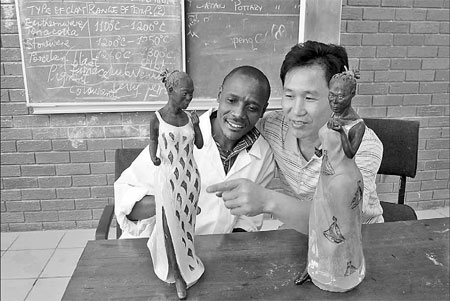
A Chinese artist teaches a student how to make ceramic items in Maseru, Lesotho, in January. Pan Zhenhui / for China Daily |
In June 2011, Pan Jingxin got a phone call that launched his adventure in southern Africa, where he was almost killed.
The call was from the cultural authority of Foshan, Guangdong province. The 53-year-old senior artist with the Guangdong Bolin Ceramic Research Institute was asked to go to Africa and help teach people there how to make ceramic items.
"I was not surprised at all," Pan said. "In the past few years, news had gotten around that a lot of experts were sent by the Ministry of Culture to Africa to help people there."
The authority briefed him that he was going to Lesotho with another two experts.
Pan had never been to Africa. All that he knew about the continent came from the media, the books and people he knew. In his mind, Africa was a far-away place of poverty and violence, Pan said.
"I was very glad to be helpful, and as soon as I got the phone call, I started preparing for the journey," Pan said.
Foshan is called the "ceramics capital" of China because of its long history and awe-inspiring achievements in ceramics, and Pan has been in the industry for his entire life.
He searched the city for the best clay, glazes, furnaces, and other materials and tools to take with them to Lesotho.
On Jan 3, Pan flew to Lesotho with two other experts. When he arrived in the small airport of Maseru, the capital and largest city, Pan was astonished.
"The airport was very shabby. The planes there looked like those of China in the 1960s," Pan said.
The group was taken to a college, where they would hold classes for the next 40 days.
The dormitory was a two-story building attached to the backyard of the college, which had very few decorations and little furniture.
"The living conditions were better than I had thought, although still very harsh," said Pan, who was the leader of the team of three. "None of us were disappointed at the conditions. Instead, we were all looking forward to the coming days."
Lesotho has one of the most undereconomies in Africa, and the team soon found that the people there had no concept of modern ceramics at all.
"The technique they used to make a ceramic item was ancient," Pan said. "We were eager to help people there."
Half of the students were local artists and college teachers. Surprisingly, the other 10 were prisoners.
The teachers and artists were to teach the skills to others after they acquired them and the prisoners were to make a living out of making ceramics products, the team was told.
On the first day of the 40-day session, Pan told the class the brief history of ceramics in China and the concept of applying art into making ceramic products.
"It was difficult to convey such ideas to them freely because of the language barriers and cultural difference, although we had an interpreter," Pan said.
"But all the students were learning with a full heart and I could see from their eyes that they trusted us and wanted to learn. There is nothing more delightful than to have eager students."
Pan made a great effort to convey intangible ideas - such as the concept of esthetic factors - through examples, demonstration, and explanation. The best method, he found, was to let the students practice as much as possible.
"In practicing, they grasped the meaning I wanted to tell them," Pan said.
When language failed, Pan resorted to body language and teach students individually.
As time went by, the students made great progress, and a mutual understanding was established between the teachers and students.
"Sometimes, I felt as if I were in China, teaching Chinese students," Pan said. "Their faces might be different, but their admiration for beauty and learning processes were the same."
Time flew quickly. Days passed as the students learned all that they were expected to, and then it was time to say goodbye.
After an inspection of the students' works by high-ranking officials from both countries, Pan and his companions got ready to leave the country.
But during their last night in Lesotho, masked robbers forced their way into the dormitory, and robbed Pan and his colleagues of their cash and valuables, including laptops and cameras. During the chaos, Pan was almost hit by gunfire.
"It was frightening, but I don't regret going there. The days in Lesotho are worth remembering," Pan said.
"If I hadn't lost the photos and documents that were on the laptop and camera, I would have nothing to complain about."
liuzhihua@chinadaily.com.cn