


Fuel-saving targets need driving home
|
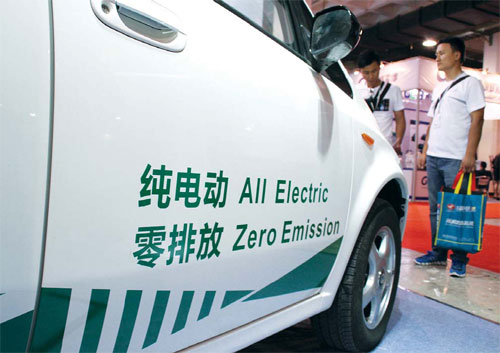
An all electric and hybrid car exhibition was held in Beijing early this month. Wu Changqing / For China Daily |
Stricter enforcement is needed to ensure that automakers meet the fuel-efficiency targets
China's State Council released the final version of the Energy-Saving and New-Energy Vehicles Industry Development Plan on July 9.
The plan shows the country will move quickly to develop new-energy vehicles such as pure electric, plug-in hybrid and fuel-cell electric automobiles, but unlike the previous draft, the final version also stated that energy-saving vehicles such as non-plug-in hybrid and energy-saving internal combustion engine automobiles will also be promoted.
Some of the specific targets for new-energy vehicles remain the same: the accumulative output of electric and hybrid vehicles will reach 500,000 units by 2015 and 5 million is targeted by 2020, when the annual manufacturing capacity should reach 2 million units.
However,a major assumption of the 500,000-unit target is that local governments will directly purchase large volumes of electric vehicles for official use.
This actually overestimates local governments' financial capability as well as their willingness to buy non-local products.
So far, most cities have less than 100 units of electric or plug-in hybrid vehicles, and there are rarely any plans to accelerate the purchase volume.
China's new-energy vehicle development formally started in January 2009, when the central government initiated the Ten Cities, Thousand Vehicles project, which targeted 1,000 new-energy vehicles for each of the 10 selected trial cities: Beijing, Changchun, Changsha, Chonqging, Dalian, Hangzhou, Hefei, Jinan, Kunming, Nanchang, Shanghai, Shenzhen and Wuhan.
In early 2010, seven more cities were added: Guangzhou, Haikou, Suzhou, Tangshan, Tianjin, Xiamen and Zhengzhou. And in late 2010, five more cities were added to the list, Chengdu, Huhhot, Nantong, Shenyang and Xiangfan.
However, there seems to be no further planning beyond 2012 as yet.
Industry insiders say that the Ten Cities, Thousand Vehicles project has failed and that although the government is urging breakthroughs in developing key technologies, the target for 2015 looks out of reach, as all electric vehicle obstacles still need to be overcome - the battery bottleneck, high prices and charging infrastructure problem.
But that begs the question - since the target of 500,000 units by 2015 cannot be reached, why have the planners left this number unchanged over the past two years?
Those in the industry believe the target is just a directional goal, not a mandatory one. They say no automakers will be punished if the goal is not reached.
Realizing that electric or plug-in hybrids are unrealistic at present, the planners have emphasized another goal in the final version of the industry development plan: drastically improving fuel economy.
In 2015, the conventional passenger vehicles produced should reach the fuel economy index of 6.9 liters per 100 kilometers and energy-saving passenger vehicles 5.9 L/100 km or below.
By 2020, the index for conventional passenger vehicles is targeted at 5.0 L/100 km, and 4.5 L/100 km for energy-saving autos.
As a reference, in July 2012, China should apply its third-stage fuel economy index at around 7.0 L/100 km for conventional passenger vehicles. Since this target is quite difficult for automakers to reach, the government gave the industry three years of buffer time, but by 2015, this target must be met. This target is more practical and more meaningful than electric technology at present. By meeting the index, China's 12 million plus new passenger vehicles will consume 15 to 20 percent less fuel than their equivalents do now.
However, if automakers are to meet their average fuel efficiency targets, they will have to install new features on their internal combustion engine vehicles, such as turbo chargers, direct fuel injection, better transmission systems, stop-start systems, mild or full hybrid features to their less fuel-efficient gas-guzzler vehicles, or change their product mix by adding more compact cars.
Though a very meaningful direction, this will need a lot of investment in powertrain technology. From both investment and technology perspectives, this is very challenging for automakers, especially local manufacturers, not to mention that the market is now slowing down and each automaker needs to control costs very carefully.
So the question is if automakers cannot reach the fuel-efficiency targets by 2015 and 2020, whatwill happen? In theory, there should be serious punishments for those companies that fail to meet the targets, however, experience suggests that they will be given a longer buffer period.
The auto industry has never lacked abundant regulations or targets, but what is usually missing is strong enforcement.
The writer is the managing director of Automotive Foresight (Shanghai) Co Ltd. You may contact him through yz@autoforesight.com
















