


Firemen of faith keep monasteries safe in Tibet
|
Tibetan monks receive firefighting training from local police. Provided to China Daily |
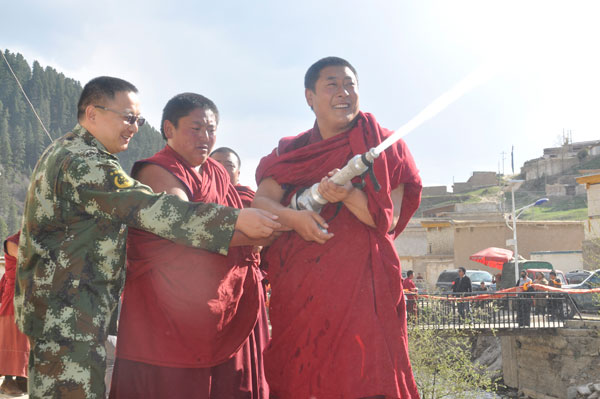
With the fire in front of them burning out of control, Zhaxi and his fellow firefighters were quick to take action. They dashed to the side of a nearby river with a handheld water pump, connected its pipes and sprayed the fire down in less than a minute, extinguishing the blaze.
Zhaxi and his partners sighed with relief. The tails of their crimson robes were spotted with mud, and the prayer beads almost fell from their wrists, but their faces beamed with joy.
These are not professional firemen. They are monks of the Tisannyi Monastery, a Tibetan Buddhist temple in the Aba Tibetan and Qiang Autonomous Prefecture of southwest China.
With the help of the local government, the monastery, built in 1823, formed its first fire department in April in response to the increasing number of fires that have broken out in recent years. Eighteen of its 538 monks, including Zhaxi, have been trained as firefighters.
"They are responsible for regular safety checks, patrols and teaching other monks about firefighting. But most important of all, they are expected to give first aid during emergencies," says Liao Jun, chief of the Aba fire brigade.
Lama Odser Lhadron, executive deputy director of the Tisannyi Monastery's administrative committee, notes that the volunteers are also expected to aid the rest of the community in the event of an emergency. More than 380 families live nearby.
Usually built far away from the towns and cities of the secular world, monasteries and convents face greater risks than other buildings in terms of fire safety. They are also built almost entirely of wood and brick. Their remote locations mean that firefighters often have little or no time to save the buildings after they catch fire.
As a part of the Aba prefectural government's efforts to better protect the areas monasteries against fire risks, four monasteries - Dagcha, Tisannyi, Mewa, and Changlie - were chosen to participate in a trial program in which they would create their own firefighting brigades.
Young and strong candidates are chosen to take part in regular training sessions that teach them how to detect fire risks, fight fires and protect themselves. Courses held by the Aba prefectural fire brigade also cover laws and regulations pertaining to fire control.
In addition to their usual routine of studying scriptures and meditating, the monks engage in firefighting training sessions once a week. Large rooms outside temple prayer halls are used as fire-control offices.
"It's so much fun to learn how to use the water pump. I saw this on TV before, but I never believed I would do it myself one day," says Zhaxi.
The novice firefighters have done surprisingly well during their training sessions.
"They study hard out of both responsibility and curiosity. It takes some of them less time than is required to assemble the facilities," says trainer Liao Jun.
"I can run faster without the robe," Zhaxi joked about his heavy firefighting gear. "What we need most is more practice," he says while discussing the correct usage of a fire extinguisher.
The monks hold firm to the idea that there is power of their beliefs, augmenting their modern firefighting equipment by praying for protection from fire.
"We still do rituals and prayers for fire control. But we need to protect our temple and the people here, so we are trying both spiritual power and firefighting techniques," says Odser Lhadron.
The Tisannyi Monastery, located more than 56 kilometers away from the county seat of Markang, has suffered multiple fires since 2009. Two of the fires began in the monks dorms, while another occurred in the temple's teahouse. All of the fires were caused by short circuits in the temple's aging wiring.
The dorm fires resulted in the destruction of several rare silk Buddhist paintings and sacred vessels, and the teahouse fire consumed a large amount of antique kitchenware.
The only nearby water source, a river located about half a kilometer away, is not of much help when the fires occur. The temple lacks both proper firefighting equipment and trained firefighters.
"It's been a problem for a long time and I always worry about it, especially after the fires," says Odser Lhadron.
"When I was recruited by the temple 30 years ago, we had more small fires because we didn't have electricity. Candles were too expensive to afford, so we used kerosene lamps. It was very smoky. My nose often turned black while reading by the light of the lamps," he recalls.
Local religious traditions also create greater risks of fire. Altars where candles are burned are made of wood. Monks who cook in their dorms do so in close proximity to highly flammable materials, such as liquid gas and dried cow dung.
"It's common in every temple, but it's very dangerous as far as fire control standards are concerned," says Liao.
Thousands of faithful Buddhists cram into the monastery during important religious occasions, creating even greater fire risks during those times.
"It would be a catastrophe if a fire broke out while so many people are here. We need to make some proactive changes," Liao warned.
To that end, the local government built a 1,000 cubic meter water reservoir nearby and replaced the temple's aging wiring system. It has also donated water pumps, fire extinguishers and fire-control handbooks.
"It's such a relief. With the pumps, we can have water sent to the temple in less than two minutes," Zhaxi said.
Bilingual exit signs and a fire prevention education boards have been set up inside and outside the prayer halls. Lamps have been moved a safe distance away from flammable materials, and exits have been cleared. These practices have been expanded from the Tisannyi Monastery to the other three pilot temples.
For the trainers, getting to know more about Tibetan Buddhism is a good starting point for understanding and helping the monasteries. The Aba fire brigade currently has eight members who can speak Tibetan and plans to recruit more.
"We also require other firemen to learn Tibetan and invite Living Buddhas to teach traditions, customs and protocols of the monastery," says Liao.
"We have one goal in common - to build a safe home for the Buddha and the people in the temples."
China Daily
















