Son of detainee designs closure for once-shunned US immigrants
|
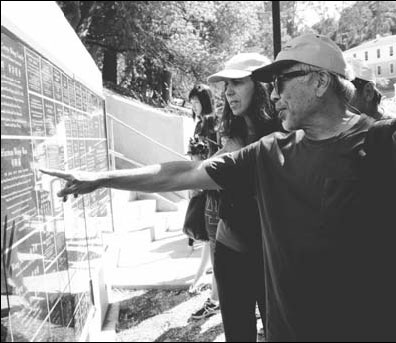
Daniel Quan, seen here at the Immigration Heritage Wall on Angel Island, designed the memorial to honor immigrants who were detained at the processing center over its 30-year history. China News Service |
Ferries take visitors to the site of the Angel Island Immigration Station, which 72 years ago closed its doors as the main US immigrant-processing center on the West Coast.
Among those who make the trip these days are people who once called the island home - former detainees. They bring with them bittersweet memories but can now celebrate the Immigration Heritage Wall, the second phase of which opened in early October.
"It is intended to honor the experiences of immigrants who passed through Angel Island on their way to becoming American citizens," the wall's Chinese-American designer, Daniel Quan, told China Daily.
The monument consists of dozens of granite plaques bearing the names of immigrants and their families and descendants.
Daniel's father, Quan Yuen Fong, left China with a brother for the United States in 1926. They were among tens of thousands processed at Angel Island, which operated from 1910 to 1940. After a brief stay, they set off for their destination of Los Angeles, presumably to join their father, who had immigrated earlier.
"But my father never talked about his experience on Angel Island. It wasn't until he passed away that I discovered he had come through the immigration station," Quan said.
After researching his family history, Quan believes the secrecy might have been due in part to inaccuracies in his father's and uncle's immigration papers.
"Both of them had two sets of names - one for immigration records and one that they were known by in the Chinese community," he said. "It was because of the restrictive immigration laws."
A deep recession in the 1870s had created widespread unemployment in the United States, and led to public outcry against Asian immigrants who would work for low pay. Between 1879 and 1904, Congress passed a number of laws targeting Chinese immigrants, including the Chinese Exclusion Act of 1882, signed by President Chester Arthur.
Only Chinese who had been born in the US or whose husband or father was a citizen were exempted from the strict laws.
Most of the 175,000 immigrants from China who arrived at Angel Island during the immigration center's 30-year history stayed between two weeks and six months. Some, however, were detained for as long as two years.
Some of those denied entry to the US and forced to remain on the island in the middle of San Francisco Bay expressed their feelings in poetic verses carved into the detention center's wooden walls. Their writing is still legible today.
In 1940, a fire that destroyed the administration building prompted authorities to abandon the facility and transfer the last group of 200 immigrants, including about 150 Chinese, to temporary quarters in San Francisco.
The Chinese Exclusion Act and related laws were repealed by Congress in 1943, once China had become an ally of the US in World War II.
In June of this year, 130 years after the main law's enactment, the House of Representatives expressed formal regret for the discriminatory legislation. The rare apology was the result of a resolution sponsored by Representative Judy Chu, a Chinese-American from California.
For Quan, recognizing those who remember life in detention on Angel Island is just as important as Washington's apology.
The first phase of the Immigration Heritage Wall was completed in 2011 as a project backed by the Angel Island Immigration Station Foundation and California's Angel Island State Park. They also developed interpretive exhibits that explain the role of the Pacific Rim in US immigration history.
"If my father were alive today, I think he would be very proud of the work that I am doing," Quan said. "The plaque on the Heritage Wall is dedicated to him.
"I think the immigration experience left him with only a partial childhood. At 15, he had to grow up pretty quickly in America. He did not have the chance to go to school or to have many friends or free time. In fact, his immigration papers stated he was several years older than he actually was, and he pretty much worked his entire life."
However, the elder Quan's business acumen helped him earn a good living and educate his three children. He became a partner in several butcher shops in San Francisco, and he owned his own meat market for over 20 years, employing 10 people from the Chinese village of his birth. Later in life, he invested in farmland.
His son shares that entrepreneurial spirit. After finishing graduate school, Quan began working as an architect in California, eventually started his own firm, Daniel Quan Design, in Oakland.
He said he's honored to have designed an exhibit about Angel Island's immigration history and hopes the work will raise awareness.
"Having been a part of the Asian-studies movement in the 1970s at UC-Berkeley, I was familiar with Chinese-American history and was intrigued by this particular story," he said.
chenjia@chinadailyusa.com