


No place for fire
|
Security workers join in a fire control drill at one of the Outer Temples in Chengde, Hebei province. Liu Xiangrui / China Daily |
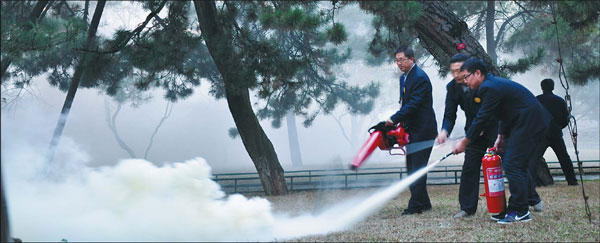
A team of security pros keeps ancient-relic sites safe from the flames that would quickly destroy them, Liu Xiangrui reports in Chengde, Hebei province.
For Song Zhu and his colleagues, the alarms of pumper-tank trucks are the most feared things.
"Even when I'm sleeping, I'll jump off the bed and rush to the window to check which direction the tankers are heading," says Song, 42.
Responsible for security for the Outer Temples near the Imperial Mountain Resort in Chengde, Hebei province, for years, Song admits he and his colleagues have developed a sensitivity to fire alarms that borders on an occupational disease.
For decades, protecting cultural heritage sites - especially against fire - has been a crucial task of the heritage department in Chengde, which boasts a rich collection of historical architecture and other relics.
The Imperial Mountain Resort, which took 89 years to build beginning in 1703, is the most famous heritage site in Chengde. It is the largest imperial garden left in China and represents ancient China's high achievements in architecture and garden design.
More than 120 ancient architectural structures within it cover more than 100,000 square meters. The Outer Temples built around the resort, 12 in total, are also important heritage sites.
The resort and surrounding temples are high fire risks for many reasons, according to Lang Junshan, head of Chengde's Cultural Heritage Bureau.
The historical buildings are mainly built from wood, while about 95 percent of the resort is covered by forest. Chengde's prolonged dry season coupled with high winds only make the threat worse, Lang says, adding the city has an average of 43 days with thunderstorms each year.
"As a result, the period of level 1 fire prevention here usually lasts half a year, and guarding the heritage sites against fire is a really challenging job," Lang explains.
With more than 10 years' experience working on the security team, Song patrols the Outer Temples area throughout the day. Sometimes he has to do night shifts for emergencies or accidents.
Today there are 41 others who are similarly deployed. Song recalls that when he started a decade ago, only a few workers - and some dogs - were dedicated to security.
There were no regular watch houses in the mountains, so they set up simple thatch shelters during winter. Song remembers how they hugged their dogs "often" to stay warm while sleeping.
In recent years, the heritage department has poured in money to upgrade fire protection facilities and technology. Security staff in and around the heritage sites got a boost too.
In 2010, the nation initiated a facelift project of 600 million yuan ($96.1 million) for the resort and its surrounding temples from 2011 to 2015. More than 30 percent of that investment has gone to 28 security-related projects, according to Lang. More than 30 million yuan was spent on upgrades such as night-viewing monitoring cameras and fire extinguishers.
"The equipment improvement and the use of technological tools have helped our work a lot," says Song, who often talks through intercoms with his teammates.
"But human work is always crucial. Fire protection covers many factors, but they all involve people. Even the most advanced facilities can only serve as tools."
More than 1,500 people are involved in work related to relics' safety in Chengde, and among them 720 are specialized in the work, Lang says.
Security workers including Song get regular training to expand their professional capabilities. They are introduced to laws related to heritage protection, fire protection and other areas. In the past, the agency hired many temporary or amateur workers, Song says.
Song admits that his job is a tiring one, as he often has to give up his holidays.
"My family often complains about it. But I don't have a choice since I have to take up the responsibility," Song says.
"Every one of us must know the importance of our work, though it is dull and appears insignificant. We shouldn't allow the valuable relics passed down for many generations to be destroyed in our hands."
There have been sad accidents in the past. For example, Puyou Temple, which belongs to the Outer Temples, was destroyed in a terrible fire. There are many other accidents caused by lightnings, too.
Some major steps are taken to further improve the security around the heritage sites in recent years, Lang says.
In the past few years, 4.6 billion yuan was spent to relocate about 8,600 households near the Outer Temples area, which has effectively eliminated potential security problems like fire accidents.
For centuries, the vast forest areas within or around the resort became covered with humus layers, which are prone to fire accidents. Before, fire-break strips were usually cut out among the trees to limit a fire's ability to consume a whole forest.
This year, Lang's department has decided to thoroughly clear out brush and humus layers to boost fire prevention. A total area of 4 million square meters will be cleared by next year; about 1 million square meters have already been cleared. The project is estimated to cost 5 million yuan.
"Such a project is the first in our history. But we will keep clearing regularly," Lang says.
Residents near the heritage sites are also mobilized in the fire prevention drive.
For example, Song and his colleagues often visit nearby communities and schools, especially during holidays and festivals, to hand out information sheets to improve people's awareness of heritage security and ask for their suggestions.
Contact the writer at liuxiangrui@chinadaily.com.cn.
















