


China-bashing season over, but frictions will persist
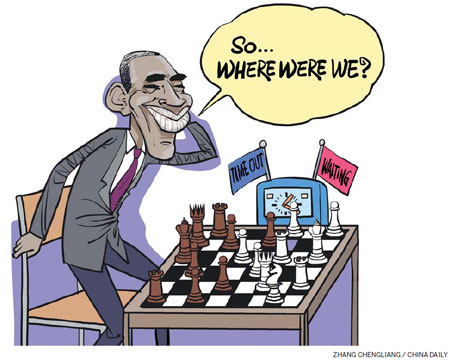
The result of the US presidential election provided some reasonably good news for relations between the United States and China. Barack Obama's re-election prevents the return of neoconservative hawks to prominent posts in the formulation and execution of foreign policy. That, in turn, reduces the danger of a belligerent US policy in many regions, particularly the Middle East and East Asia.
Chinese officials are probably relieved that Mitt Romney will not be the next occupant of the White House. Although the head of his transition team, Robert Zoellick, had a well-deserved reputation as a pragmatist and had repeatedly emphasized the crucial nature of US economic ties with China, other members of Romney's foreign policy inner circle advocated a far more hard-line policy toward Beijing. They included the former US ambassador to the United Nations John Bolton, the Princeton University Professor Aaron Friedberg, the author of A Contest for Supremacy: China, America, and the Struggle for Mastery in Asia, and Liz Cheney, daughter of the former vice-president Dick Cheney.
Romney also received input from other prominent neoconservatives such as William Kristol, editor of the influential magazine The Weekly Standard. Indeed, a high-priority goal of such anti-China hawks was to ensure that Zoellick or other pragmatists such as the former US ambassador to China Jon Huntsman, did not get high-level posts in a Romney administration.
If Romney had won the election, relations between the US and China would probably have been frosty. The Republican candidate went out of his way to criticize Beijing's policies, especially on trade and currency issues. Pledging to "clamp down" on trade "cheaters", he charged that "China is the worst example of that. They have manipulated their currency to make their products artificially inexpensive". He also pledged to "go after them for stealing our intellectual property". Romney accused the Obama administration of not standing up enough for US interests. On one occasion he denounced Obama for being "a near supplicant to Beijing", not just on trade matters, but on human rights and security issues as well.
Although bashing China, especially by the candidate trying to unseat the incumbent, has become a feature of nearly every US presidential campaign of the past 20 years, Romney's criticism was particularly intense. Moreover, the Republican Party has changed noticeably over that time, with the role of religious conservatives becoming more prominent and the role of business leaders less so. That shift made it even more likely that a Romney administration would have adopted a hard-line, if not outright confrontational, stance toward Beijing.
Obama's re-election makes such a stance less likely. However, complacency about the bilateral relationship is unwarranted and could prove dangerous. During Obama's nearly four years in office the US has taken a number of measures that Chinese leaders and the Chinese people could interpret as less than friendly. During his re-election campaign he highlighted his decisions to impose punitive tariffs on Chinese tires and to file complaints with the World Trade Organization over alleged unfair subsidies on auto parts and other products. One of the congressional leaders seeking to impose penalties on China for its supposed currency manipulation is Charles Schumer, a close ally of Obama in the US Senate.
The administration's conduct on security issues has not been especially friendly toward China either. Despite Beijing's objections, Washington approved another arms-sale package to Taiwan, including upgrades to F-16 fighter jets. The timing of that decision was unhelpful, given that tensions between the mainland and Taiwan had noticeably diminished since the election of Ma Ying-jeou as Taiwan's leader in 2008.
Most important, it was the Obama administration that proclaimed the so-called US strategic pivot to East Asia. Although the president, as well as the Secretary of State Hillary Clinton and the Secretary of Defense Leon Panetta, insisted that the pivot, which includes redeploying more US air and naval forces to the western Pacific, is not directed against China, US policy hawks laud the move as a way of containing Beijing's growing power and influence.
The emergence of a de facto containment policy directed at China is also suggested in Washington's stance on territorial disputes in the South China and East China seas. Although administration officials insist that Washington remains neutral regarding the substance of those disputes, US conduct suggests otherwise. Indeed, the administration's backing of Japan in the recent tensions involving the Diaoyu Islands has been anything but subtle. And Washington's deepening involvement in South China Sea controversies has a pronounced tilt in favor of the Philippines, Vietnam and other countries that challenge China's territorial claims.
Finally, the administration has engaged in vitriolic criticism of Beijing's position on the Iran and Syria crises. The attitude of Clinton, the US Ambassador to the UN Susan Rice, and other officials is that China is engaging in immoral behavior if it does not back the approach of the US and its allies in dealing with those problems.
All of this suggests that relations between the US and China may be surprisingly tense during the second Obama administration. The extensive trade and investment ties between the two countries will almost certainly prevent a complete rupture in the relationship. And China's holdings of nearly $1.2 trillion in US treasury debt - and the willingness to buy additional debt offerings to fund the US federal budget deficit - will induce some caution among administration officials who may be tempted to engage in China bashing. Obama's reduced need to cater to trade unions and others who seek a more confrontational posture toward China on trade and other issues may also ease the pressure.
Nevertheless, there are enough factors in place to indicate that bilateral relations in the next four years are likely to be less cordial than in previous administrations. China and the US are entering a new and somewhat unsettling era in their relationship.
The author is a senior fellow at the Cato Institute. The views do not necessarily reflect those of China Daily.
















