


Hong Kong seeks to quell fears of asset bubbles
|
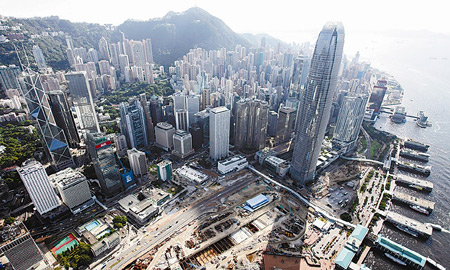 Skyscrapers tower over Hong Kong's Central district, where commercial rental prices are some of the highest in the world. Provided to China Daily |
Preventing an attack on the local currency is one thing. But avoiding property overheating is another, as Gao Changxin reports from the SAR.
Leung Fung-yee, undersecretary for financial services and the treasury of Hong Kong, has tried to strike a note of reassurance by telling China Daily that the city's financial system is sound enough to withstand the current capital inflows and a potential outflow.
But her words seem barely sufficient to quiet public fears of bigger asset bubbles, especially one in the property market, as memories are still fresh of the megafund inflow in 2009 after the global financial crisis, which gave rise to Hong Kong' elevated asset prices today.
Since October, central bankers in Hong Kong have been working their tails off to maintain the Hong Kong dollar's peg to the US dollar, as strong fund inflows put upward pressure on the local currency.
Most recently, on Nov 2, the Hong Kong Monetary Authority stepped into the money market for the 10th time in less than a month by selling HK$5.038 billion ($650 million) as the local currency hit the strong end of its trading range.
Hong Kong pegs its currency at 7.8 to the US dollar, but allows it to trade between a band of 7.75 to 7.85. Under the arrangement, the HKMA is mandated to step in when the Hong Kong dollar hits 7.75 or 7.85 to keep the band intact.
Analysts believe the fund inflows are a result of the third round of quantitative easing in the United States. On Sept 13, the Federal Reserve announced that it will start buying $40 billion in mortgage-backed securities every month, with the end date remaining up in the air.
Operation Twist, in which the Fed sells short-term bonds and buys long-term assets, will continue. Together, the two programs will add $85 billion of short-term assets and cash into the money market each month.
Most of the liquidity is likely to flow to emerging markets, including Asia, where growth is more robust.
Leung said it's still hard to measure the exact size of the inflows, but authorities will watch the situation closely.
To provide a glimpse of the size of the inflow figures from EPRF Global, which tracks nearly 45,000 funds managing more than $17.5 trillion in total assets, show that up to $600 million flowed into funds tracking Chinese equities during the final week of October.
Alarmingly, asset prices reacted quickly to the inflows. The benchmark Hang Seng Index was up more than 5 percent over the past month and 14 percent since September. The index rose 1.2 percent, or 253 points, to 21442 points at its close on Wednesday.
Meanwhile, the property market remained buoyant despite an Oct 26 decision to impose a 15 percent buyers' stamp duty on non-locals.
Recent developments raised fears in Hong Kong because they mirror what happened in the special administrative region in 2009, when the mainland's fast recovery from the global financial crisis drew huge amount of funds created by quantitative easing in the US to Hong Kong.
That directly created the asset bubbles now in Hong Kong. Pushing asset prices even higher is dangerous because a sudden and collective de-investment would pose a serious test of the strength of the region's financial system.
In 2008 and 2009, more than HK$640 billion flowed into Hong Kong in search of a safe haven, which helped double property prices, official figures show.
For now, economists, market watchers and government officials' views differ on what the incoming funds are betting on and whether they are speculative in nature.
K. C. Chan, secretary for financial services and the treasury, told reporters on Oct 24 that it will take further observation to determine if the funds flowing in are "hot money".
Frances Cheung, a senior strategist at Credit Agricole CIB, also said that it's hard to classify the funds as "hot money".
In an e-mail to China Daily, she said that aside from QE3, the re-appreciation of the yuan onshore is also helping attract extra inflows. And Hong Kong's high credit rating is another attractive factor.
"In recent years, whenever the RMB was expected to appreciate, the bet had been for the Hong Kong dollar to strengthen further if it was de-pegged from the US dollar," she wrote.
But this time around, she added, the inflows will not be as big as in 2008 and 2009, when low confidence in US dollar made assets in Hong Kong dollars a substitute.
For now, the Hong Kong-US currency peg is safe, she added. It is much easier for the Hong Kong central bank to defend the local currency on the strong side than on the weak side, as it can simply print more money to buy US dollars. Hong Kong's Exchange Fund, which is used to back the Hong Kong dollar, stood at HK$2.65 trillion at the end of September.
What is worrisome, however, is the money-printing caused by the fund inflows. The central bank's market intervention will inevitably inject liquidity into the banking system. This will further push down rates in the interbank lending market.
On Nov 6, the overnight Hong Kong Interbank Offered Rate stood at just 0.06 percent. The banks' aggregate balance, a term used in Hong Kong to measure interbank liquidity, reached HK$180.87 billion that day, up 22 percent from HK$148.65 billion on Aug 6.
Persistent low interest rate levels encourage borrowing and threaten to further inflate asset bubbles.
Liu Ligang, chief China economist at ANZ Banking Group Ltd, felt that apart from Hong Kong dollar assets, yuan assets in the city are also a key investment target.
Yuan assets are made attractive under the prospect of the yuan's appreciation, which increases investment returns in dollar terms. The yuan has touched its daily trading ceiling in the past five trading days.
On Tuesday, the People's Bank of China set the yuan's reference rate against the dollar at 6.3078, up from 6.3449 on Oct 10. The yuan traded at around 6.24 at Tuesday's close. China International Capital Corp Ltd predicts that the reference rate will be at 6.27 at year end.
The bottoming-out of economic growth in the Chinese mainland also adds to market optimism. In annualized terms, GDP grew 9.1 percent, well above the 7.5 percent annual growth target, providing a clear sign that the growth slump on the mainland has passed.
Leung Fung-yee, however, said the size of the yuan market in Hong Kong is not yet big and diversified enough for any serious bets.
"Most of the yuan products in Hong Hong are cash market products, such as bonds and ETFs. They are not as good a speculation target as those in the futures market," she said.
Futures are better betting tools than cash market products because they allow leverage. In some cases, leverage can be as high as 100 times, meaning that an investor can invest 100 yuan with just 1 yuan in hand.
The band of yuan products in Hong Kong has widened substantially in recent years along with the growth of yuan deposits, which stood at 545.7 billion yuan at the end of September. But the market size is still small in real terms.
For now, the "dim-sum" bond is the major yuan product in Hong Kong. The Hong Kong Stock Exchange rolled out the first yuan futures in September, the deliverable yuan futures, but trading volume has been lackluster.
The mainland would be a much better place to take bets on yuan assets. But experts' views differ on whether the funds will find their way into the mainland.
Yi Xianrong, a researcher at the Institute of Finance and Banking of the Chinese Academy of Social Sciences, said it's unlikely that the funds will flow into the mainland in quantity.
"Both the property market and stock market have shown no signs of a rally. And the central bank has a rigorous set of systems to control 'hot money', so it's hard for them to come, bet and go," he said.
But Li Youhuan, who studies "hot money" and is the director-general of the Centre of Guangdong Social Science for Integrated Research and Development, said that inflows to the mainland have already started, though it's still hard to tell which assets they are betting on.
Li closely follows more than 100 underground banks. He has found that the banks have been increasing their positions in the mainland. Money has been flowing into the banks since September and accelerated in October.
"The trend has been in place where 'hot money' accelerates its flow into the mainland markets," Li said
Contact the writer at gaochangxin@chinadaily.com.cn
















