


Running into danger
|
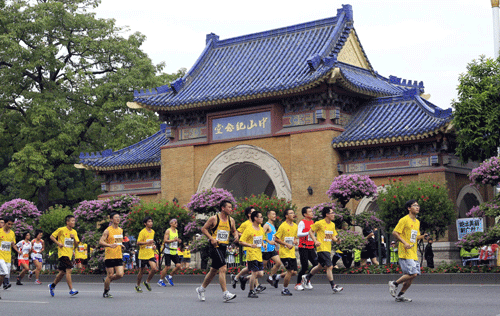
The first Guangzhou International Marathon attracted about 20,000 professional and amateur runners. Zou Zhongpin / China Daily |
Few realize the risks of taking on a marathon. Liu Zhihua and Tang Yue report.
Thirty thousand people had signed up for the Beijing International Marathon, which will take place on Sunday, by Nov 12, the fourth day of registration.
The public raced to fill all openings for the mini (4-km), half (21-km) and full (42-km) races.
But many amateurs don't know the risks of taking on a marathon - the potential of injury and even death - if they don't prepare and overexert themselves.
On Nov 18, 21-year-old college student Chen Jie passed out at the finish line of the Guangzhou International Marathon in Guangdong province's capital and later died in the hospital from a heart attack and consequent organ failures.
The Guangzhou marathon's official statistics show 1,517 racers reported discomfort, sprains, dizziness and cramps. Two men, including Chen, passed out and were sent to the hospital.
"Many people don't realize a marathon is nothing like casual jogging," says Liao Shaofang, an emergency room doctor with Tsinghua University No 1 Hospital.
Liao used to be a Tier-2 national track-and-field athlete.
"It's a skill-based endurance race and requires an outstanding physique," he explains.
Runners should undertake professional training for at least two months - preferably half a year - before the race.
They should also make sure they don't have any chronic or metabolic diseases, such as heart disease, diabetes, high-blood pressure or obesity.
And contestants shouldn't push themselves too hard and stop if they believe the distance is too much, he says.
It's worth recalling that the legendary Greek runner, whose story gave rise to the marathon tradition - he's said to have dashed the full distance without resting to deliver a message - died from overexertion, Liao says.
Xu Qiong, a public relations executive in Beijing, had a painful experience when running the Beijing International Marathon last year.
The 28-year-old is a former soldier, who ran 5 km every morning - without difficulty - in the army. Since leaving the force in 2007, he has continued exercising regularly, swimming and playing badminton.
Xu was so confident in his physique that he didn't undertake training beforehand and ignored the official website's warnings.
"I signed up for the half-marathon and ended up only finishing the mini," he says.
"It was totally different from what I'd expected."
Xu ran fairly fast at first. But he quickly felt it was increasingly difficult to keep that pace. He started walking after 7 km and never resumed running.
"I was short of breath," Xu recalls.
"My limbs ached, and my calves felt too weak to move. I felt like I was dying when I dragged myself off the racetrack to seek help."
Xiong Xibei, a 61-year-old Beijing Sport University track-and-field professor and a referee of the Beijing International Marathon from 1981-2011, says: "Challenge yourself, but never push too hard."
Xiong was a middle school physical education teacher in the 1970s.
Back then, his girl students could easily run 5 km and the boys had no problem finishing 10 km. But people are in worse shape today, he says.
Liao says: "It's impossible for many people to run a full marathon. You can't do it unless you're in great health. It's an endurance event that challenges the heart, lungs, blood vessels and nerves."
The extreme exertion strains the metabolism's ability to meet energy demands and challenges the organs to properly excrete waste.
This can cause blisters, sprains, strains, dehydration, heart attacks and stroke.
Wu Xinmin, a public servant in Beijing, knows he should run at a comfortable pace.
The 32-year-old grew up in the countryside and is no stranger to manual labor. So, he thought nothing of signing up for the full Beijing International Marathon in 2003.
He'd never run more than 10 km and didn't prepare for the race. Wu had to stop at about 20 km, when he felt completely breathless.
He felt extremely tired in the following days and found it painful to go up stairs.
Wu prepared well for the following year and began training about three months before the race. He ran five times a week, starting at 5 km and working his way up to 20 km.
He completed the marathon in four hours and 20 minutes - not bad for an amateur.
"The preparation is time-consuming but pays off," Liao says.
"Listen to your body. Don't force yourself, or you'll run into trouble."
Contact the writers at liuzhihua@chinadaily.com.cn and tangyue@chinadaily.com.cn.
















