


Expert calls for high-tech traffic control
|
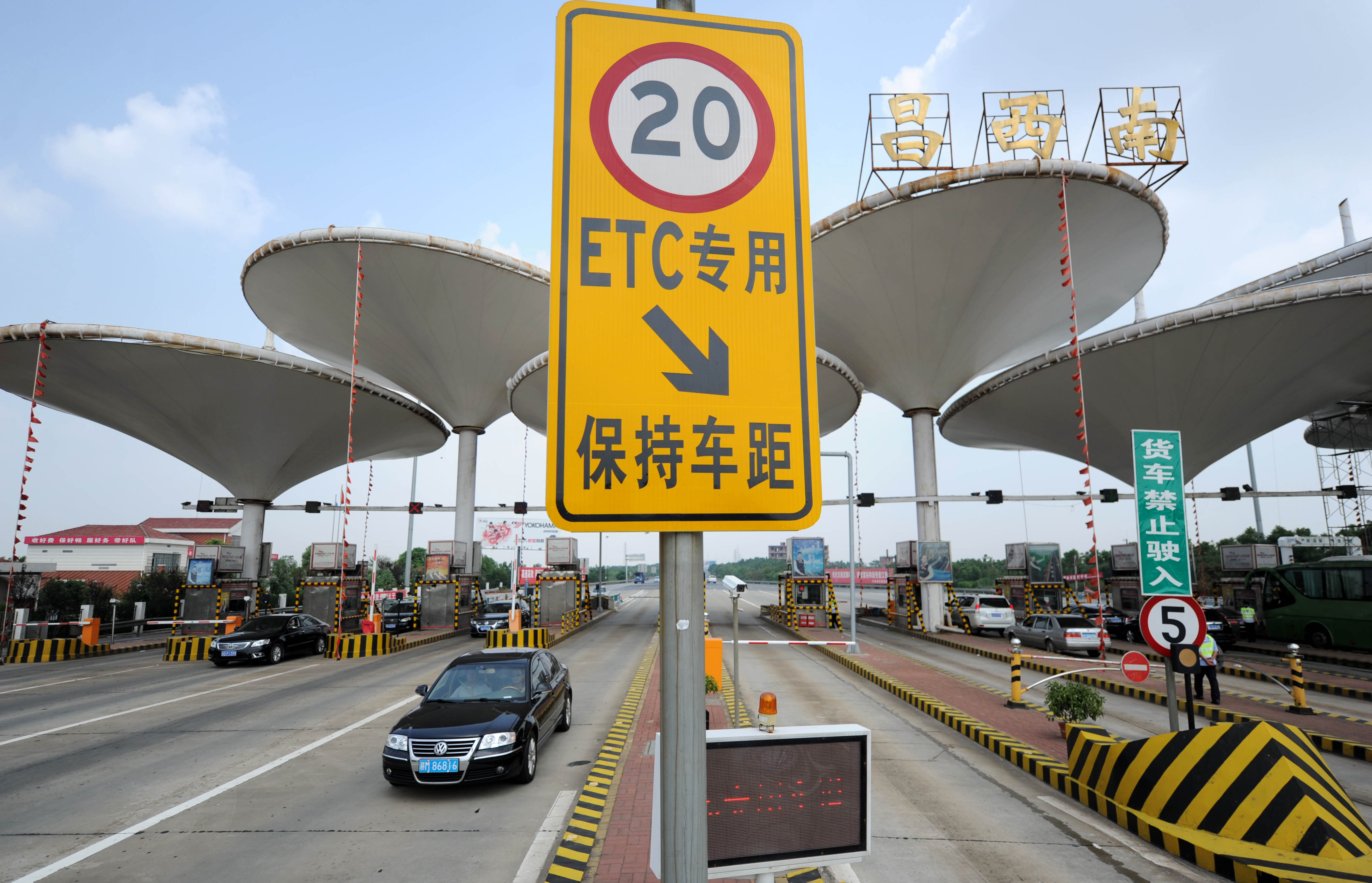 A highway toll station that uses electronic toll collection devices in Xinjian county, Jiangxi province, in August. Zhou Ke / Xinhua News Agency |
Customer-oriented safety measures should make transportation safer
Have you ever imagined having your car slow down its speed automatically to prevent rear-end collisions, or having your satellite-aided navigation device pick up a clear road to avoid congestion based on real-time road conditions?
Those scenarios might gradually become a reality, as a leading transportation expert says that China's intelligent transportation system, known as ITS, should develop smart-traffic technologies that are more customer-oriented, while boosting greener, safer and more efficient modern transportation in the country.
"China's ITS applications should shift their focus to provide more solutions for public transportation in the next decade, and the industry should get a new stimulus by responding to the needs of the market," said Wang Xiaojing, chief engineer at the Research Institute of Highway under the Ministry of Transport.
Wang, one of the pioneers and founders of China's ITS, was inducted into ITS Hall of Fame at the 19th ITS World Congress in Vienna, Austria, in October. The award makes him the first Chinese to be recognized by the global ITS community for achievements in establishing and developing the nation's ITS industry.
The ITS industry in China has long been driven by major construction projects of infrastructure since its launch in the mid-1990s, Wang said. He has been committed to the field since the ITS industry began.
"But it's time to make a change, as there is a growing number of ITS users calling for more customized products that facilitate public transportation and traffic safety, especially applications based on smartphones or other portable devices," Wang said.
As the end of 2011, China's highway mileage has been increased to 84,900 km - the second-longest in the world after the United States. The number of automobiles has surged to 110 million by the end of June, 75.62 percent of which are private cars, according to the transport authority.
Given the fast expansion of the road network and the increasing number of vehicles, the Chinese government has given intensive use of intelligent transportation technologies in recent years.
The idea became more popular after the 14th ITS World Congress held in Beijing in 2007, and ITS applications have made great contributions to the success of transportation during two major events - the Beijing Olympic Games and Shanghai World Expo.
"However, ITS applications in the urban area, such as roadside variable message signs showing transportation data, still serve more for private car owners instead of public transportation," he said.
"More applications based on ITS technologies should be provided to facilitate public transportation, which enable users to be well-informed and make reasonable travel decisions by themselves, further helping ease the long-standing road congestion problem."
ETC application
According to Wang, in the past few years, China has gone through an investment blitz for ITS applications, with the chief aim of easing jammed roads and improving traffic efficiency.
One remarkable application was the development of electronic toll collection, or ETC, on highways, he said.
China first put its ETC highways into public use in 2007 in Beijing and Fujian province. Although China learned from other countries during the industry startup, the country now has developed about 3,700 lanes with ETC devices in 24 provinces and has attracted 4.6 million users.
"Without building toll stations, ETC lanes can save land and labor costs," Wang said. "And the traffic flow can move three to four times faster than in normal lanes."
Liu Jiayuan, a publicity officer at the Beijing Capital Highway Development Group, which manages the city's airport expressways, said the company's two ETC lanes have greatly improved highway traffic speed by offering drivers nonstop trips.
"On our normal lanes, a car usually needs six to eight seconds to pass the toll gates, but the time would be cut into two seconds on ETC lanes," Liu said.
The company plans to transform half of its 14 total lanes into ETC ones in the next two to three years.
"The trend is that ETC technology will be employed on more lanes, as there is an increasing demand from users."
But the industry still falls far behind Japan - a country renowned for ITS technologies, and which has more than 40 million ETC users.
In Japan, 85 percent of toll collection transactions are through ETC, but the figure in Beijing is about 30 percent, Wang said.
"The data show that there is an eight- to 10-year development gap between China's ITS and that of the developed countries."
Showcase effect
By now the benefits of the ITS system have been mainly recognized by both the government and the public, thanks to the showcase effect in the 2008 Beijing Olympic Games and the 2010 Shanghai World Expo.
"People living in the metropolises benefit from the conveniences of ITS every day," Wang said, adding that one Olympic legacy is that Beijing has set up a citywide camera network to keep its traffic under surveillance.
"The system provides real-time traffic information for travelers or assists the police to deal with emergency traffic accidents."
"It still works today and has set good examples for other Chinese cities to fight against congestion."
The ITS system excelled during the Shanghai Expo as well, as it aided the municipal traffic authority to plan public traffic control for the six-month international event with more than 70 million visitors.
"Shanghai made a breakthrough to make urban traffic smooth without restricting vehicles from other provinces to enter the city at that time," he said.
"China has gained its reputation in the world for its traffic management and supporting system in large international events by employing ITS."
The road ahead
In August, Hong Xiaofeng, deputy director-general of the Ministry of Transport's technology department, vowed that the ministry will strategically encourage more private investment in the ITS field.
The new move means more business opportunities for telecom and Internet service providers from private sectors, which make profits by providing traffic information services to users, Wang said.
However, the problem is service providers may not have enough real-time and accurate traffic data, Wang warned.
"The information collected on public infrastructures should also be made public, just like the information of weather," he said.
Wang urges traffic authorities to allow private companies to have access for basic data. This way, service providers can put added-on value on traffic information, which not only benefit subscribers but could also help nurture a new economic growth engine.
"It is obvious that the telecom operators, service providers and new market players such as Internet or smartphone-application developers would benefit from such new businesses."
Zhao Xinying contributed to this story.
tanzongyang@chinadaily.com.cn
















