


Noda quits as party chief and concedes DPJ's defeat
|
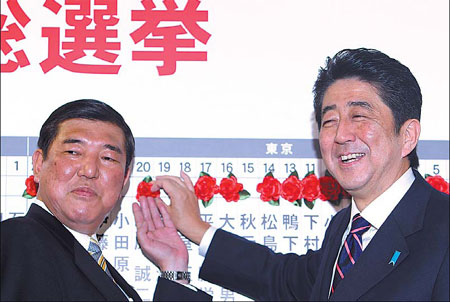
Japan's main opposition leader, Shinzo Abe (right) of the Liberal Democratic Party, and the party secretary-general, Shigeru Ishiba pose for photos at the party's headquarters in Tokyo on Sunday as they place a rosette on the name of a candidate elected in parliamentary elections. Junji Kurokawa / Associated Press |
Low turnout among voters reflects disillusionment with Japan's policies
Japanese Prime Minister Yoshihiko Noda on Sunday conceded his party was defeated in the general election and said he was stepping down as leader of the Democratic Party of Japan.
"I will resign as the head of the DPJ because I take this result seriously," he told a news conference. "I want to deeply apologize as I could not produce results."
Tokyo was quiet on Sunday when the candidates for Japan's House of Representatives put away their loudspeakers. Many of them had almost lost their voices by the time voters headed for the polls.
Newspaper and TV exit polls previously showed that the opposition Liberal Democratic Party was sure to win and, with its long-time ally New Komeito, achieve the two-thirds majority in the 480-seat chamber needed to override decisions by the upper house, in which no single party has a majority.
But Noda was re-elected to the lower house. He fought tooth and nail for his party until Sunday morning when he cast a vote in Hunabashi, Chiba. Noda had double candidacy for Chiba's 4th single-seat constituency and one of Tokyo's proportional presentation constituencies.
The LDP dominated the election from the start in about 180 constituencies.
A total of 1,504 candidates vied for the 480 seats in the lower house - 300 allocated to single-seat constituencies and 180 in 11 proportional representation blocs.
"Chaotic" was the catchword for Sunday's election, in which a record 12 parties fought at close quarters.
As a result, a motley collection of campaign manifestos confused voters.
Japanese voters are so disappointed with their country's policies that they showed little interest in the election.
Voter turnout was 42 percent by 6 pm on Sunday, down 7 percentage points from the previous 2009 poll, Japan's Ministry of Internal Affairs and Communications said.
Hayashiguchi Yuriko, a 39-year-old housewife, voted on Sunday for a Your Party candidate in a single-seat constituency and a Social Democratic Party of Japan candidate in the proportional representation constituency of Chiyoda-Ku, Tokyo.
"I choose two different parties for the hope of a balance of power in this country," she said at a polling station.
Hayashiguchi worries that the LDP's tough talk will aggravate the tension caused by the territorial dispute between Japan and China.
"With a view to the years ahead, I hope that the two countries can remain at peace," she said.
Hayashiguchi called on the Japanese government to formulate and implement policies on the country's present problems, such as the national pension.
In a campaign speech in Iruma, Saitama prefecture, on Saturday, LDP leader Shinzo Abe spoke of his party's new economic measures. He said his party was one step away from overcoming deflation when it was in power.
"Based on this, we will, without fail, lift the country out of deflation by implementing three policies - a more powerful financial policy, fiscal policy and growth strategy," he said.
"Our ability to restore public trust in politics is being put to the test," he added.
The LDP seems to have won back Japanese voters after confidence in its biggest rival, the DPJ fell over the past three and a half years. Formed in a merger of several opposition parties, the DPJ, swept to power in 2009 to end more than half a century of almost unbroken LDP rule.
Voters were smitten by the DPJ's big-picture pledges to change: break up the "iron triangle" between the powerful bureaucracy, business and LDP lawmakers, pay heed to consumers' interests and put elected officials in charge of policy. They also liked promises of free schooling, bigger child-support allowance and toll-free expressways.
But the party's support slumped over what voters saw as broken promises, a confused response to last year's tsunami and nuclear crisis and Noda's embrace of unpopular causes such as the tax hike and the restart of nuclear reactors.
The LDP's campaign platform called for stronger defense and conservative nuclear energy policies.
AFP contributed to this story.
















