


The future global economy
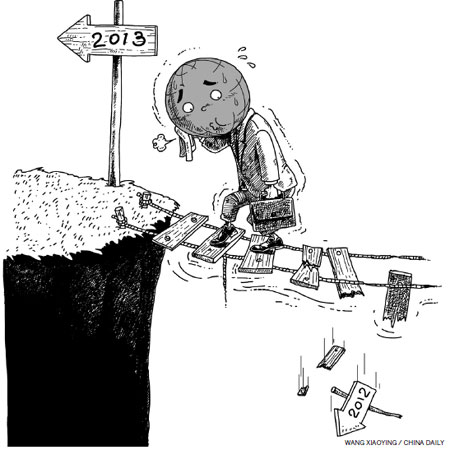
As the world enters yet another year in the shadow of continued financial and economic crisis, a broader view of the contours of the future global economy is required.
The longer-term trends are clear. Dynamic emerging markets from Asia to Latin America are rising in prominence. The United States and Japan remain important drivers of the global economy but face major debt and deficit challenges. Europe is going through a difficult but historic process of re-engineering and integration. The Middle East is transforming before our eyes. Sub-Saharan Africa is breaking through to sustained development, creating a new frontier of growth after decades of stagnation.
These changes are shaping our future in a positive way. Yet there are still considerable roadblocks to overcome. The global economic recovery remains too weak. With more than 200 million unemployed around the world, prospects for job creation are still too dim. And the gap between rich and poor, exacerbated by the crisis, is still too wide.
There is a tough road ahead if we are to turn optimism into reality. I see three key milestones.
First, and most obviously, we need to put the crisis behind us, once and for all. And we know how to do that: accommodative monetary policy; fiscal adjustment in all advanced economies that includes concrete and realistic plans to reduce debt over the medium term, but does not undercut short-term growth; completing the banking-sector cleanup; and reforms to boost productivity and growth potential. All of this should be complemented by a rebalancing of global demand toward dynamic markets, including emerging economies.
Perhaps the greatest obstacle will be the huge legacy of public debt, which now averages about 110 percent of GDP in the advanced economies, the highest level since World War II. This leaves governments highly exposed to subtle shifts in confidence. It also ties their hands, especially as they seek to build the physical and institutional infrastructure of the 21st century while respecting social promises. The needs of aging populations will add to these pressures.
History offers two clear lessons: reducing public debt is incredibly difficult without growth, and increasing growth is incredibly difficult with a huge burden of public debt. So we face a twofold imperative, securing growth while reducing debt. The key now is not only to move from deliberation to action on the policies that we know are needed, but to move together and on all fronts.
The second milestone is a better global financial system. We need to move beyond the system that gave us the crisis, a financial sector in which some, as the ancient Greeks might say, toyed with hubris and unleashed nemesis. Of course, there has been important progress, especially on the Basel III agenda to create more resilient capital and liquidity buffers. But momentum is flagging, both on implementing the agreed reforms and on progress in areas like derivatives and shadow banking.
As a result, the system as a whole is not yet much safer than it was in September 2008, when Lehman Brothers collapsed. It is still too complex; activities are still too concentrated in large institutions; and the specter of "too big to fail" remains. Continuing excesses and repeated scandals show that the culture of finance has not really changed.
Many in the financial-services industry are concerned about the costs of new regulations. A recent IMF study shows that better regulation would indeed nudge banks' lending rates up, but by relatively little. We also found that increasing capital buffers to appropriate levels helps, rather than hurts, economic growth. Reforming financial-sector taxation would also help to reduce excessive risk-taking and leverage.
The bottom line is that the costs of reform are affordable. The costs of complacency are not.
The third milestone relates to the quality and inclusiveness of growth. While growth is essential for the future global economy, it must be a different kind of growth, inclusive and not simply the fallout of unfettered globalization.
The policy implications of such a reorientation are profound. It requires a fiscal policy that focuses not only on efficiency, but also on equity, particularly on fairness in sharing the burden of adjustment, and on protecting the weak and vulnerable. It means expanding access to credit and financial services everywhere. And it means more transparency and better governance.
Achieving these milestones presupposes greater global cooperation. A world that is bound closely together must be a world that works closely together if it is to prosper together. There is simply no other choice. We are multiple players, but we are engaged in a single game, a game that must be cooperative, not simply competitive. In such a world, multilateral institutions like the International Monetary Fund play a vital role in boosting economic cooperation.
The year 2013 offers the chance to put the economic crisis behind us and to shape the world for the better. Policymakers must seize this chance. The IMF will support them in building a fairer and more prosperous future.
The author is managing director of International Monetary Fund.
Project Syndicate
















