


Family planning stands pat
|
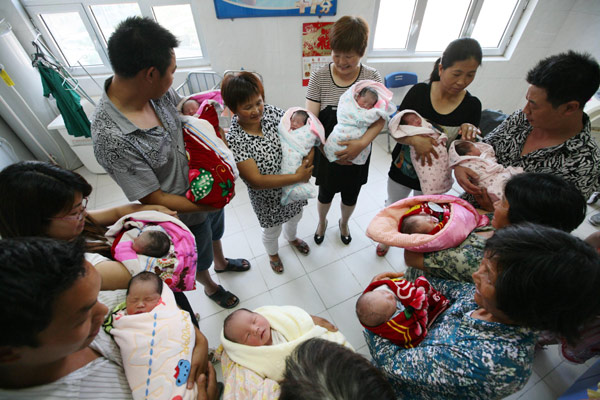 Parents and family members hold five sets of twins who were born on the same day at No 1 People's Hospital of Xiangyang, Hubei province, in May. Gong Bo / for China Daily |
Maintaining low birthrate remains a priority, says top population official
China will stick with its current family planning policy to maintain the country's low birthrate but will make an effort to fine-tune it, the country's population planning chief said.
Wang Xia, minister of the National Population and Family Planning Commission, made the remarks at a national conference in Beijing on Monday amid widespread speculation that the one-child rule on the Chinese mainland might soon be relaxed.
"Maintaining a low birthrate remains a top priority in 2013 and beyond. But policy implementation has to fit into local situations," she said.
China has maintained a low birthrate for about 20 years, said Lu Jiehua, a social demographics professor at Peking University.
Many people, including academics, have called for relaxing the policy to better meet new demographic challenges such as a rapidly aging society, a skewed gender ratio and a rising labor shortage.
But Zhai Zhenwu, dean of the School of Sociology and Population Studies at Renmin University of China, doesn't agree with that strategy.
Zhai said China's current low birthrate is not stable and would rebound sharply in most parts of the country if the family planning policy were to be abandoned.
The birthrate on the mainland was 11.93 per 1,000 in 2011, a decrease of 0.93 per 1,000 from 2002, according to the National Bureau of Statistics.
China's population topped 1.34 billion by the end of 2011, an increase of more than 60 million over 2000, the bureau said.
The total birthrate, the average number of children a woman gives birth to, has fallen to about 1.6, an even lower level than in some developed economies, such as the UK.
"A country's birthrate is closely related to its economic and social development," Zhai said. "Normally, the higher the development level of a country, the lower is its birthrate."
Most countries with a birthrate lower than 2.0 are developed countries with high levels of urbanization, social security and education, and a per capita GDP of more than $30,000, he said. In comparison, the per capita GDP of China was $5,400 in 2011, according to the International Monetary Fund.
"This showed China's low birthrate is not a natural result of social and economic development," he said.
"Rather, it is largely attributed to the family planning policy that has been enforced over the past three decades," he said.
Because China's economic and social development still lag behind a level in line with its low birthrate, the nation's current birthrate is not stable and would certainly rebound sharply in most parts of China, except in a few large developed cities, he said.
Although China's population growth rate remains low, the number of newborns has still been 16 million annually in recent years due to the large population base, which will continue to put a burden on environmental protection and resources, he added.
"This means China will have to continue to carry out family planning policies over the long term to ease the pressure," he said.
Lu, the Peking University professor, said, "The family planning policy has never been simply a one-child rule". He added that the policy has improved with economic and social development in the past decade.
China adopted a family planning policy, which limited most couples to just one child, in the 1970s.
Currently, rural couples may have a second child if the first is a girl. In urban areas, couples who are both the only child of their families are allowed to have a second child.
Contact the writers at wangxiaodong@chinadaily.com.cn and shanjuan@chinadaily.com.cn
















