


Demystifying the middle-class myths
|
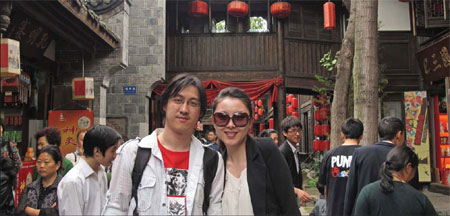
Ethan Chang (left), a product manager in Sobey Digital Technology Co, and Donna Tang, a senior analyst at the Italian Trade Commission. Provided to China Daily |
Sam Li, a senior manager with a US multinational company in Beijing, says the term middle class is a European and US concept that does not really apply in China.
The executive in his 40s who was passing through Oriental Plaza in Beijing, one of China's most exclusive shopping malls, says this is because many Chinese are first-generation middle class as a result of the fast development of the country over the past 30 years.
"Most Chinese now are richer than their parents and certainly their grandparents. It is a great leveling thing. Income is the only benchmark we can really use," he says.
Zhang Hongxia, a 33-year-old administrator in a middle school, is someone who regards herself as part of this first-generation middle class.
"I would say that I am now middle class. I don't think it is any great thing. I would expect eight out of 10 people in China to regard themselves in this category," she says.
Zhang, originally from Fushun in Liaoning province, says rising income levels and middle class standards of life do not necessarily translate into a more optimistic view of the future.
"I don't think it is like in the past. Chinese people are less optimistic than in the past, although they are still probably more optimistic than people in Europe and the US. I have nonetheless considered emigrating to the US in the past."
Ethan Chang, 31, and Donna Tang, 33, are married and have a combined income of about 18,000 yuan ($2,889; 2,142 euros) a month with bonuses.
They both regard themselves as moving into the entry level of middle class but don't think any definition is very precise.
"Most people in China don't really know as far as I can see what qualifies them to be middle class. There are so many wealthy people in Beijing, it seems more of an aspiration than a reality," Chang says.
Despite both having professional jobs - Chang works as a product manager in Sobey Digital Technology Co Ltd, one of the largest TV station facility and system manufacturers, and Tang as a senior analyst at the Italian Trade Commission - they still live with Chang's parents.
"We haven't bought an apartment in Beijing because we want to save money for our future children's education," Chang says.
"It is not unusual for people with careers like us in Beijing to still live with our parents, because of the high housing costs."
Julia Zhu, 42, an immigration consultant from Dalian in Liaoning province, has experience of what defines the middle class in both the UK and China.
She majored in human resources at the University of Sunderland and worked as an interpreter for the Scottish Legal Services in Edinburgh for eight years.
"In Scotland, class is very different. It is an established social order. You can't just go out and buy a handbag and make a statement about your class but people seem to think they can do that here," she says.
"I have friends who buy luxury brands just because they are expensive and to show off. They even sometimes have no idea what the brands are. I think in Scotland people buy such products if they like them. That is the difference."
Dennis Yang, 36, originally from China but now a mathematics teacher in Philadelphia, believes it is easier to become middle class in the United States than in China.
"I think in China it is much more of a struggle to become middle class than it is in the US," he says.
"In America, many people regard themselves as middle class. President Barack Obama famously talked of Joe the Plumber as being middle class. Joe actually would make more money than me in a year so he would be more qualified to be middle class."
Yang met his wife Cathy Qin, 37, now an art consultant in Beijing, in the US when she was doing a master's degree at New York University.
Qin believes it is much more expensive to have a middle class lifestyle in China than in the US.
"I can get organic and other quality food and living necessities in a supermarket in the US at a much cheaper price than I can in China. So basically if you want to live a middle-class life, it costs more, compared to the US," she says.
Sam Li believes class structures are much more nuanced in China than some interpret.
He says it is something of a double bind while status might depend on income, your actual status can actually determine your income in the first place.
"It is a different world for many people in China than 10 or 20 years ago. The opportunity you have to earn good income really depends on what family you come from, which city, what kind of network you have and not so much on educational background."
This is something of a frustration for Zhang Hongxia, the school administrator.
"Whether you get into a particular school can depend on how much money you have, who you are and what relationships you have. How much you score in examinations can be the least important factor," she says.
















